The Best Travel Drones for Photography, Hiking, and More
BY Zacc Dukowitz
4 August 2026The best travel drone is a balance between size and features.
You want a drone small enough that you’ll actually bring it, but still capable enough to capture strong photos and video.
The good news? Today’s compact drones can capture strong photos and video while offering obstacle sensing, subject tracking, and other advanced features.
Even a drone weighing less than 250 grams (0.55 pounds)—the FAA’s registration threshold for recreational flying—can offer a solid camera, obstacle sensing, and automated flight modes.
In this guide we’ll go over the best travel drones on the market, travel drone features to consider, how to choose a drone for different types of travel, and more.
Here’s everything we cover:
- The Best Travel Drones on the Market
- The Best Drones for Hiking and Backpacking
- What Makes a Good Travel Drone?
- Should You Choose a Travel Drone Under 250 Grams?
- What To Do Before You Travel with Your Drone
- Travel Drone FAQ
The Best Travel Drones on the Market
Choosing the best travel drone isn’t just about specs.
It’s also about finding the right drone for the type of trip you’re planning.
For example, a backpacker covering ten miles a day has different needs than a photographer driving between landscape locations.
That’s why we’ve broken these drones down based on what they’re best for when it comes to travel.
Here’s an overview of our top picks:
| Travel Drone | Best For | Aircraft Weight | Main Limitation |
|---|---|---|---|
| DJI Mini 5 Pro | General vacations, hiking, and carry-on travel | Under 0.55 lb (249 g) | Adding extended batteries increases its weight to over 250 grams |
| DJI Air 3S | Photography-focused trips and landscape filming | 1.6 lbs (724 g) | The larger aircraft, batteries, and carrying kit take up substantially more room |
| DJI Neo 2 | Budget-friendly vacations and quick automated travel clips | 0.33 lb (151 g) | Small camera and short flight time make it less capable for expansive landscapes and demanding conditions |
| Antigravity A1 | Immersive sightseeing footage and creative 360° travel videos | 0.55 lb (249 g) | Goggles and motion controller make the complete kit larger and more specialized than the aircraft weight suggests |
| HOVERAir X1 PROMAX | Solo adventures, hiking, cycling, and travel vlogging | 0.42 lb (192 g) | It is better suited to close-range self-filming than conventional piloting or expansive landscape flights |
Keep reading for more information on each drone covered in the chart above.
1. DJI Mini 5 Pro
Best for: General vacations, hiking, and carry-on travel

The DJI Mini 5 Pro is our top pick for most travelers because it combines a compact folding design with a 1″ camera, omnidirectional obstacle sensing, and conventional flight controls.
True Vertical Shooting is great for social media, while 42GB of internal storage provides a valuable backup if you forget a memory card.
- Aircraft weight: 0.55 lb (249 g) with the standard battery
- Camera: 1″ CMOS sensor
- Video: Up to 4K/120fps; 4K/60fps HDR
- Flight time: Up to 36 minutes with the standard battery
- Travel features: Folding airframe, True Vertical Shooting, omnidirectional obstacle sensing, and 42GB of internal storage
2. DJI Air 3S
Best for: Photography trips and landscape filming

The DJI Air 3S is the strongest choice when aerial photography is one of the main purposes of the trip.
Its 1″ primary camera captures broad landscapes, while the 70mm medium telephoto camera helps isolate distant details and create more compressed compositions.
- Aircraft weight: 1.6 lbs (724 g)
- Cameras: 1″ wide-angle camera and 70mm medium telephoto camera
- Video: Up to 4K/120fps
- Flight time: Up to 45 minutes
- Travel features: Dual-camera flexibility, omnidirectional obstacle sensing, and 42GB of internal storage
3. DJI Neo 2
Best for: Budget vacations and quick travel clips
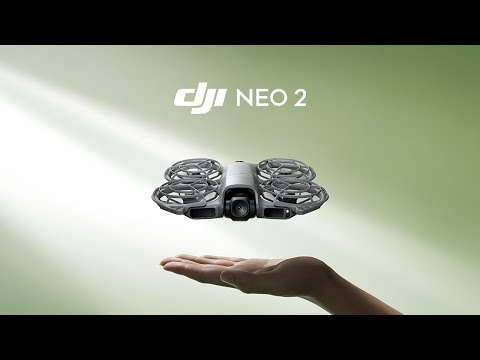
The DJI Neo 2 gives beginners and casual travelers an inexpensive way to capture automated footage without carrying a conventional camera-drone kit.
It can launch from the palm, follow a subject, respond to gesture controls, and also work with a compatible controller when you want a more traditional flying experience.
- Aircraft weight: 0.33 lb (151 g)
- Video: Up to 4K/60fps
- Flight time: Up to 19 minutes
- Stabilization: Two-axis gimbal
- Travel features: Palm takeoff and landing, automated tracking, gesture control, and omnidirectional obstacle sensing
4. Antigravity A1
Best for: Sightseeing and creative 360° travel videos

The Antigravity A1 records everything around the aircraft in 8K 360° video, allowing travelers to choose their perspective and camera movements after the flight. T
That makes it a compelling option for immersive sightseeing footage, although the required goggles and motion controller create a larger overall travel kit than the aircraft’s 249-gram weight suggests.
- Aircraft weight: 0.55 lb (249 g) with the standard battery
- Camera: Dual-lens 1/1.28″ 360° camera
- Video: Up to 8K/30fps 360° video
- Flight time: Up to 24 minutes with the standard battery
- Travel features: Folding design, reframing after capture, 20GB of internal storage, and replaceable lens protectors
5. HOVERAir X1 PROMAX
Best for: Solo adventures, hiking, cycling, and vlogging

The HOVERAir X1 PROMAX works more like a flying action camera than a conventional drone, automatically following and filming the traveler without requiring a controller.
Its enclosed propellers, folding body, and 192-gram weight make it especially convenient for capturing yourself hiking, cycling, or exploring a destination.
- Aircraft weight: 0.42 lb (192 g)
- Camera: 1/1.3″ CMOS sensor
- Video: Up to 8K/30fps and 4K/120fps
- Flight time: Up to 16 minutes
- Travel features: Folding design, enclosed propellers, automated flight modes, subject tracking, and 64GB of internal storage
The Best Drones for Hiking and Backpacking
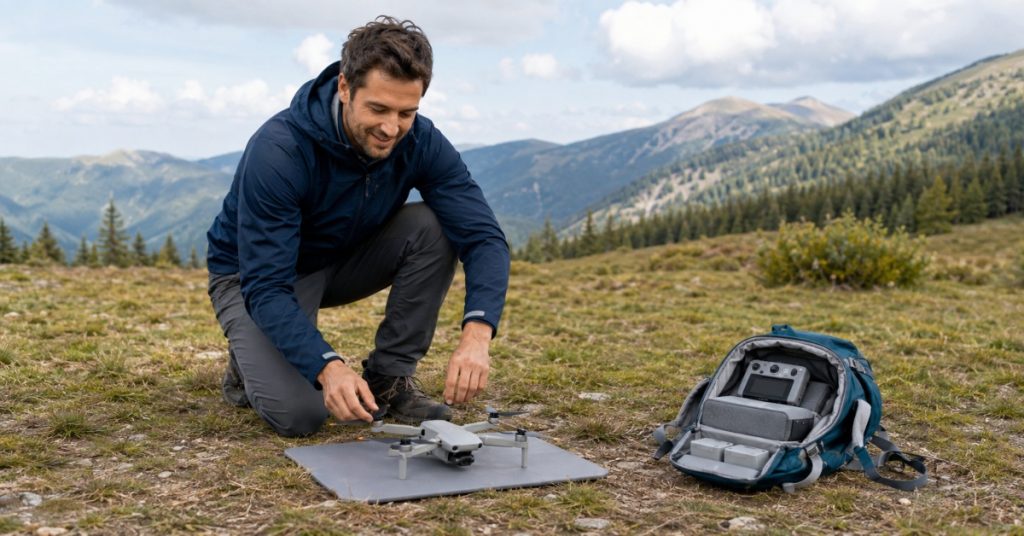
For most hikers, the DJI Mini 5 Pro offers the best balance of portability and camera capability.
It weighs about 250 grams with the standard battery, folds into a compact package, and provides the conventional flight controls and camera performance you need for landscapes, overlooks, and campsite footage.
Looking for a selfie drone you can use to film yourself hiking? Then the HOVERAir X1 PROMAX is probably a better choice.
Its automated tracking and controller-free operation reduce the amount of equipment you need to carry. That said, it’s less versatile than the Mini 5 Pro for broad aerial landscapes and manually composed shots.
Whichever drone you choose, make sure to look at the complete kit—not just the aircraft:
- Pack only the batteries you expect to use. Additional batteries, a charging hub, a controller, and a protective case can quickly turn a lightweight drone into a substantial kit.
- Plan for exposed conditions. Ridges, overlooks, canyons, and coastlines may be much windier than the sheltered trail leading to them.
- Use extra caution around trees. Thin branches, low light, and complex terrain can limit obstacle sensing and make automated tracking risky.
- Check the rules before packing. Many popular hiking destinations—including U.S. national parks—restrict drone takeoffs and landings.
What Makes a Good Travel Drone?
A good travel drone is one that fits the way you actually travel.
For some people, that means a drone and controller small enough to keep in a daypack. For others, it means accepting a larger kit in exchange for better image quality, stronger flight performance, or a second camera.
Before choosing, think about the complete system you’ll carry, the footage you want to capture, and the conditions you are likely to encounter.
Here is a quick overview of the main factors to compare:
| Factor | What to Compare | Why It Matters for Travel |
|---|---|---|
| Total packed size and weight | Drone, controller, batteries, charger, cables, and case | Determines how much room the complete kit takes up in your luggage |
| Camera | Sensor size, lens options, vertical shooting, and image controls | Helps you match the drone to the footage you will actually capture |
| Flight performance | Wind resistance, flight time, and operating conditions | Affects where and how reliably you can fly |
| Travel workflow | Controller, charging method, and storage options | Determines how easy the drone is to use away from home |
| Product support | Availability of batteries, propellers, repairs, and replacement parts | Reduces the chance that one damaged or missing component ends your flying |
Total Packed Size and Weight
Drone weight actually tells you very little about how much room a drone will take up in your luggage.
That’s because the controller, batteries, charger, cables, spare propellers, filters, and carrying case can collectively weigh more than the drone itself.
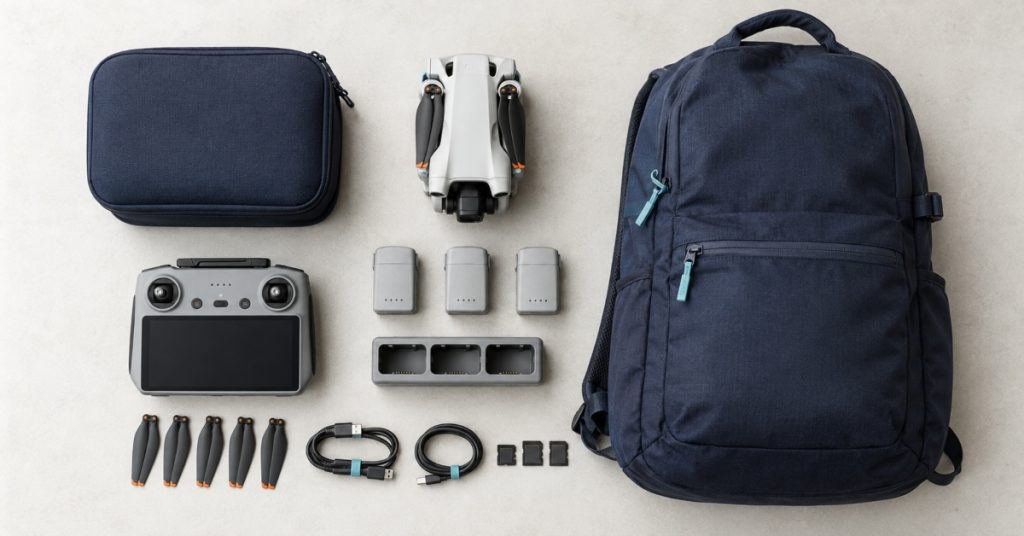
When comparing drones, account for the smallest complete setup you would realistically bring:
- Carry-on travel: Check whether the entire kit fits without displacing clothing, camera equipment, or other essentials.
- Hiking and backpacking: Consider both the weight on your back and the amount of space the kit occupies in a daypack.
- Controller-free filming: If you mainly want short automated clips, a self-flying camera may eliminate the need for a traditional controller.
Camera Quality for the Footage You Actually Shoot
The best travel-drone camera isn’t necessarily the one with the highest resolution.
Sensor size, lens options, vertical shooting, low-light performance, and image controls may have a greater effect on the footage you bring home.
Start with where the footage will appear and how much creative control you need:
- Vacation videos and social media: A compact drone with a capable camera may provide everything you need, while native vertical shooting simplifies publishing to Instagram, TikTok, and YouTube Shorts.
- Landscape photography: A larger sensor generally provides more flexibility in demanding light and during editing.
- Photography-focused trips: Multiple focal lengths let you vary your compositions, while a telephoto camera can isolate distant features without requiring the drone to fly as close to them.
Wind Performance and Flight Time
Small drones are easy to carry, but their low weight becomes a disadvantage in wind.
This matters around coastlines, mountains, exposed overlooks, and many of the other places travelers commonly want to photograph.
Published specs provide a helpful starting point, but real-world conditions determine how much flying time and performance you actually get:
- Wind resistance: A published limit does not guarantee that the drone will be easy or safe to fly at that wind speed.
- Usable flight time: Leave enough battery for takeoff, positioning, filming, the return trip, and a safe landing.
- Environmental conditions: Cold temperatures, altitude, repeated climbs, strong wind, and aggressive flying can shorten flight time.
Wind may also be stronger above the launch point, and returning against it can use considerably more power than the outbound flight.
If your trips regularly involve exposed terrain or changing conditions, a larger drone may be worth carrying. For calm, close-range flights, a lightweight model may be the better option.
Controller, Charging, and Storage
The drone is only one part of the travel workflow. How you control, charge, and store the drone can determine whether it’s actually practical to use once you are away from home.
Look at how the complete system fits into a typical day of travel:
- Controller: A built-in screen avoids tying up your phone, while a phone-based or controller-free setup may take up less room.
- Charging: Check for USB-C support, charging-hub functions, recharge times, and the number of outlets the complete kit requires.
- Storage: Internal storage provides a useful backup, but frequent filming may also require extra memory cards, a portable drive, or enough device storage to copy files.
These details matter more as access to power becomes less reliable.
Charging several batteries may be easy in a hotel or during a road trip, but almost impossible at a campsite or remote destination. In remote settings like those, charging time and battery capacity may determine how many flights you get for the entire trip.
Availability, Repairs, and Replacement Parts
A travel drone should be supported well enough that you can find the batteries, propellers, chargers, and other parts needed to keep it flying.
Before building a trip around a particular model, check:
- Product availability: Confirm that the drone and the configuration you want are sold in your market.
- Parts and repairs: Look for readily available batteries, propellers, chargers, and manufacturer or retailer support.
- Setup time: Buy early enough to activate the drone, install updates, practice flying, and test every component before departure.
This step deserves extra attention with newer products, imported models, and drones with limited retail distribution.
Should You Choose a Travel Drone Under 250 Grams?
For most travelers, a drone under 250 grams is a smart choice. It’s easier to pack and carry, and recreational pilots may face fewer registration requirements in some countries.
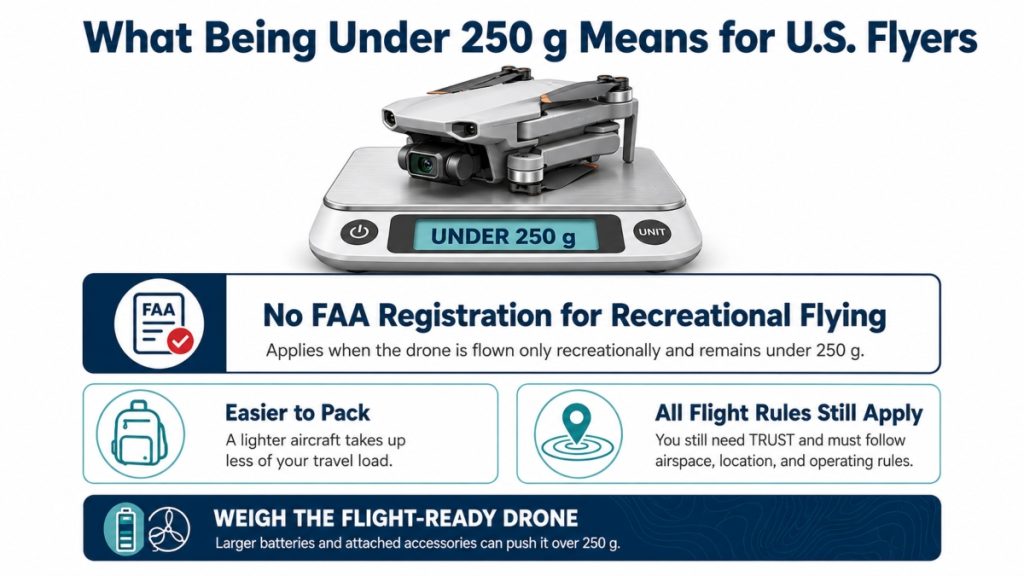
But a 249-gram drone isn’t exempt from drone laws. The advantage depends on where you fly, why you are flying, and the aircraft’s actual weight at takeoff.
Here is what the threshold changes in the United States:
| Type of Flying | Registration | Remote ID | Other Requirements |
|---|---|---|---|
| Recreational only | Generally not required below 250 g | Generally not required if the drone is not registered | TRUST and other recreational rules still apply |
| Part 107 | Required regardless of weight | Required unless operating under an applicable exception | Part 107 rules still apply |
What 250 Grams Changes in the U.S.
A drone weighing less than 250 grams doesn’t have to be registered with the FAA when flown exclusively for fun. (That is, not flown for work.)
Also, because Remote ID generally applies to drones that are required to be registered or have been registered, an unregistered sub-250-gram recreational drone generally does not need Remote ID.
But the weight exemption doesn’t apply to Part 107 operations.
If you use the drone for work or another non-recreational purpose, you must register it regardless of weight and comply with the applicable Remote ID requirements.
Regardless of your drone’s weight, recreational pilots still have to take the TRUST (The Recreational UAS Safety Test) and follow airspace, visual-line-of-sight, and other operating rules.
What to Check Before Traveling
As in the U.S., some countries give lighter drones more flexibility. But you may still have to register as a drone pilot, follow geographic restrictions, or obtain permission before flying.
When traveling, confirm in advance:
- National requirements: Check the registration, training, identification, and import rules at every destination.
- Local restrictions: Parks, cities, resorts, and historic sites may prohibit takeoffs and landings even when national rules allow the drone.
- Actual takeoff weight: Larger batteries, propeller guards, lights, and other attached accessories can push a drone over 250 grams.
Want to learn about drone laws in each state and abroad? Check out our master list of drone laws.
What to Do Before You Travel with Your Drone
Before buying or packing a travel drone, make sure you can use it at your destination.
You need to answer three basic questions: Can you bring the drone into the country? Can you legally operate it? And can you launch from the places you plan to visit?
Research the trip at four levels:
| Check | What to Confirm |
|---|---|
| Country | Import rules, registration, training, insurance, and visitor requirements |
| Airspace | Flight restrictions, authorization requirements, and temporary restrictions |
| Launch Site | Park, city, tribal, resort, event, and private-property rules |
| Airline | Battery limits, carry-on requirements, and carrier policies |
1. Research the Destination’s Drone Rules
Start with the national aviation authority for every country you plan to visit.
A country may allow visitors to bring in drones but require registration, training, identification, insurance, or advance permission before they fly.
Before traveling, confirm:
- Import rules: Whether visitors can bring drones into the country and whether they must declare them at customs.
- Registration: Whether the pilot, operator, or aircraft must be registered.
- Flight requirements: Whether you need training, identification, insurance, or permission to fly.
- Purpose of the flight: Whether commercial or other non-recreational flying requires additional authorization.
2. Check Every Planned Flight Location
Knowing a country’s drone laws does not tell you whether you can fly at a particular beach, landmark, trail, hotel, or event.
An aviation authority may allow flight in the airspace while a park, city, tribal nation, resort, or property owner prohibits launching or landing from the ground it controls.
Check each place where you realistically expect to fly:
- Protected areas: National parks, wildlife areas, and historic sites often have their own restrictions.
- Tribal lands: Check the rules of the tribal nation and do not assume FAA authorization overrides restrictions on access, launching, or conduct on its land.
- Private property: Hotels, resorts, attractions, and other property owners may prohibit drone use.
- Practical conditions: Crowds, wind, trees, confined spaces, and limited visibility may make a legal location unsafe or impractical.
3. Confirm Airline and Battery Requirements
Most consumer camera drones can be transported on passenger flights, but lithium batteries require special handling.
Under current FAA guidance, spare lithium batteries must be carried in the cabin and protected from damage and short circuits.
Before packing, check:
- Battery capacity: Batteries up to 100 watt-hours are generally permitted, while those from 101 to 160 watt-hours require airline approval and are limited to two spares.
- Battery storage: Keep spare batteries and power banks in your carry-on baggage, with their terminals protected.
- Airline policies: Check every carrier on the itinerary, including connecting and return flights.
- International requirements: Other countries may impose additional battery, security-screening, or customs rules.
Travel Drone FAQ
Here are answers to some of the most commonly asked questions about travel drones and using drones for travel.
What Is the Best Travel Drone for Most People?
The DJI Mini 5 Pro is the best travel drone for most people. It combines a compact, lightweight design with a capable camera, obstacle sensing, and conventional flight controls.
The DJI Air 3S is better for travelers who prioritize image quality and wind performance. The HOVERAir X1 PROMAX is a stronger fit for solo travelers who mainly want automated footage of themselves.
Is a Drone Worth Bringing on Vacation?
A drone is worth bringing when aerial photography is important to your trip and you have identified places where you can legally and safely fly.
It may not be worth the luggage space if most of your itinerary involves crowded cities, restricted parks, indoor attractions, or poor flying conditions. Check your planned flight locations before packing it.
Can You Take a Travel Drone on a Plane?
Yes, most consumer travel drones can be taken on passenger flights. Spare lithium batteries generally must remain in your carry-on baggage with their terminals protected from short circuits.
Airline policies and international requirements vary, so check every carrier on your itinerary. See our complete guide to taking a drone on a plane for detailed battery and packing guidance.
Is a Drone Under 250 Grams Easier to Travel With?
Generally, yes. A drone under 250 grams is easier to pack and may face fewer registration requirements in some countries.
However, the weight does not give you blanket permission to fly. Airspace restrictions, local launch-site rules, and other operating requirements still apply. Larger batteries and attached accessories may also push the aircraft above 250 grams.
How Many Drone Batteries Should You Bring?
Two or three batteries are enough for most trips. Two may be sufficient for occasional flights, while three provide more flexibility when aerial photography is a major part of the itinerary or charging access is limited.
Bring only the batteries you expect to use, and inspect them before leaving. Do not travel with lithium batteries that are damaged, swollen, or recalled.
What Is the Best Travel Drone for Hiking?
The DJI Mini 5 Pro is the best hiking drone for most people because it balances portability, camera performance, and obstacle sensing. When comparing options, remember to consider the weight of the controller, batteries, charger, and protective case—not just the aircraft.
The HOVERAir X1 PROMAX may be better for hikers who mainly want automated footage of themselves. The DJI Air 3S offers stronger camera and flight performance, but its larger complete kit is harder to justify when pack weight matters.