These Drones Were Made for Social Media—Here’s How They Compare
BY Zacc Dukowitz
29 July 2026If you’ve ever posted drone footage to Instagram or TikTok, you’ve probably run into the same problem: your drone shoots horizontal video, but social media uses vertical video.
For years, that meant cropping your footage and losing part of the image.
But as Instagram Reels, TikTok, and YouTube Shorts have grown in popularity, drone makers have started designing cameras with vertical video in mind.
Vertical shooting works two ways on drones:
- By physically rotating the drone’s camera 90 degrees
- By cropping the center of the image
Keep reading to learn how vertical shooting works on a drone, the best drones for social media, and what to know before choosing one.
How Vertical Shooting Works
Above, we covered the two ways you can shoot vertical video on a drone.
The end results look similar, but the two approaches differ in image quality, resolution, and flexibility.
Here’s a quick overview:
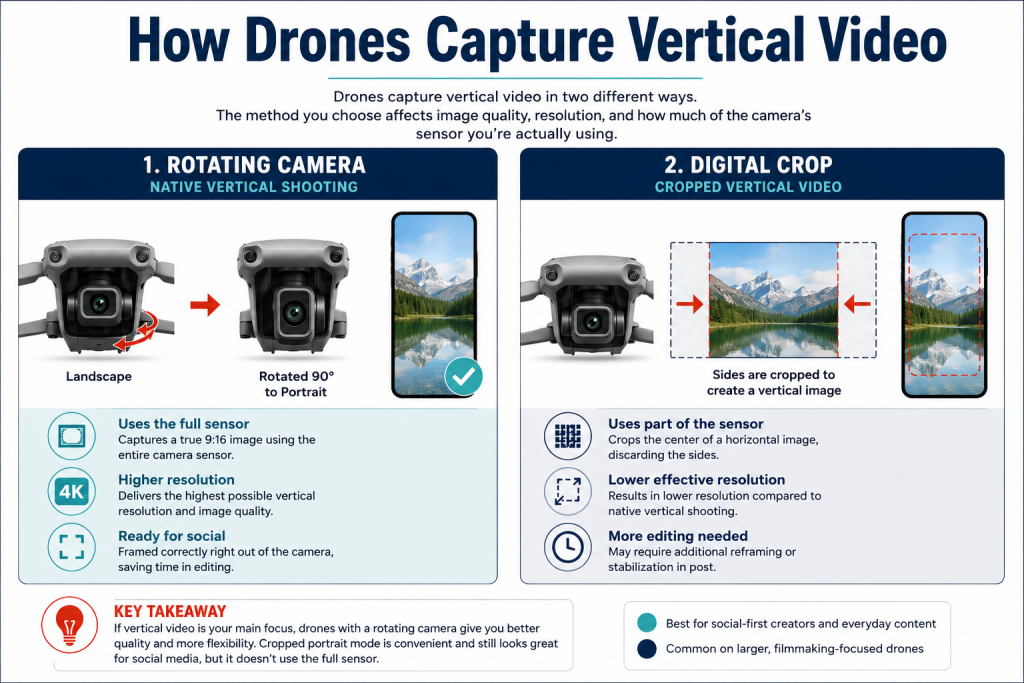
Option 1: A Rotating Camera
This is probably the best approach for shooting vertical video. It’s also the simplest.
On drones that use this approach, the camera and gimbal physically rotate 90 degrees into portrait orientation. Instead of cropping the image after it’s captured, the drone uses the camera’s full sensor to record a native 9:16 video.
Because the entire sensor is being used—instead of shooting then cropping, as in the other approach—you get the highest possible vertical resolution without sacrificing image quality.
Your footage is also framed correctly straight out of the camera, reducing the amount of cropping and reframing needed during editing.
Option 2: A Digital Crop
Other drones create vertical video by cropping into the center of a standard horizontal image.
Instead of rotating the camera, the drone records using its normal landscape orientation, then trims away the sides of the frame to produce a portrait-format video.
This approach is simpler from a hardware standpoint because it doesn’t require a rotating gimbal. And it can still produce good-looking results for many social media posts.
The tradeoff is that you’re only using part of the camera’s sensor, which means lower effective resolution and less flexibility than a drone with a true rotating camera.
For casual creators, the difference may not matter. But if you regularly create content specifically for vertical platforms, using a drone with a native vertical camera is probably the better option for you.
The Best Drones for Vertical Video
Finding the right drone for social media depends on the kind of content you create.
Some creators want the best all-around camera drone, while others are looking for the lowest-cost way to shoot native vertical video, or a hands-free drone for taking easy aerial shots.
In the top picks below, we’ve covered different use cases to help you find the best option for your specific needs.
1. Best Overall: DJI Mini 5 Pro

The DJI Mini 5 Pro is our top overall choice for vertical video.
It offers the strongest balance of portability, camera quality, obstacle sensing, and intelligent flight features among the drones on this list. And its camera physically rotates into portrait orientation, letting you frame social content in the air while using the full sensor instead of relying on a crop.
Key highlights:
- Vertical capture: Native 9:16 footage from a rotating camera
- Best feature: Large 1-inch sensor in a compact drone
- Main tradeoff: Costs more than simpler Mini models
LEARN MORE
2. Best Value: DJI Mini 3

The DJI Mini 3 is one of the most affordable ways to get true vertical shooting without relying on a cropped image.
Its camera rotates 90 degrees, allowing it to record social-ready footage while still offering 4K HDR video for landscape shooting.
While the Mini 3 lacks some of the obstacle sensing and tracking features found on more recent Mini Pro models, it lets you get vertical-video features at an inexpensive price.
Key highlights:
- Vertical capture: Native footage from a rotating camera
- Best feature: True vertical shooting at a relatively accessible price
- Main tradeoff: Limited obstacle sensing and tracking
LEARN MORE
3. Best for Social-First Creators: HoverAir X1 Pro Max

The HoverAir X1 Pro Max is designed around quick, autonomous shooting. It can launch from your hand and uses automated flight modes to follow, orbit, or pull away from you while recording.
That makes it especially useful for creators who want footage of themselves hiking, cycling, traveling, or taking part in other activities. It’s less versatile than a traditional camera drone, but its ease of use can make it faster for you to capture and publish social content.
Key highlights:
- Vertical capture: Dedicated portrait recording up to 4K
- Best feature: Automated, controller-free filming
- Main tradeoff: Less manual control than a conventional camera drone
LEARN MORE
4. Best for Hybrid Creators: DJI Mavic 4 Pro

The DJI Mavic 4 Pro is the strongest option for filmmakers whose primary work is traditional landscape video but who also publish short-form content.
Its portrait mode relies on a crop rather than physically rotating the camera, but it still lets creators capture vertical footage without reframing every shot during editing.
Its larger three-camera system also provides more creative flexibility than the compact drones above. That makes it the better fit for professional or advanced creators who prioritize broad filmmaking capabilities and view vertical shooting as one part of a larger production workflow.
Key highlights:
- Vertical capture: Crop-based portrait mode
- Best feature: Versatile three-camera system
- Main tradeoff: Larger and more expensive, without native rotating capture
LEARN MORE
The Big List of Drones That Shoot Vertical Video
The models below can all produce portrait-format video, although their approaches and intended uses vary.
Some rotate the camera to capture a native vertical frame, while others crop a horizontal image or use a dedicated portrait recording mode.
Here are all the main consumer drones that shoot vertical video:
| Drone | Vertical Video | Best For | What to Know |
|---|---|---|---|
| DJI Mini 5 Pro | Native rotating camera | Best all-around option | Our top overall pick for image quality, portability, and features. |
| DJI Mini 4 Pro | Native rotating camera | Advanced features in a compact drone | Delivers most of the Mini 5 Pro experience at a lower price. |
| DJI Mini 3 | Native rotating camera | Budget-conscious creators | The lowest-cost DJI drone with true vertical shooting. |
| DJI Flip | Digital crop | Vlogging and casual content | Portrait mode uses a crop instead of a rotating camera. |
| DJI Air 3 | Digital crop | Travel and dual-camera shooting | Excellent dual-camera drone, but portrait mode is cropped. |
| DJI Air 3S | Digital crop | Travel photography and video | Improved imaging over the Air 3, but still relies on a crop. |
| DJI Neo | Digital crop | Beginners and quick social clips | Simple, lightweight, and designed for easy content creation. |
| DJI Mavic 4 Pro | Digital crop | Filmmaking and professional content | Outstanding camera system, but portrait mode uses a crop. |
| HoverAir X1 Pro | Native portrait recording | Hands-free social content | Autonomous flight makes solo filming fast and easy. |
| HoverAir X1 Pro Max | Native portrait recording | Premium hands-free content | Higher image quality than the X1 Pro with the same autonomous workflow. |
What to Look for in a Drone for Vertical Video
If vertical video is your priority, a rotating camera is usually worth paying for. That’s because shooting with native portrait lets you preserve the full image and eliminates the need to crop footage later.
But the camera isn’t the only thing that matters.
Before choosing a drone, ask yourself:
- Will you also shoot landscape video?
- Do you want to fly manually or use autonomous flight modes?
- How important is obstacle avoidance?
- Will you edit your footage or post directly from your phone?
- Is portability more important than camera quality?
For creators who mainly publish to Instagram, TikTok, or YouTube Shorts, a compact drone with native vertical shooting will usually provide the simplest workflow.
But for creators who make a mix of commercial work, travel videos, or YouTube content, a larger drone with a stronger camera system may be a stronger option—even if its portrait mode relies on a crop.