Engineers Teach Computers to Hear When a Drone Is About to Fail
BY Zacc Dukowitz
29 October 2026If you’ve ever powered up a drone before noticing a nicked propeller, you may have heard that something sounded a little off.
Engineers at the University of Cincinnati (UC) are using microphones to capture a drone’s sound, and a ground-station computer to analyze those sounds for signs of damage before takeoff.
Prompted by NASA’s interest in detecting motor problems before takeoff, the UC team recorded the sounds drones make when their propellers are chipped or cracked, or when a motor is damaged or starting to fail.
Then they converted those recordings into data that ground-station computers can use to warn operators that a drone may not be airworthy.
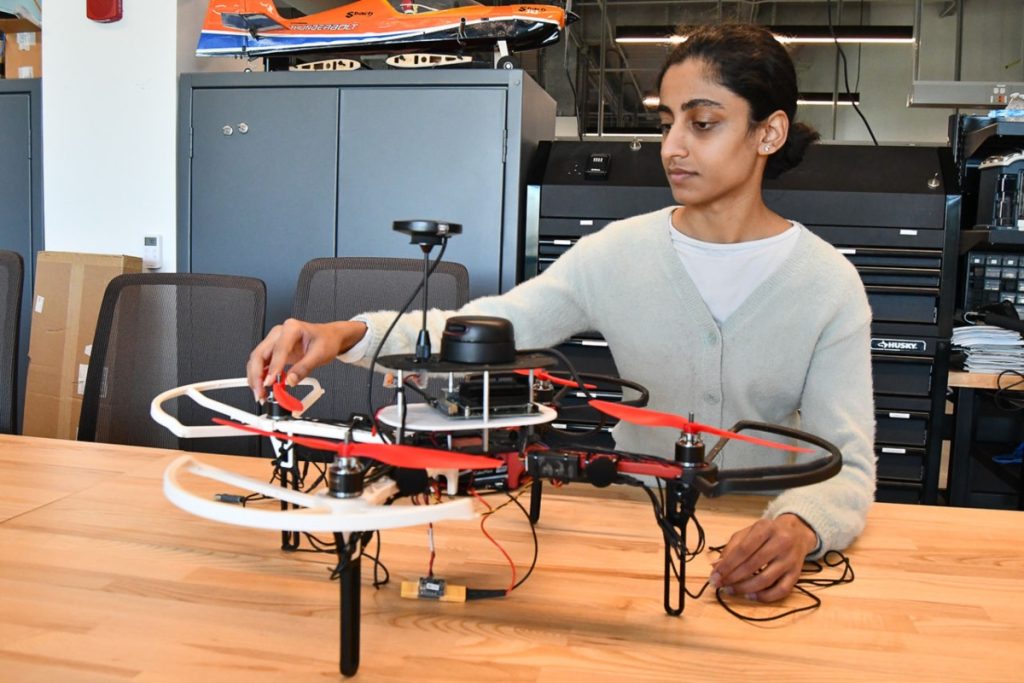
UC doctoral student Prissha Chawla with the drone used in the research | Credit: Michael Miller
Hearing the Damage a Walkaround Can Miss
The idea here is to add an acoustic check to the preflight process.
Instead of relying only on a visual inspection, a ground-station computer listens for sounds that could indicate damage before takeoff.
For now, the team is focused on supporting preflight tests NASA already conducts. But diagnosing damage during flight remains a longer-term goal.
Why sound? Because sometimes, damage that could cause a drone to crash is hard to see.
A crack in a propeller may be visible if you look closely. But a problem inside a motor is a different story.
UC doctoral student Prissha Chawla, who is working on the project, said grit and other debris can get into motor bearings and cause a motor to seize. That kind of contamination may be hard to see by looking at the outside of the drone—but it can change how the motor sounds.
That’s what makes the work interesting for drone pilots.
A chipped propeller is a known risk, and most pilots check for it. A bearing that’s starting to grind may be easier to miss during a routine visual inspection.
From NASA Preflight Tests to Drone-in-a-Box Docks
UC student Luke Busse recently said that one of the clearest potential uses for the damage-detection system could be in fully autonomous drone-in-a-box systems, where there isn’t a pilot present to carefully review a drone’s condition.
In these operations, a drone lives in a weatherproof dock, while the larger system manages launching, landing, charging, data uploads, and scheduled missions without an operator nearby.
“You could have sensors in the box that provide preflight checks,” Busse said.
That would address a real gap.
When nobody is standing next to the drone before each flight, nobody is conducting a traditional walkaround.
A dock that can listen for a damaged propeller or malfunctioning motor could provide an additional preflight check.
The students also have a longer-term goal: an autonomous drone that uses sound to detect damage to its propellers and other mechanical systems during flight, allowing it to return to base before a catastrophic failure.
For now, the preflight inspection is still on you. But stay tuned—an automated inspection process may be coming in the next few years.