DJI Unveils First eVTOL Cargo Drone in Dramatic Everest Mission
BY Zacc Dukowitz
10 July 2026DJI just rolled out the EV50, its first eVTOL delivery drone.
The EV50 is a cargo drone built for longer-distance deliveries, with a claimed payload capacity of 110 pounds and a maximum range of 93 miles.
But the design is what makes it different.
Unlike DJI’s FlyCart drones, which have a familiar multirotor configuration, the EV50 is a lift-and-cruise aircraft. It takes off and lands vertically, then transitions to fixed-wing flight for longer-distance travel. And it can carry substantial cargo over much longer distances.
DJI introduced the EV50 through a high-altitude test on Mount Everest, where the drone carried atmospheric research equipment for Peking University, reaching a peak altitude of 29,072 feet—that’s 5.5 miles high.

As with many drone launches lately, the EV50 isn’t for sale here in the U.S.
That’s because it hasn’t received FCC approval. Unlike the DJI Lito series and the DJI Avata 360—which had received FCC approval but were simply delayed in their U.S. rollout—the EV50 is unlikely to launch here at all.
What Is the DJI EV50?
The DJI EV50 is a long-range eVTOL delivery drone built for cargo logistics.
In plain English, eVTOL means electric vertical takeoff and landing. The EV50 can rise straight up like a multirotor, then fly forward on fixed wings like an airplane.
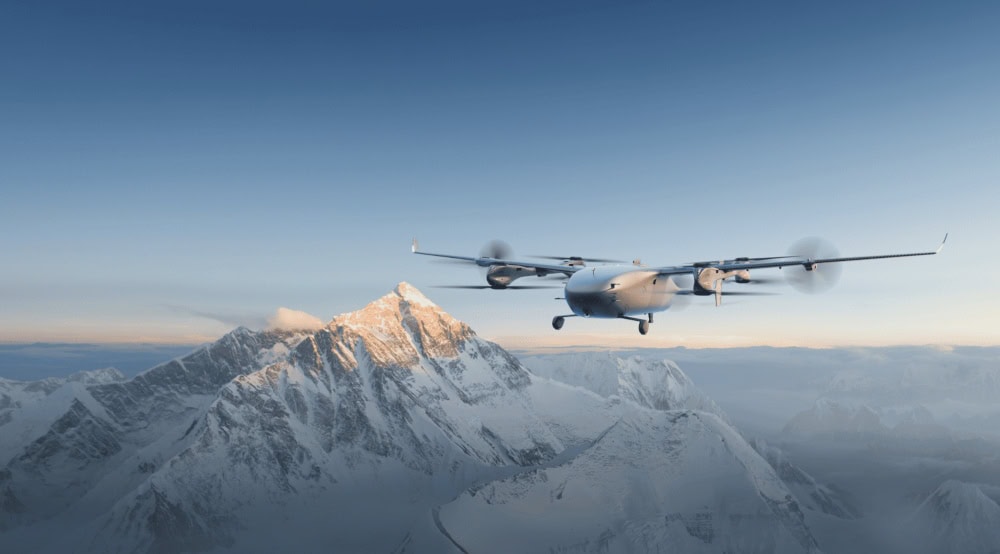
Credit: DJI
The two capabilities solve different problems:
- Vertical takeoff makes the EV50 useful in places where there may not be a runway, like mountain camps, or remote worksites, allowing it to take off in congested environments.
- Fixed-wing cruise helps the aircraft cover longer distances more efficiently once it is in the air, optimizing it for long-range deliveries.
With the EV50, DJI is moving into a broader logistics category—one where drones aren’t just lifting heavy payloads, but moving them across meaningful distances.
That same trend is showing up elsewhere in the industry. We recently covered Skyways’ offshore cargo drones, which also use a hybrid VTOL design to move heavy supplies to remote industrial locations.
The EV50 points in the same direction, providing a cargo drone made for real industrial loads that can operate in harsh, demanding environments.
DJI EV50 Specs
Here are the main specs for the EV50:
- Payload capacity. Up to 110 pounds (50 kilograms)
- Maximum unloaded range. Up to 93 miles (150 kilometers)
- Maximum unloaded speed. Up to 99 mph (160 kph)
- Cargo space. 270-liter cargo compartment
- Aircraft type. Lift-and-cruise eVTOL cargo drone
- Propulsion layout. Eight vertical-lift rotors and three pusher propellers
DJI Tested the EV50 By Flying Higher than the Top of Mount Everest
DJI didn’t introduce the EV50 with a typical delivery demonstration. Instead, it flew the drone nearly 29,100 feet above sea level—higher than the elevation of Mount Everest’s summit. (Everest is about 29,032 feet high.)
Working with Peking University, DJI used the EV50 to carry ozone-measuring equipment for research into atmospheric pollutants in the upper troposphere.

Credit: DJI
Over 12 days, the EV50 completed 12 transport flights from a base camp in the Qomolangma National Nature Reserve. The drone flew in spirals and back-and-forth patterns to collect data while dealing with complex winds and extreme high-altitude conditions.
Its highest flight reached 29,072 feet (8,861 meters), with a maximum continuous climb of 12,238 feet (3,730 meters).
Why This Everest Mission Was Different
DJI has flown drones around Everest before. In 2024, the FlyCart 30 made the first drone delivery on the mountain, carrying oxygen bottles up and trash down.

But the EV50 mission presented a different challenge.
The air gets thinner as altitude increases, making it harder for both propellers and wings to generate lift. For the EV50, that meant testing every stage of its hybrid flight at extreme altitude.
The drone had to take off vertically using its lift rotors, transition to fixed-wing flight, and then follow spiral climbs and S-shaped flight patterns, all while carrying scientific equipment through complex mountain winds.
And it had to do all of this at elevations approaching the summit of Everest.
Not just a flashy launch stunt, the test gave DJI a way to demonstrate the EV50’s hybrid design in exactly the kind of difficult environment cargo drones are increasingly being built to serve.
How the EV50 Is Different from DJI’s FlyCart Drones
DJI already makes heavy-lift delivery drones. So why build the EV50?
The short answer is that the EV50 and DJI’s FlyCart drones are designed to solve different logistics problems.
While the FlyCart series handles heavy lifting, the EV50 gives it a long-range option.
Here are the main differences:
| DJI EV50 | DJI FlyCart Series | |
|---|---|---|
| Aircraft design | Lift-and-cruise eVTOL | Multirotor |
| Primary strength | Long-distance cargo transport | Heavy-lift cargo transport |
| Forward flight | Uses fixed wings for cruise | Relies on rotors throughout flight |
| Hovering | Built to transition from vertical lift to forward flight | Can hover and maneuver like a traditional multirotor |
| Delivery approach | Moves cargo over longer distances | Supports cargo and winch delivery into difficult locations |
| Best suited for | Long-range logistics routes | Heavy deliveries in difficult terrain |
The biggest difference comes down to what happens after takeoff.
A FlyCart has to use its rotors to generate lift for the entire flight. The EV50 can transition to forward flight, where its wings generate lift as it moves through the air.
That’s what helps make the EV50 better suited for longer logistics routes.
The distinction is especially clear when you look at DJI’s Everest work. The FlyCart 100 carried climbing supplies and waste between Base Camp and Camp 1, completing one-way flights in eight minutes. It was solving a heavy-lift access problem on a specific route.
The EV50 supported a different kind of mission on the other side of the mountain, carrying scientific equipment and flying long, complex patterns at extreme altitude.
One drone was built around moving heavy cargo through difficult terrain. And the other was built to travel long distances.
Adding the EV50 to its FlyCart series, DJI now has a cargo drone for both scenarios.