Why Skyways Is Betting on Offshore Cargo Drones
BY Zacc Dukowitz
30 June 2026Skyways isn’t trying to build the next big drone delivery company.
Instead, the Texas-based startup has spent years quietly developing autonomous cargo drones for a very specific job: transporting supplies to remote industrial sites.
Its biggest focus is offshore facilities. But it also works with other industrial operators transporting time-sensitive cargo, like replacement parts or maintenance equipment.

It’s a focused strategy—and one that reflects a broader shift happening across the commercial drone industry.
Rather than chasing every drone delivery opportunity, companies are finding success by solving one problem well.
For Skyways, that problem is moving cargo offshore, where helicopters and crew boats have long been the default option for transporting tools, replacement parts, medical supplies, and other critical equipment.
And that focus is paying off. RWE says its cargo drone pilot project has completed more than 80 successful offshore flights, including work with Skyports Drone Services using Skyways’ V2 for long-range offshore wind deliveries.
Why Skyways Is Taking a Different Approach
For years, cargo drone companies have promised a future where autonomous drones would deliver everything from groceries to online purchases.
And while some of those companies have found success, many discovered that broad consumer delivery is a hard thing to pull off at scale.
Skyways has taken a different path.
Instead of trying to replace traditional package delivery, the company is focused on industrial logistics—particularly offshore operations, where moving even small items can require an expensive helicopter flight or a lengthy boat trip.
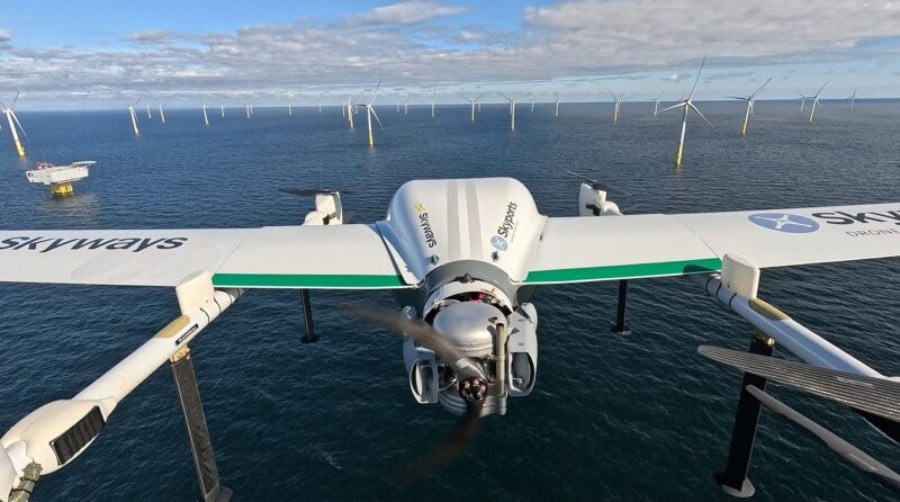
Credit: Skyways
That’s an environment where autonomous aircraft can offer immediate value. A replacement sensor, specialized tool, or medical kit may not weigh much, but getting it to an offshore platform quickly can save significant time and money, while also reducing risk to personnel.
This reflects a broader trend in commercial drones.
As the industry matures, companies are increasingly finding success by building aircraft around specific operational challenges rather than trying to serve every possible customer.
DJI’s FlyCart series points in the same direction.
The FlyCart 30 and newer FlyCart 100 aren’t built for doorstep delivery. They’re made for heavy-lift logistics in places like mountains, construction sites, emergency response zones, and other areas where conventional transportation is difficult.

The FlyCart 100 | Credit: DJI
Skyways is aiming at a different slice of that same market, with cargo drones designed around longer-range cargo missions and offshore operations.
Skyways’ Two Cargo Drones
Skyways currently has two cargo drones: the V2 and the V3.
Both drones use a hybrid VTOL (vertical takeoff and landing) design, meaning they take off and land vertically, then transition to fixed-wing flight for longer distances.
That combination makes them well suited for offshore logistics, where space is limited and destinations can be many miles from shore.
The Skyways V2
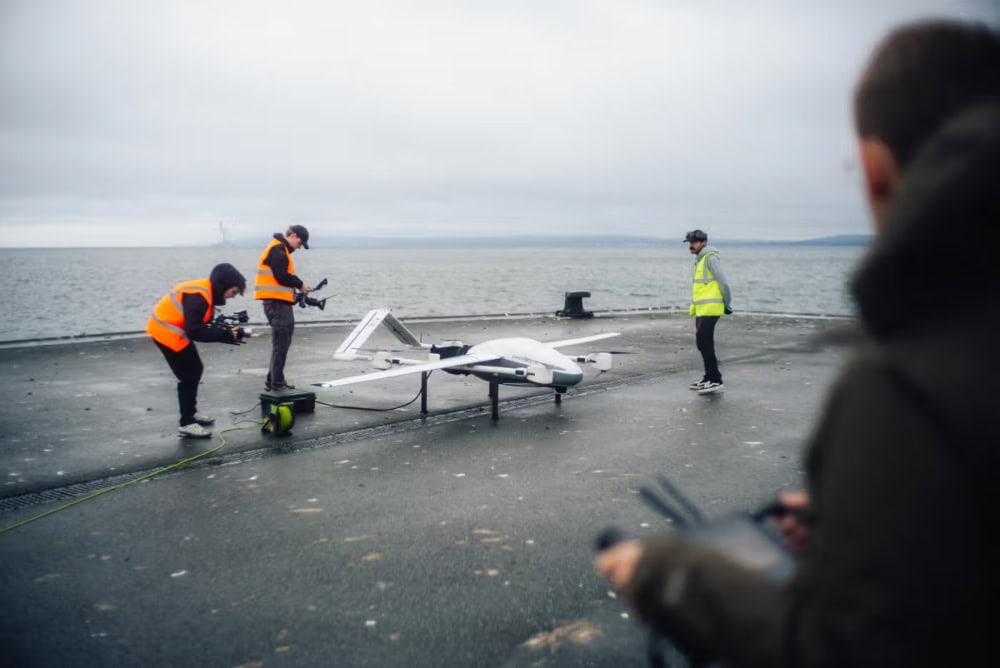
The Skyways V2 | Credit: Skyways
The V2 is the drone that established Skyways’ commercial credentials.
It’s been used in offshore logistics demonstrations, including a long-range BVLOS offshore wind turbine resupply mission, flying a 50-mile round trip with a payload of around 22 pounds.
Key Specs for the V2
- Aircraft type. Hybrid VTOL autonomous cargo aircraft
- Range. About 450-500 miles (724-805 km)
- Payload capacity. Up to 30 pounds (13.5 kg)
- Cruise speed. Approximately 70 mph (113 kph)
- Primary missions. Offshore logistics, military resupply, industrial cargo transport
The Skyways V3

Building on the V2, the V3 increases both payload capacity and operational flexibility while maintaining the same autonomous cargo focus.
Key Specs for the V3
- Aircraft type. Hybrid VTOL autonomous cargo aircraft
- Range. About 1,000 miles (1,609 km)
- Payload capacity. Up to 100 pounds (45 kg)
- Cruise speed. Approximately 80 mph (129 kph)
- Primary missions. Offshore logistics, defense, industrial cargo transport, emergency resupply
The V3’s larger payload opens the door to a much wider range of logistics missions, from transporting maintenance equipment to supporting emergency response and defense operations.
Skyways’ Progress So Far
Skyways is still a relatively young company, and autonomous cargo remains an emerging market.
But its focused approach is paying off.
Over the past year, the company has:
- Landed a $37 million award with the U.S. Air Force to transition the V3 from prototype to full-rate production.
- Raised $5 million to accelerate production of V3 aircraft for DoD customers.
- Conducted historic BVLOS cargo flights under Project ULTRA, demonstrating autonomous logistics missions in controlled U.S. airspace under FAA oversight.
- Conducted commercial offshore cargo missions with RWE and Skyports Drone Services, among others, helping validate Skyways’ cargo drones for real-world operations.
This momentum matters, because Skyways isn’t trying to prove cargo drones are useful in theory.
It’s trying to prove they can become a repeatable logistics tool for customers already spending significant time and money moving supplies to remote locations.
It’s an approach that’s already working elsewhere in the drone industry, too. BRINC has built its business around drones for public safety, while Flyability has become a leader in confined-space inspection with its Elios drones.
Skyways is applying a similar playbook: choose a hard operational problem, build around it, and validate it in real-world conditions.
The test now is execution.
Skyways has shown it can build capable drones and attract serious customers. The next challenge is scaling production and turning these early successes into a long-term cargo drone business.