Researchers Build a Drone That Hunts for Cracks Inside Bridges
BY Zacc Dukowitz
18 November 2026Researchers in Germany are developing a small autonomous drone that can fly through the hollow interior of a concrete bridge and use AI to search for cracks.
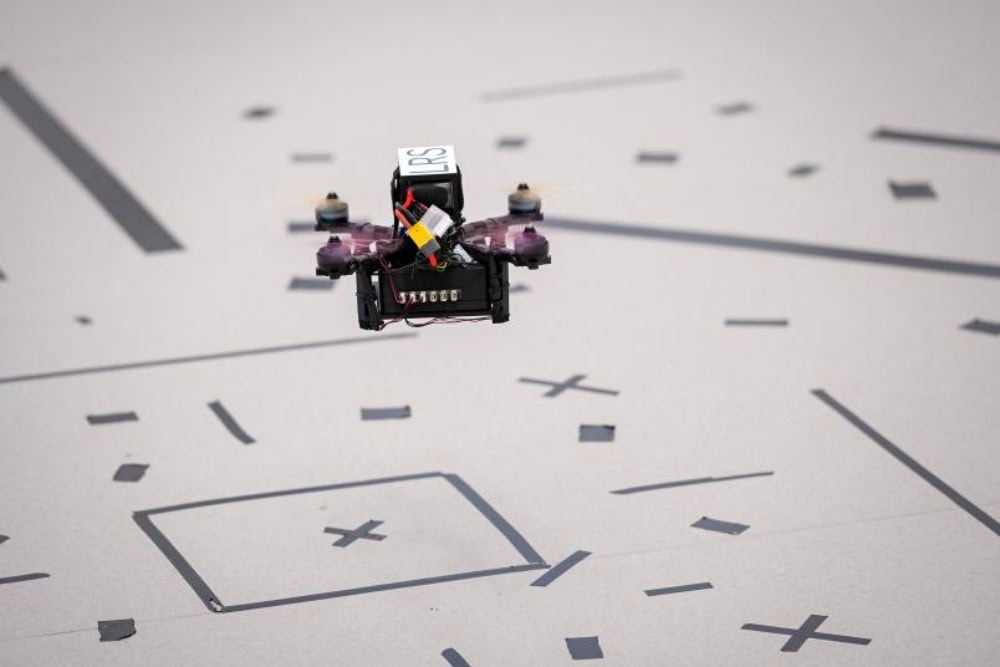
Credit: Roberto Schirdewahn / Ruhr University Bochum
The drone is being developed at Ruhr University Bochum as a tool for inspecting box girders—the narrow, enclosed structural sections found inside many concrete bridges.
These spaces can be dark, difficult to enter, and too confined for many commercial inspection drones.
The research team’s current drone measures about 23 centimeters, or nine inches, across. It can plan its own route, scan concrete surfaces, and save its findings to an onboard SD card.
The next major step will be testing the drone for an actual bridge inspection.
The Drone Navigates Without GPS
GPS signals generally aren’t available inside concrete box girders, so the drone uses simultaneous localization and mapping, or SLAM, to understand its surroundings.
As it flies, the drone builds a map and estimates its position within that map. This allows it to navigate through dark, winding spaces without relying on an external positioning system.
An onboard AI model examines images of the concrete pixel by pixel and flags areas that may contain cracks.
Distinguishing real damage from paint marks, pores, dark spots, and spiderwebs is one of the project’s central challenges.
When the software is uncertain, the drone can approach an area from another angle and collect additional imagery.
The team began with an eight-centimeter prototype, but found that it was too small to carry the necessary battery and processing hardware. The researchers then built a larger 23-centimeter version from scratch.

Credit: Roberto Schirdewahn / Ruhr University Bochum
The Drone Is Intended to Assist Human Inspectors
The project remains in the laboratory stage.
Researchers are testing the drone at Ruhr University Bochum’s indoor flight lab, where a motion-capture system helps them measure its position and evaluate its navigation algorithms.
According to the university’s official project announcement, the team’s next goal is to demonstrate that the system can work inside a real bridge.
Battery life and the integration of the drone’s sensors, flight controls, and onboard AI remain technical challenges.
The researchers also stress that the drone isn’t meant to replace qualified bridge inspectors.
Instead, it would collect imagery, identify potentially damaged areas, and help inspectors decide where to take a closer look. And a future version could contribute to a digital twin that maps cracks and other defects across a bridge.