Ukraine Reports World’s First Combat Medevac by Drone
BY Zacc Dukowitz
27 October 2026Ukraine says a drone just did something ground robots couldn’t: it lifted a wounded soldier out of a mined front-line position and flew him to safety.
Ukraine’s 92nd Separate Assault Brigade released video of the rescue on October 19.
It shows a heavy-lift hexacopter descending over the position, lifting the injured infantryman beneath the aircraft, and carrying him away. (Skip to 00:48 for the beginning of the man attaching himself to the drone.)

The brigade described the mission as the world’s first evacuation of a wounded soldier by an aerial drone.
And the soldier, a man named Kostiantyn Vlasenko, survived. He’s now receiving treatment and rehabilitation, and the brigade says his life is no longer in danger.
Why Ground Robots Couldn’t Reach Him
Uncrewed ground vehicles have become an important way for Ukrainian forces to move wounded troops without exposing additional soldiers to front-line fire.
But the area around Vlasenko’s position was heavily mined and under constant threat from Russian drones, making a ground evacuation impossible.
So the only option for getting him out over the mined terrain was to try flying over it, instead of crossing it on land.
According to local reporting, Vlasenko had lost both feet by the time he was evacuated. Drones had been delivering food and other supplies to him every four or five days.
How a Heavy-Lift Hexacopter Carried a Soldier
The drone that carried Vlasenko to safety was a Heavy Shot Ayudag-6 from Gurzuf Defence.
According to Ukraine’s Ministry of Defense, the hexacopter used weighs 216 lbs (98 kg) and can carry up to 287 lbs (130 kg). During the mission, it flew over 9 miles (15 km) to rescue the soldier.
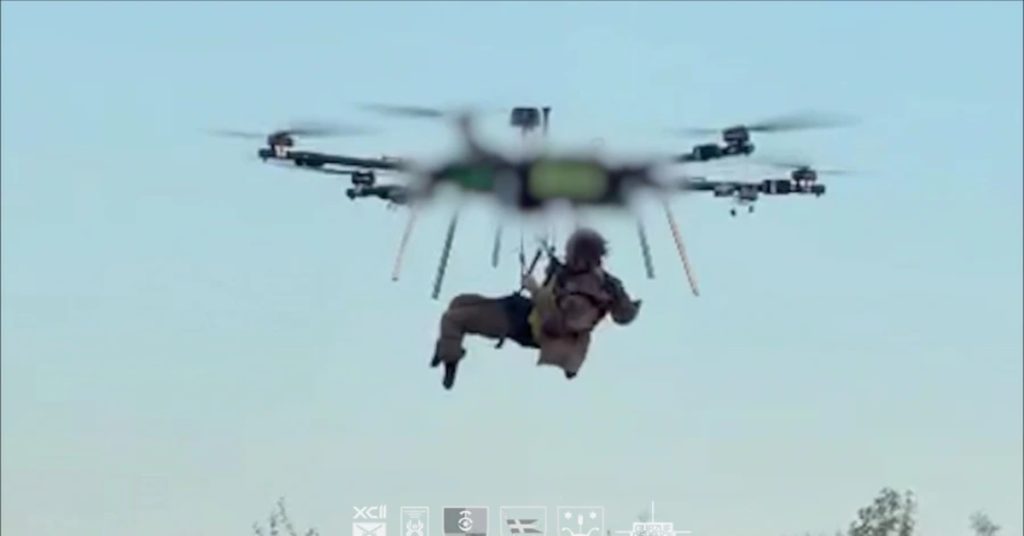
A screenshot of footage provided by Ukraine’s 92nd Separate Assault Brigade
The Heavy Shot drone was originally designed to carry heavy loads, not to transport people. Adapting it for the evacuation took about six months of engineering, testing, and planning.
The rescue happened in stages:
- Delivering the equipment: The team first sent Vlasenko evacuation gear fitted with carabiners so he could connect himself to the aircraft.
- Flying in the hexacopter: The Heavy Shot arrived with a cargo winch and lowered the attachment system to the position.
- Securing the soldier: Personnel stayed in contact with Vlasenko and guided him as he attached himself to the system.
- Covering the evacuation: Other Ukrainian units reportedly launched heavy drones to distract Russian interceptor drones from the evacuation aircraft.
- Flying him out: The hexacopter lifted Vlasenko and carried him to a safer transfer point. From there, a Peacemaker ground robot carried him another 5 miles (8 kilometers) before he was transferred to a vehicle.
A person suspended beneath an aircraft is a heavy, shifting load. Movement along the cable can cause the load to swing, potentially destabilizing the drone.
Engineers from the military and Gurzuf Defence developed and tested changes intended to keep the hexacopter stable without tipping or swaying excessively. About 15 people reportedly took part in preparing and planning the operation.
The result wasn’t simply a cargo drone with a winch attached.
It was a carefully planned mission involving a specialized heavy-lift aircraft, months of testing, multiple military units, and support from other drones operating nearby.