Drone Obstacle Avoidance: How It Works, Why It Matters & What to Look For
BY Zacc Dukowitz
17 June 2026If you’ve shopped for a drone in the last few years, you’ve probably noticed that obstacle avoidance has gone from a premium feature to a standard selling point.
Drone companies often highlight obstacle sensing as a way to prevent crashes, make flying safer, and improve automated flight modes.
But not all obstacle avoidance systems are created equal—and not every pilot needs the same level of protection.
For some, obstacle avoidance is one of the most valuable features on a drone. For others, it’s helpful but not all that important.
In this guide, we’ll look at how drone obstacle avoidance works, where it helps most, where it falls short, and share obstacle sensing guidance for different types of drones.
Here’s everything we cover:
- How Does Obstacle Avoidance Work on a Drone?
- The Three Types of Drone Obstacle Response
- What Drone Obstacle Avoidance Can and Can’t Do
- When Obstacle Avoidance Matters Most
- How to Choose a Drone With Obstacle Avoidance
- Types of Obstacle Avoidance Systems
- Obstacle Avoidance Sensors: Vision, Infrared, LiDAR, and Radar
- Drone Obstacle Avoidance FAQ
How Does Obstacle Avoidance Work on a Drone?
Obstacle avoidance helps a drone detect objects in its flight path and respond before a collision occurs.
It works by using a range of sensors to help the drone understand and react to its surroundings.
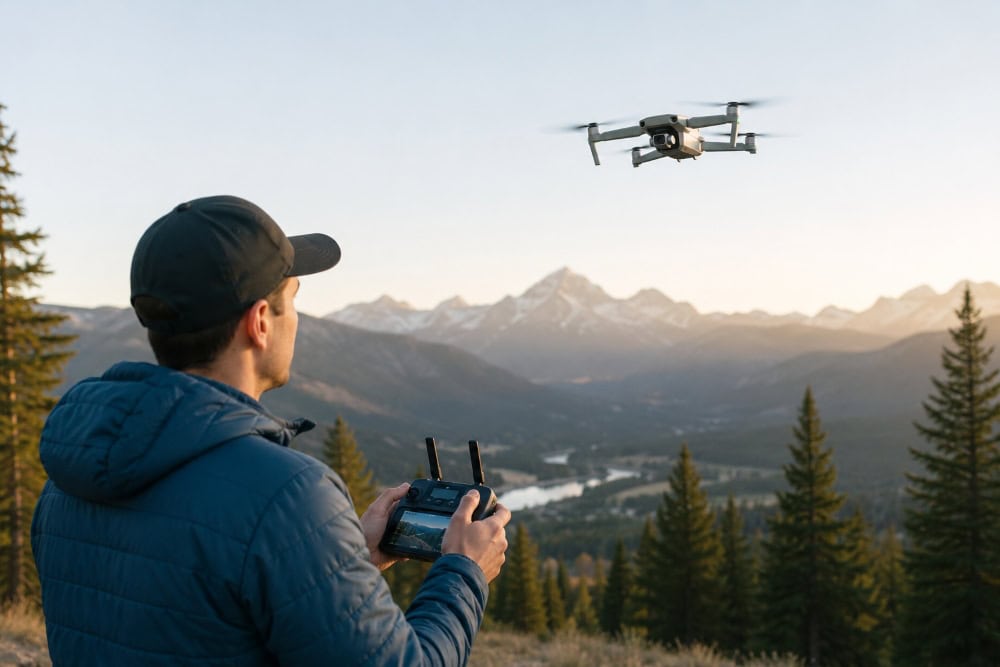
Depending on the drone, these sensors may be used to detect obstacles, measure distance, identify potential collision risks, and support automated flight functions.
Common obstacle avoidance sensors include:
- Vision sensors. Cameras that help the drone identify and track objects in its environment.
- Infrared sensors. Sensors that help estimate distance to nearby objects.
- LiDAR. Laser-based sensors that create highly accurate distance measurements and environmental maps.
- Radar. Radio-wave sensors that can detect objects in conditions where vision systems may struggle.
Many modern drones combine multiple sensor types into a single obstacle avoidance system, allowing the drone to build a more complete understanding of the environment around it.
Why Obstacle Avoidance Matters
Many drone accidents happen because the pilot is focused on something other than the obstacle.
That might be composing a photo, tracking a moving subject, inspecting a structure, or monitoring telemetry on the screen. Obstacle avoidance provides an additional layer of awareness that can help catch mistakes before they lead to a crash.
For many pilots, it’s one of the most valuable safety features available on a modern drone.
But not every pilot needs the same level of protection:
- You may not need it if: most of your flights take place in open fields or similar areas with few obstacles.
- You probably do need it if: you fly regularly near buildings, trees, utility structures, or use automated tracking modes.
Think of It as a Safety Net, Not a Guarantee
A common misconception among new pilots is that obstacle avoidance makes a drone crash-proof.
In reality, these systems are designed to reduce risk, not eliminate it. They can miss “seeing” thin branches that could still take out your drone, struggle in low light, or fail to detect certain surfaces.
In practice, the best way to think about obstacle avoidance is as a backup safety net.
A good safety net can save you from mistakes. It can’t replace good flying habits.
The Three Types of Drone Obstacle Response
Obstacle avoidance sounds straightforward: the drone sees an obstacle and avoids it. But in reality, several different things happen between detection and the drone’s response.
Understanding that process can help you choose the right obstacle avoidance systems for the type of flying you want to do. It can also help you be a better drone pilot.
Most obstacle avoidance systems follow the same basic workflow:
- Detect an obstacle.
- Determine whether a collision is likely.
- Respond according to the drone’s programming.
The biggest differences between drones usually appear in the response.
Here are the three most common responses:
1. Warning You
Some drones simply warn the pilot when an obstacle is nearby.
You might see a visual alert on the screen, hear an audible warning, or receive both.
The drone keeps flying, but the system gives you extra awareness that something is in its path.
This approach can be helpful, but it still relies entirely on the pilot to avoid the obstacle.
2. Hitting the Brakes
Many modern camera drones automatically stop when they detect an obstacle in their flight path.
If you’re flying toward a tree, wall, or building, the drone may slow down and come to a halt before reaching it.
For many pilots, this is the most valuable type of obstacle avoidance because it can prevent simple mistakes from becoming expensive crashes.
3. Bypass the Obstacle
More advanced systems can attempt to fly around an obstacle instead of simply stopping.
This is especially useful during automated flight modes like subject tracking, where stopping completely could interrupt the shot.
Different manufacturers use different names for these systems, but the basic idea is the same: the drone identifies an alternate path and tries to continue the mission without hitting the obstacle.
Return-to-Home Support
Obstacle avoidance can also play an important role during Return-to-Home (RTH).
If a drone loses signal or reaches a low-battery threshold, it may begin flying back to its takeoff point automatically. On drones equipped with advanced obstacle sensing, the aircraft may detect obstacles along that route and either stop, reroute, or adjust its path depending on the capabilities of the system.
This is one reason obstacle avoidance can provide value even when you’re not actively using automated flight modes.
Key takeaway: Obstacle avoidance is not a single feature.
→ When comparing drones, make sure you understand how the system responds when it senses an obstacle—not just that it has obstacle avoidance at all.
Two drones may advertise obstacle avoidance, yet respond very differently to the same obstacle.
Some systems simply warn the pilot. Others can brake automatically, navigate around obstacles, or support obstacle-aware Return-to-Home.
What Drone Obstacle Avoidance Can and Can’t Do
Obstacle avoidance has become one of the most valuable safety features on drones.
In many situations, it can detect obstacles early enough to stop the drone, warn the pilot, or automatically steer around a hazard. And for commercial drone work like inspections, mapping, and other complex flights, that extra layer of protection can help prevent expensive mistakes.
But obstacle avoidance isn’t magic.
Every system has strengths, weaknesses, and situations where it may not perform as expected.
Here’s a quick overview:

What Obstacle Avoidance Does Well
Most obstacle avoidance systems are very effective at detecting large, clearly visible objects.
Trees, buildings, walls, vehicles, and other obvious obstacles are often identified long before they become a collision risk.
It’s helpful to think of obstacle avoidance as a second set of eyes. It won’t replace good flying habits, but it can help catch mistakes before they become crashes.
This is especially helpful when you’re focused on camera composition, subject tracking, or navigating a complex environment.
Where Drone Obstacle Avoidance Struggles
The biggest limitations usually involve obstacles that are small, hard to see, or hard for sensors to interpret.
This means things like:
- Power lines
- Thin branches and twigs
- Fishing line or cables
- Wire fences and netting
- Small protruding objects
Surface characteristics can also be a problem. Glass, reflective materials, and large areas with little visual texture may be harder for vision-based systems to interpret accurately.
Even when a drone detects larger objects reliably, these edge cases can still present a risk.
Environmental and Flight Mode Limitations
Obstacle avoidance performance depends heavily on conditions.
Many consumer drones rely primarily on vision-based sensors, which means low light, glare, fog, rain, shadows, or direct sunlight can reduce effectiveness.
An obstacle avoidance system that performs perfectly on a clear afternoon may behave very differently near sunset or in the rain.
The flight mode you use also matters.
Many drones reduce or disable obstacle avoidance when operating in Sport Mode or other high-speed settings. Manufacturers do this to prioritize responsiveness and performance, but it means the safety net you’re used to may no longer be available.
When Obstacle Avoidance Matters Most
Not every drone pilot needs the same level of obstacle avoidance.
The value of the feature depends largely on where you fly, what you fly around, and how much of your flying involves automation rather than direct manual control.
These five scenarios are some of the most important for obstacle avoidance:
1. Beginner Flying
For new pilots, obstacle avoidance can provide an extra margin for error while learning basic flight skills.
It won’t prevent every crash, but it can help reduce the consequences of simple mistakes such as drifting toward a tree, backing into an obstacle, or misjudging distance while composing a shot.
[Just getting started? Check out our guide on learning how to fly a drone.]
2. Follow-Me and Tracking Shots
Obstacle avoidance becomes much more important when the drone is responsible for part of the flying.
More advanced obstacle avoidance systems can help maintain the shot while reducing the risk of collisions.
Subject-tracking modes ask the aircraft to follow a person, vehicle, or object while maintaining framing. During these flights, the drone may encounter trees, signs, poles, or other obstacles while focusing on the subject.
3. Real Estate and Other Commercial Video Work
Many camera drone pilots regularly fly near homes, buildings, landscaping, fences, and other structures.
In these environments, obstacle avoidance can provide valuable protection during slow, controlled movements where a small mistake could damage the drone or nearby property.
4. Inspections Near Structures
Inspection work often requires flying close to assets.
Whether you’re inspecting a roof, bridge, or tower, obstacle avoidance can help reduce risk when operating in complex environments.
That said, many inspection pilots still rely primarily on careful flight planning and manual control. Obstacle avoidance is helpful, but it’s rarely treated as a substitute for precision flying.
5. Return-to-Home Operations
One of the most overlooked benefits of obstacle avoidance is what happens when you’re not actively flying.
Signal loss and low-battery alerts can trigger RTH—and that’s when you want the drone to be able to avoid hazards in its path.
How to Choose a Drone With Obstacle Avoidance
Manufacturers often advertise the number of sensors on a drone, but that doesn’t always tell the full story. A drone with fewer sensors may still be the better choice if its obstacle avoidance system aligns with the way you fly.
For most buyers, the goal isn’t to find the most advanced obstacle avoidance system available. It’s to find one that provides the right balance of safety, capability, and cost.
Here’s some quick guidance on how to choose the right system for you:
| If You… | Prioritize | Why It Matters | Examples |
|---|---|---|---|
| Are buying your first drone | Forward, rear, and downward obstacle avoidance | Provides an extra margin for error while learning basic flight skills and orientation. | DJI Mini 4 Pro, DJI Mini 3 Pro |
| Shoot real estate or commercial video | Omnidirectional obstacle avoidance | Helps reduce risk when flying near homes, buildings, landscaping, and other structures. | DJI Mini 4 Pro, DJI Air 3S, DJI Mavic 4 Pro (high-end option) |
| Use Follow Me or subject-tracking modes frequently | Obstacle bypass capability | Allows the drone to navigate around obstacles while maintaining the shot instead of simply stopping. | DJI Flip, DJI Mini 4 Pro, DJI Air 3S |
| Fly mostly in open fields or rural areas | Basic obstacle sensing | You may not need the most advanced system if obstacles are rarely part of your flights. | DJI Mini 3 Pro, DJI Mini 4 Pro |
| Conduct inspections near structures | Strong obstacle awareness plus good manual flying skills | Obstacle avoidance can help reduce risk, but precision flying and mission planning remain critical. | DJI Air 3S, DJI Mavic 4 Pro |
| Frequently rely on Return-to-Home | Obstacle-aware Return-to-Home features | Can help the drone identify and avoid obstacles during automated return flights. | DJI Mini 4 Pro, DJI Air 3S, DJI Mavic 4 Pro (high-end option) |
Three Good Obstacle Avoidance Drones for Most Pilots
We made the table above to help you match the way you fly to the obstacle avoidance features found on specific drones.
But if you want a fast starting point, these three drones cover most common use cases well:
1. DJI Mini 4 Pro

Credit: DJI
The DJI Mini 4 Pro is a strong choice for beginners, travelers, and camera drone pilots who want capable obstacle avoidance in a small package.
It offers omnidirectional obstacle sensing, making it much more capable than many entry-level drones when flying near trees, buildings, and other common hazards.
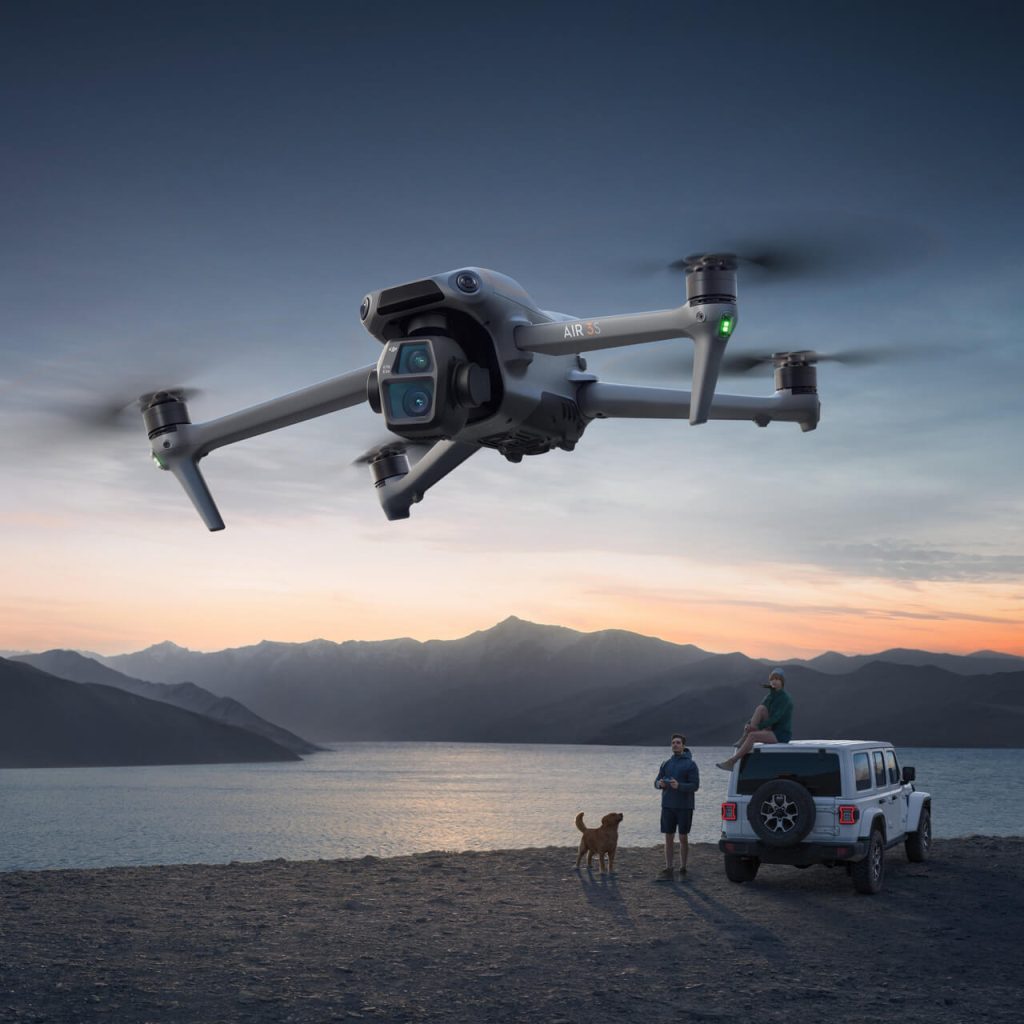
2. DJI Air 3S
Credit: DJI
The DJI Air 3S is a good step up for pilots who want stronger camera performance, reliable tracking, and more confidence when flying in complex environments.
It’s a solid fit for real estate, commercial video, Follow Me flying, and some inspection-style work where obstacle awareness matters but you don’t necessarily need a larger enterprise platform.
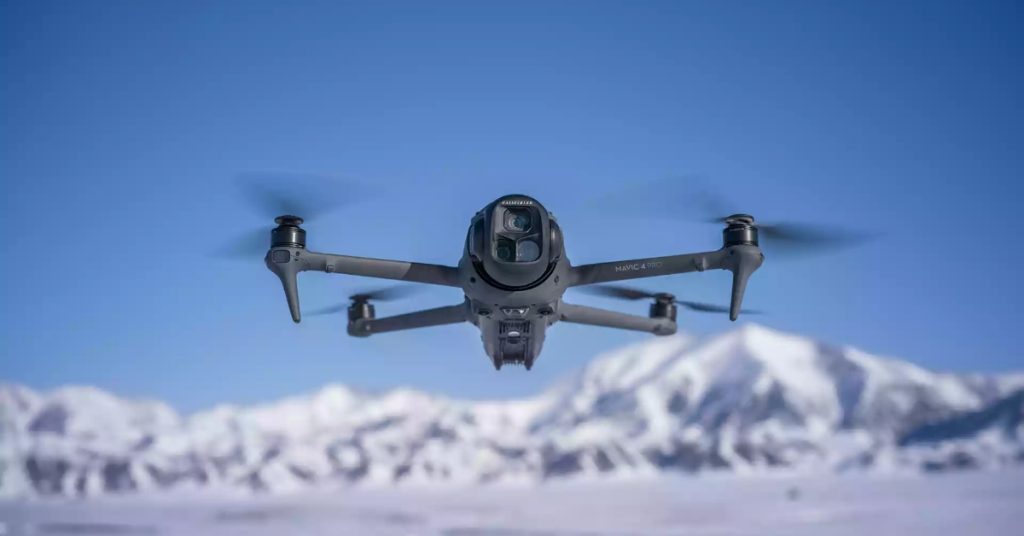
3. DJI Mavic 4 Pro
Credit: DJI
The DJI Mavic 4 Pro is the higher-end option for pilots who want advanced camera capabilities and more robust obstacle avoidance features.
For many recreational pilots, it will be more drone than they need. But for professional photo, video, and higher-stakes commercial work, it can make sense to pay for the added capability.
Types of Obstacle Avoidance Systems
Not all obstacle avoidance systems provide the same level of protection.
One of the biggest differences from one system to another is how many directions they can monitor. Understanding those differences can make it much easier to compare models and understand what you’re actually paying for.

Forward Obstacle Avoidance
Forward sensing systems monitor the area in front of the drone.
Because most pilots spend the majority of their flight time moving forward, this is often the first obstacle avoidance capability manufacturers add.
Forward sensing can help prevent collisions during normal flight, but it won’t protect against obstacles behind, above, beside, or below the aircraft.
Downward Sensing
Many drones include downward-facing sensors that help with positioning, landing, and low-altitude stability.
These systems aren’t primarily designed to prevent collisions with trees or buildings, but they can help the drone maintain awareness of the ground beneath it.
Downward sensing is common even on drones that have little or no obstacle avoidance in other directions.
Forward, Backward, and Downward Sensing
Many mid-range drones expand coverage beyond the front of the aircraft.
Adding rear and downward sensing provides additional protection during backing maneuvers, automated flight modes, and Return-to-Home operations.
For many recreational and commercial pilots, this level of coverage provides a good balance between capability and cost.
Omnidirectional Obstacle Avoidance
Omnidirectional systems monitor obstacles in multiple directions around the drone, including forward, backward, upward, downward, and often side-to-side movement.
This level of drone obstacle avoidance provides the highest level of situational awareness available on most consumer and prosumer drones.
Omnidirectional sensing is particularly useful for tracking modes, complex camera movements, and flights near structures where obstacles may approach from multiple directions.
Obstacle Avoidance Sensors: Vision, Infrared, LiDAR, and Radar
When manufacturers talk about obstacle avoidance, they’re really talking about a collection of sensors working together to help the drone understand its surroundings.
The specific technology varies from one drone to another, but most modern UAVs rely on some combination of RGB cameras, infrared sensors, LiDAR, and radar.
Here’s a quick overview:
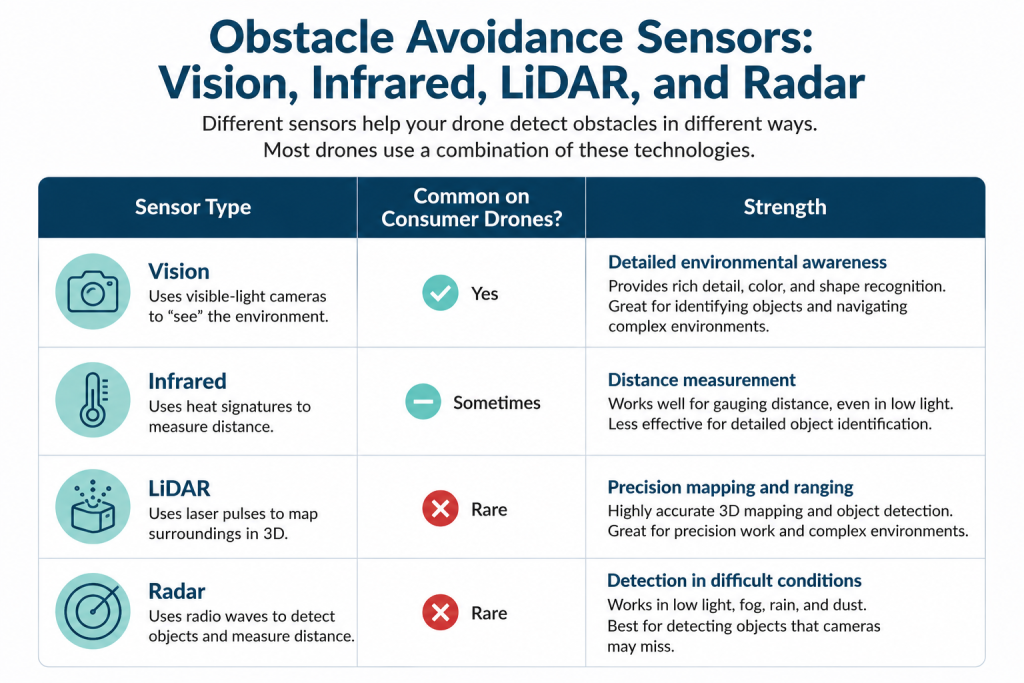
For most pilots, the important question isn’t which sensor the drone uses. It’s how well the overall system performs in the environments where they fly.
Here’s a closer look at each type:
Vision Sensors
Vision-based obstacle avoidance systems use cameras to identify and track objects around the drone.
This is the most common approach on consumer and prosumer drones because cameras are relatively lightweight, affordable, and capable of providing detailed environmental information.
When conditions are good, vision systems can be extremely effective. Their biggest limitations tend to appear in low-light conditions, poor visibility, or situations where obstacles are difficult to distinguish from the background.
Infrared Sensors
Some drones use infrared sensors alongside cameras to improve obstacle detection.
Infrared systems can help measure distance to nearby objects and provide additional information when visual data alone isn’t sufficient.
LiDAR
Drone LiDAR uses laser pulses to measure distances and create highly accurate representations of the surrounding environment.
Because LiDAR doesn’t rely solely on visible light, it can offer advantages in situations where traditional vision systems struggle.
While LiDAR has become increasingly important in mapping, surveying, and autonomous vehicle applications, it remains relatively uncommon on most consumer camera drones due to cost, weight, power requirements, and system complexity.
Radar
Radar uses radio waves rather than light to detect objects.
One advantage of radar is its ability to operate in conditions that may challenge vision-based systems, like low light/darkness, fog, dust, or precipitation.
Radar is becoming increasingly important in advanced aviation and detect-and-avoid applications, but it’s still far less common than vision-based obstacle avoidance on consumer drones.
Sensor Fusion
Many of the most capable systems combine multiple sensor types.
This approach, called sensor fusion, lets the drone compare information from different sources and make better decisions about potential obstacles.
Drone Obstacle Avoidance FAQ
Here are answers to some common questions about drone obstacle avoidance.
What is drone obstacle avoidance?
Drone obstacle avoidance is a safety feature that helps a drone detect and respond to obstacles in its environment. Depending on the aircraft, the system may warn the pilot, stop automatically, navigate around obstacles, or assist with automated flight functions such as Return-to-Home.
How does drone obstacle avoidance work?
Most obstacle avoidance systems use a combination of sensors and software to detect nearby objects and estimate their distance from the aircraft. Common sensor types include vision sensors, infrared sensors, LiDAR, and radar. The drone uses this information to identify potential collision risks and determine how to respond.
Can obstacle avoidance prevent all drone crashes?
No. Obstacle avoidance reduces risk, but it does not make a drone crash-proof.
Thin branches, power lines, wire fences, poor lighting conditions, reflective surfaces, and certain flight modes can all affect obstacle detection performance. Pilots should treat obstacle avoidance as a safety feature rather than a guarantee.
What obstacles can drones usually detect?
Most modern obstacle avoidance systems are effective at detecting larger objects such as trees, buildings, walls, vehicles, and utility poles.
Smaller hazards such as power lines, cables, fishing line, and thin branches are often more difficult for drones to detect consistently.
What is the difference between obstacle avoidance and Detect and Avoid?
Obstacle avoidance focuses on nearby objects such as trees, buildings, and other physical hazards around the drone.
Detect and Avoid (DAA) is a broader aviation concept that focuses on identifying and avoiding other aircraft while maintaining safe separation. The two terms are related but are not the same thing.
Do all drones have obstacle avoidance?
No. Many entry-level drones do not include obstacle avoidance, while others offer only limited forward-facing sensing.
Higher-end consumer and professional drones often include omnidirectional obstacle avoidance that monitors multiple directions around the aircraft.
Is obstacle avoidance worth paying extra for?
For many pilots, yes.
Obstacle avoidance can be particularly valuable when flying near structures, using Follow Me modes, capturing video, conducting inspections, or operating in unfamiliar environments. Pilots who primarily fly in wide-open spaces may place less value on advanced obstacle avoidance features.
What is the best type of obstacle avoidance system?
In general, omnidirectional obstacle avoidance provides the greatest level of protection because it can monitor obstacles in multiple directions around the aircraft.
However, the best system depends on how you fly. A drone with well-implemented obstacle avoidance that matches your use case is often a better choice than simply buying the drone with the most sensors.