DJI Neo 2 Launches Globally (But Not in the U.S.)
BY Zacc Dukowitz
13 November 2025DJI just launched the Neo 2 around the world—except in the U.S.
The Neo 2 came out in China a few weeks ago, and as of today you can buy it in most major regions, including Europe, Canada, Brazil, and parts of Asia.
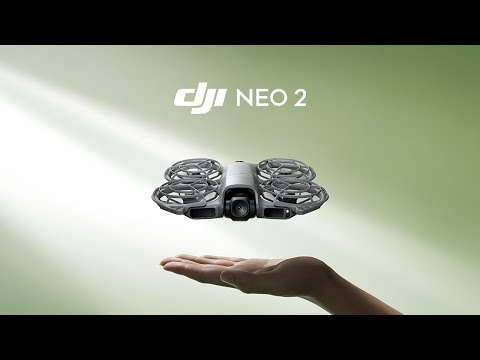
DJI has confirmed that, like the Mini 5 Pro and the Mavic 4 Pro, the Neo 2 will not be sold through its U.S. website or authorized U.S. retailers at launch, citing “evolving local conditions” and a tightening regulatory environment around Chinese-made drones.
The launch comes shortly before the looming December 23 DJI ban deadline. If the company hasn’t been formally audited by that date, it will automatically be banned in the U.S., according to guidelines established in the 2025 NDAA (a bill that funds federal defense).
[Note: Although the Mini 5 Pro and Mavic 4 Pro weren’t officially launched here, they’re both currently for sale on Amazon.]
Smart Follow-Me Power in a Palm-Sized Drone
Since the original Neo launched, DJI’s small follow-me drones have become a gateway for people who want to get high-quality aerial shots right away, without needing to master full-stick flying.
Credit: DJI
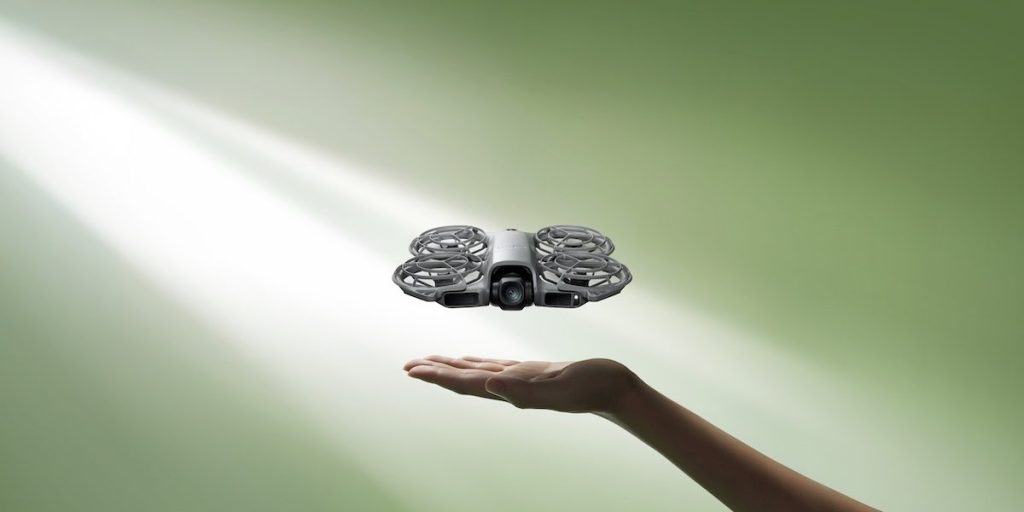
But the Neo 2 pushes that concept a lot further, turning the selfie drone category into a legit flying camera operator with much better safety, tracking, and image quality—all packed into a super-light .33 pound (151 gram) frame.
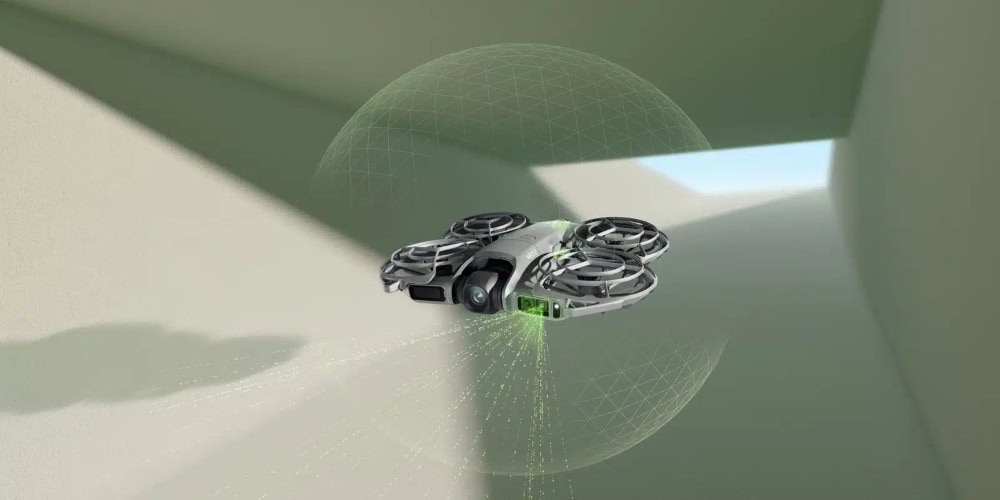
The biggest upgrade in the Neo 2 is the addition of LiDAR to support omnidirectional obstacle sensing, which also uses downward infrared sensors and front-facing vision sensors.
Thanks to this upgrade, the Neo 2 can see and avoid obstacles while following you from the front, side, or diagonals—something the original Neo couldn’t do.
DJI also redesigned how you interact with the drone:
- New self-flying capture modes. A small built-in display and dedicated mode buttons on the body let you pick capture modes without digging into your phone.
- New takeoff and landing options. Palm takeoff, palm landing, and the new Return to Palm feature make launching and recovering the Neo 2 more like tossing a ball than flying an aircraft.
On the creative side, the Neo 2 adds a 1/2″ 12MP camera on a 2-axis mechanical gimbal that shoots 4K/60 video by default, and slow-motion 4K/100 fps when paired with a remote.
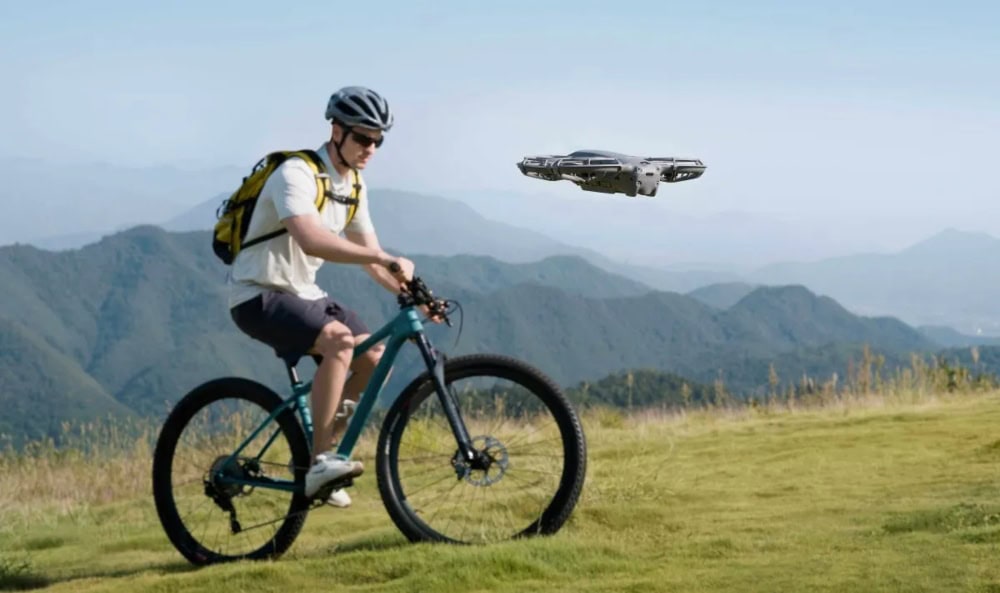
Combined with upgraded ActiveTrack that can follow runners and cyclists at up to 27 mph (12 m/s), it’s clearly built to keep up with real-world action instead of just casual walk-and-talks like the Neo.
Credit: DJI
Specs and Features for the Neo 2
The Neo 2 aims to be a “set it and forget it” flying camera—simple enough for first-time pilots, but with enough built-in quality to keep creators happy.
Here are its standout features:
- Camera. 1/2″ 12MP CMOS sensor with f/2.2 aperture and a high-performance image processor for sharp, low-noise footage.
- Video. Shoots 4K video up to 60 fps, with 4K/100 fps slow motion and vertical 2.7K recording when used with a compatible remote controller.
- Gimbal and stabilization. 2-axis mechanical gimbal paired with electronic stabilization to smooth out motion in wind and during fast tracking shots.
- Obstacle sensing. Omnidirectional system combining forward LiDAR, forward visual sensing, and downward infrared sensing to detect and avoid obstacles in real time.
- Tracking. Upgraded ActiveTrack with new Cycling mode, eight-direction tracking, and follow speeds up to 12 m/s for running, biking, and other fast-moving activities.
- Gesture and palm control. Palm takeoff and landing, Return to Palm, and gesture controls let you fly and frame shots without a traditional remote.
- Flight time. Up to 19 minutes of flight per battery in ideal conditions, with optional Fly More combos for extended sessions.
- Weight and portability. Weighs about 151 g with integrated prop guards, keeping it well under the 250 g threshold in regions where that matters for registration.
- Storage and connectivity. 49 GB of built-in storage plus Wi-Fi and optional O4 transmission (via Neo 2 Digital Transceiver) for app control, RC-N3/RC 2 remotes, and FPV-style flying with DJI Goggles and a Motion Controller.
Credit: DJI
Neo vs. Neo 2: Key Upgrades
DJI didn’t just tweak the Neo’s specs and rebrand it.
The Neo 2 is a noticeably more capable follow-me drone, especially if you’re moving fast or flying in wind and cluttered environments.
You get stronger tracking, better stabilization, more storage, and true omnidirectional obstacle sensing. And it still has the “toss it in a small bag and go” simplicity that made the original Neo appealing.
Here’s a side-by-side comparison showing what’s been upgraded in the Neo 2:
| Feature | DJI Neo 2 | DJI Neo |
|---|---|---|
| Weight | 151 g (with full prop guards) | 135 g |
| Camera & Sensor | 1/2″ 12 MP CMOS with updated processing | 1/2″ 12 MP CMOS, earlier-gen optics and processing |
| Max Video Resolution | 4K/60 fps standard, 4K/100 fps slow motion (manual flight) | 4K/30 fps |
| Gimbal & Stabilization | 2-axis mechanical gimbal (tilt + roll) plus electronic stabilization | 1-axis mechanical gimbal (tilt) with electronic stabilization |
| Flight Time | Up to 19 minutes (1,606 mAh battery) | Up to ~18 minutes (smaller pack) |
| Wind Resistance | Level 5 (up to ~10.7 m/s / 24 mph) | Level 4 (up to ~8 m/s / 18 mph) |
| Obstacle Sensing | Omnidirectional (vision sensors + forward LiDAR + downward IR) | Basic downward sensing only |
| Tracking & Follow Speed | ActiveTrack with new Cycling mode, up to 12 m/s (~27 mph) | Basic tracking, up to ~8 m/s (~18 mph) |
| Internal Storage | 49 GB (no microSD slot) | 22 GB (no microSD slot) |
| Control Methods | Palm control, gesture 2.0, voice, DJI Fly app, RC-N3/RC 2, Motion Controller + Goggles | Palm control, DJI Fly app, optional remote, basic gesture control |
Will I Ever Be Able to Get the Neo 2?
Short answer: if you’re in the U.S., it’s unlikely you’ll be able to buy the Neo 2 through official DJI channels any time soon.
Could you still get one? Maybe—but only by importing it yourself or buying from third-party marketplace sellers. (Or possibly through Amazon, though it’s not listed there right now.)
But even though DJI drones are temporarily back in stock, this is an uncertain time to invest in DJI technology, whether new or old. (Even old DJI drones could face a ban under new FCC rules.)
As we mentioned in the opening of this article, DJI is facing a potential nationwide ban next month.
And we don’t say this lightly. DJI is a mainstay of the commercial drone industry, and has helped build it up from infancy into a thriving sector of the economy.
If you’re determined to buy the Neo 2 or another DJI drone right now, we recommend sticking to these guidelines for buying from third-party sellers:
What to Know Before You Buy from Third-Party Sellers
- Not sold by DJI or official U.S. retailers. Current listings are typically from independent resellers, not DJI’s own store or authorized U.S. partners. Research the history and trustworthiness of any seller before you buy.
- Gray-market and import caveats. Many third-party listings are effectively imports, which can raise questions about where the drone was originally sold, how it was sourced, and what kind of support you’ll get if something goes wrong.
- Region-locked warranty. DJI warranties—and DJI Care Refresh—are tied to the purchase region, so U.S. service may be denied if the drone was originally sold in another market.
- Regulatory uncertainty. With possible U.S. restrictions or bans on new DJI imports on the horizon, future repairs, parts, or replacements could become harder to get for gray-market units.
- Policies vary by seller. Return windows, restocking fees, and support options are set by each storefront, not DJI, so always read the fine print before checking out.