DJI FlyCart 100 Launches Globally—Except for the U.S.—With Whopping 220 Pound Payload Capacity
BY Zacc Dukowitz
11 December 2025After years of development and several regional pilots, DJI has officially launched the FlyCart 100.
The 100 is a rugged, heavy-lift delivery drone that carries up to 220 pounds (100 kg) and can fly for up to 40 minutes with lighter loads.

The FlyCart 100 isn’t DJI’s first delivery drone—that title belongs to the FlyCart 30.
But the FlyCart 30 was released in China first, then rolled out to other regions. In contrast, the 100 is being launched globally, making it DJI’s first fully standardized drone for long-range logistics that was launched everywhere.
Er—almost everywhere. As of right now, it looks like the FlyCart 100 isn’t yet for sale in the U.S. However, it may soon be available through resellers.
A Heavy-Lift Drone Built for Real-World Logistics
In dangerous or remote areas, helicopters and trucks have always been the only options for transportation. Neither option is ideal—they’re both big, bulky, and expensive.
The FlyCart 100 presents a new option, with DJI touting it as a practical “drone truck” that can replace short-haul ground or air routes.
With up to 220 pounds of lift, the 100 is designed to carry serious weight, making it a solid solution for a range of work like construction supply runs, mountain rescues, powerline and tower maintenance, and on-demand rural deliveries.
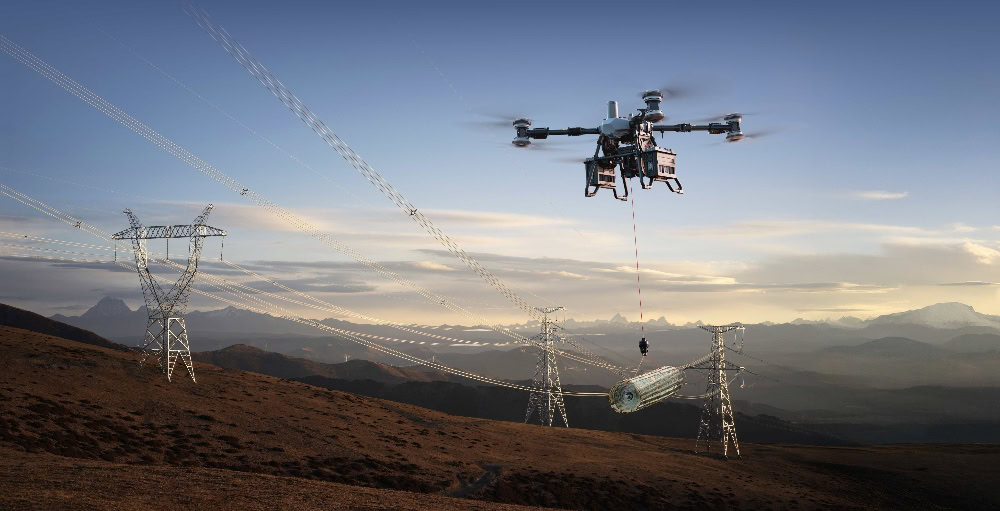
Credit: DJI
Specs and Features for the FlyCart 100
Here are the FlyCart 100’s standout capabilities:
- Payload capacity. Up to 220 pounds (100 kg) with dual batteries.
- Battery life. Up to about 18 minutes with a full payload and up to 40 minutes with no payload, depending on weight and conditions.
- Range. Up to 12.4 miles (20 km) with a full payload; significantly farther with lighter loads.
- Flight modes. Tilting rotor design for hybrid VTOL + efficient forward flight.
- Cargo options. Sealed cargo box and integrated winch system.
- Safety and redundancy. Dual-battery system, ADS-B, multi-sensor obstacle awareness, integrated parachute system, and fault-tolerant flight control.
- Transmission. DJI O3 Enterprise with enhanced interference resistance and long-range HD link.
- Weather performance. IP 55-level protection designed for harsh environments, including wind, cold, and wet conditions.
- Software ecosystem. Compatible with DJI Pilot 2, FlightHub 2, and enterprise route-planning tools.
Heavy-Lift Delivery Without the Complexity
Most heavy-lift drones today require significant customization—external winches, custom mounting plates, third-party flight controllers, or mission-specific software setups.
The FlyCart 100 is the opposite of that.

Credit: DJI
DJI built the drone so operators can run real logistics missions on day one, without needing to engineer their own delivery system.
Here are the features that simplify heavy-lift aerial transport with the FlyCart 100:
- Smart, sealed cargo box. The removable box automatically monitors weight, temperature, and locking status, giving operators full visibility into the load during flight.
- Automated winch delivery. The powered winch lowers payloads with centimeter-level precision, auto-stabilizes during descent, and monitors tension in real time—no manual rigging required.
- No-landing delivery option. Deliver supplies directly to cliff sides, towers, or disaster zones without putting the aircraft at risk.
- Tilt-rotor efficiency. Hybrid vertical and forward-flight capability gives long-range performance with the stability needed for heavy lifting.
- Built-in safety stack. Dual batteries, multi-sensor obstacle awareness, fault-tolerant flight control, and an integrated parachute system create layers of protection for high-risk missions.
- Simple mission workflows. DJI Pilot 2 and FlightHub 2 support route planning, fleet management, load verification, and delivery records—all within DJI’s enterprise software ecosystem.
Combined, these tools make the FlyCart 100 a practical logistics platform, not just a powerful drone, with the 100 taking care of the technical details so teams can just focus on moving supplies.
FlyCart 100 vs. FlyCart 30: Key Differences
DJI built the FlyCart 100 on lessons learned from the FlyCart 30, scaling up payload capacity and adding a more capable safety and sensing stack for tougher missions.
Big picture, the FlyCart 100 doubles down on payload and safety, and is positioned as the more scalable choice for operators who want a standardized heavy-lift platform for demanding logistics work.
Here’s a side-by-side comparison:
| Feature | DJI FlyCart 100 | DJI FlyCart 30 |
|---|---|---|
| Max payload (dual battery) | Up to 187 lbs (85 kg) | Up to 66 lbs (30 kg) |
| Max payload (single battery) | Up to 220 lbs (100 kg) | Up to 88 lbs (40 kg) |
| Typical delivery range with full payload | Up to ~7.5 miles (12 km) with a heavy load* | Up to ~10 miles (16 km) with a 66 lb (30 kg) payload |
| Payload systems | Standardized cargo box + flagship winch system | Cargo box + winch system (earlier-generation implementation) |
| Sensing & safety | Integrated parachute, LiDAR, millimeter-wave radar, multi-directional vision, enhanced safety suite | Enterprise-grade safety with ADS-B and obstacle sensing (lighter sensing stack overall) |
| Flight architecture | Tilt-rotor design for efficient forward flight and long-range delivery | Conventional multirotor layout optimized for delivery missions |
| Market positioning | Global heavy-lift logistics platform launched through DJI Delivery dealers | Earlier heavy-lift delivery platform, rolled out regionally and in pilot programs |
*Ranges are approximations, and vary depending on factors like configuration, weather, wind, and payload weight.
Who Is the FlyCart 100 For?
The FlyCart 100 isn’t aimed at everyday drone pilots—it’s built for teams that move heavy loads where traditional vehicles struggle.

Credit: DJI
Here’s who will get the most value from it:
- Utility and telecom crews. Deliver tools, replacement parts, and hardware to powerlines, towers, and remote infrastructure without sending extra climbers or support vehicles.
- Construction and infrastructure firms. Move materials around large or hard-to-access job sites, especially where roads, slopes, or terrain slow down trucks.
- Mining and industrial operators. Transport tools, samples, and critical components across pits, plants, and remote facilities safely and on demand.
- Emergency responders and disaster relief teams. Get medical supplies, food, or equipment into areas cut off by floods, landslides, or damaged roads.
- Mountain and remote-access specialists. Support mountaineering, remote research stations, and high-altitude work sites where helicopters are expensive or unavailable.
For these use cases, the FlyCart 100 isn’t just a new aircraft. It’s a way to rethink how short-haul logistics get done in places where trucks and helicopters are slow, risky, or too expensive to justify.
Will You Be Able to Buy the FlyCart 100?
Though DJI has launched the FlyCart 100 globally, it has explicitly said that it won’t be available in the U.S. for the time being. But it could be sold through U.S. resellers at some point down the road, as the FlyCart 30 and other enterprise drones from DJI are.
Complicating things further, DJI is facing a potential U.S. ban on new product approvals tied to the December 23 FCC “Covered List” deadline.
This is all to say that there is a lot of uncertainty about the future. For now, all we know is that the FlyCart 100 is only available in non-U.S. markets.