What New Skydio and DJI Reports Reveal About the Future of DFR
BY Zacc Dukowitz
15 July 2026For years, one of the biggest questions surrounding Drone as First Responder (DFR) programs was whether they could scale beyond a handful of pioneering agencies.
Two new reports—one from Skydio and one from DJI—make it clear that conversation is changing.
- Skydio has announced that it’s deployed more than 1,000 autonomous drone docks in just over a year.
- DJI has published a white paper focused on how agencies are building successful DFR programs around dock-based systems.

Taken together, the reports point to a broader shift.
Instead of asking whether dock-based DFR programs can work, agencies are increasingly focused on how to deploy them effectively—integrating drones with dispatch systems, developing repeatable workflows, and using aerial intelligence to support responding officers before they arrive on scene.
To put it another way, using the crawl-walk-run progression often associated with emerging technologies, DFR programs have now moved from crawling to walking.
And that is a remarkable thing given how complicated DFR programs are, and how much regulatory and technical complexity you have to navigate to run one.
What Is a DFR Program?
A Drone as First Responder (DFR) program uses drones to respond to emergency calls before—or alongside—police, fire, or EMS personnel. The goal is to provide dispatchers and first responders with live aerial video as quickly as possible, helping them assess the situation before arriving on scene. Today, many DFR programs rely on drone-in-a-box systems, which keep drones charged, protected, and ready to launch automatically when needed.
Skydio’s Milestone Shows DFR Is Moving Beyond Pilot Programs
Skydio’s latest deployment numbers provide strong evidence that DFR programs are maturing.
Just over a year after shipping its first docks, Skydio says customers are using them at a scale that would have been hard to imagine just a few years back.
The Numbers Behind the Milestone
| Skydio’s First-Year Dock Milestone | |
|---|---|
| Production docks deployed | 1,070 |
| Countries | 3 |
| Autonomous flights | 4+ million |
| Primary sectors | Public safety, critical infrastructure, defense |
According to Skydio, these figures represent the largest deployment of an autonomous robotic flight system performing repeatable work for commercial and government organizations in the U.S. to date.

The Skydio X10 and Skydio Dock | Credit: Skydio
What the Numbers Mean
By themselves, those numbers don’t prove that dock-based DFR has become commonplace. But they suggest that organizations are moving beyond small-scale pilot programs and starting to incorporate autonomous docks into routine operations.
Just as importantly, Skydio’s announcement focuses less on the dock itself and more on what customers are actually doing with it:
- Police departments operating DFR programs
- Utilities performing routine infrastructure inspections
- Defense organizations monitoring facilities
In each case, the dock isn’t the end goal. Instead, the dock is providing the infrastructure that makes these operations possible.
That’s an important shift, because early discussions about drone docks often centered on the technology itself. Could the system launch reliably? Could it withstand the weather? Could it recharge quickly between flights?
Now, we’re talking about real use cases, with millions of real flights conducted in the field.
DJI’s White Paper Shifts the Focus From Hardware to Operations
Skydio’s 1,000-dock deployment milestone suggests that dock-based DFR is gaining traction. DJI’s new white paper helps explain why.
Rather than requiring a pilot to drive to an incident and launch a drone manually, drone-in-a-box systems keep a drone positioned, charged, and ready to fly. When integrated with a DFR program, they allow a drone to launch automatically in response to a call, often arriving at the scene while officers are still en route.
In a traditional response, officers head to the scene with only the information provided by the caller. In a dock-based DFR program, a drone may already be overhead by the time the first patrol car arrives, giving dispatchers and officers a live view of what’s actually happening.
DJI says agencies using dock-based systems have reported significantly faster response times, because drones can launch almost immediately after a call is dispatched.
Also, mature DFR programs can allow experienced remote pilots to oversee multiple dock locations under established operating procedures, making more efficient use of available personnel.
And that’s the operational shift DJI’s white paper is focused on: how agencies are actually incorporating dock-based drones into their emergency response workflows.
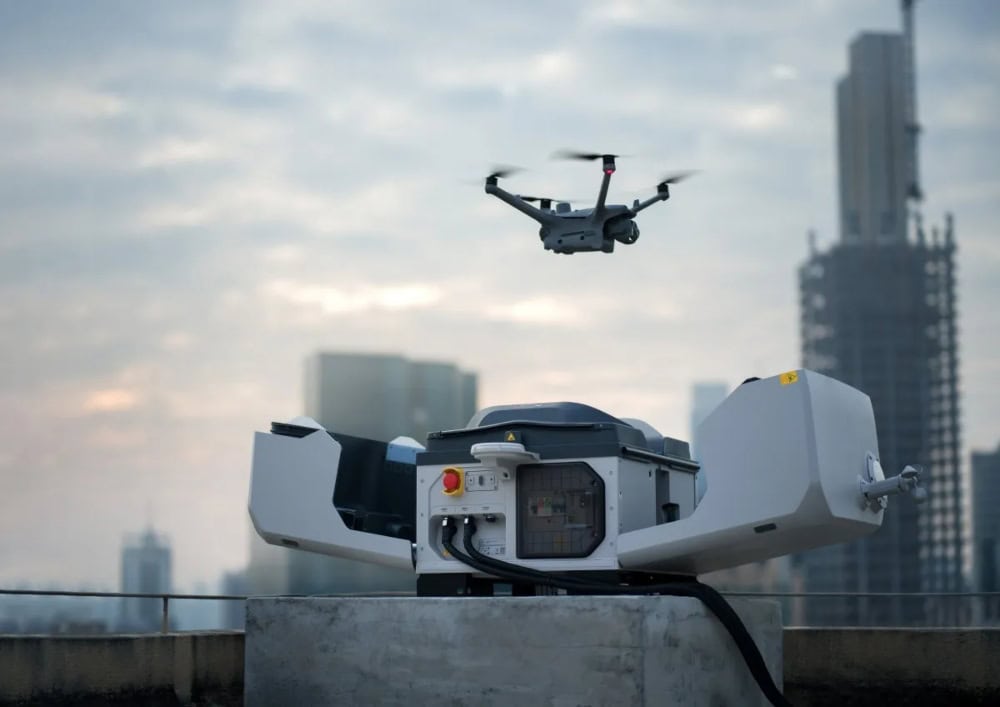
The DJI Dock 3 and the DJI Matrice 4D | Credit: DJI
What Successful DFR Programs Have in Common
According to DJI, successful DFR programs depend on a lot more than just buying a drone dock.
In the white paper, DJI lists these operational building blocks to help agencies create sustainable programs:
- Standard operating procedures (SOPs) for routine missions
- Integration with computer-aided dispatch (CAD) and other public safety systems
- Trained remote pilots and clear operational roles
- Repeatable launch, response, and recovery workflows
- Fleet management tools that support multiple dock locations
Instead of treating each flight as a standalone mission, DJI recommends that agencies build repeatable processes that deliver aerial intelligence consistently across hundreds—or even thousands—of emergency calls.
Taken together, these elements represent a transition from simply flying drones to building an operational capability that can support emergency response day after day.
What Comes Next for DFR
DFR programs are still far from commonplace.
Building a successful program requires more than just installing a drone dock. Before a program can operate successfully, agencies have to navigate FAA requirements, develop operating procedures, train remote pilots, and integrate drones with existing dispatch and public safety systems.
That’s what makes these two reports so significant.
Skydio has provided evidence that agencies are deploying dock systems at meaningful scale, while DJI is offering a glimpse into what those agencies are learning as their programs mature.
Together, the two reports suggest the industry is entering a new phase—one focused less on proving the technology works, and more on using it effectively.