VTOL Drones: An In-Depth Guide [New for 2026]
BY Zacc Dukowitz
23 January 2026VTOL drones—short for Vertical Take-Off and Landing drones—are a fast-growing category of UAV that combine the hovering ability of multirotors with the range and efficiency of fixed-wing aircraft.
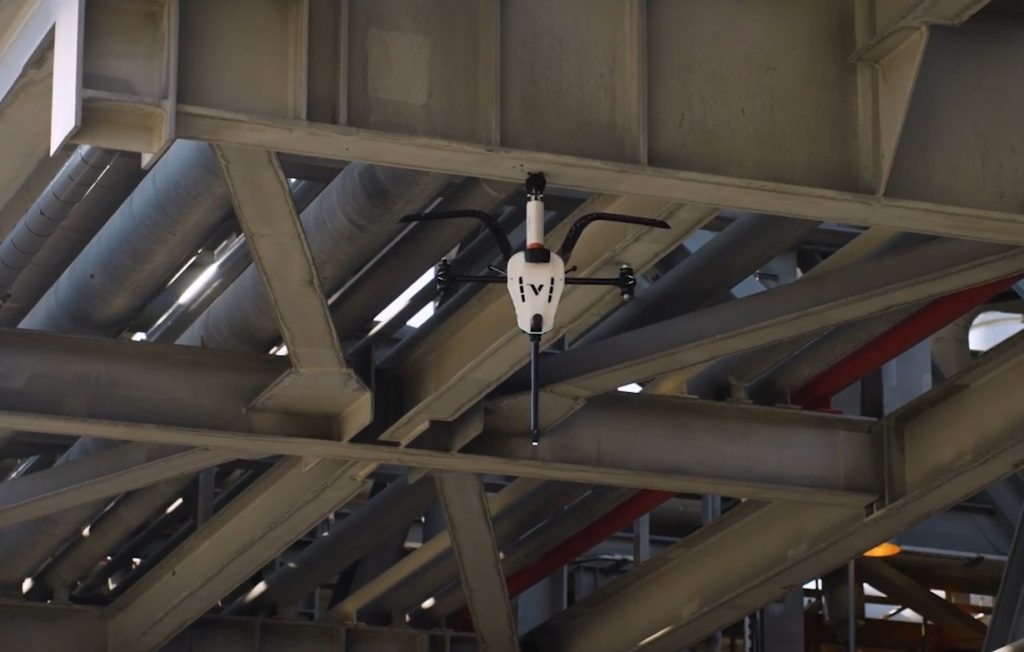
The Voliro T VTOL drone is made for industrial inspections
Traditional drones require horizontal space to launch. But VTOL drones can take off and land vertically, then move horizontally once airborne, making them a good option when flying in tight spaces.
Today, VTOL technology is being adopted in industries as diverse as agriculture, energy, logistics, and defense. Companies use VTOL drones for high-precision surveys in places where launch space is limited, for long-range deliveries in rural areas, and for intelligence-gathering missions where endurance and flexibility are critical.
In this guide, we’ll take a closer look at the top VTOL drones on the market, how VTOL drones work, and how they’re being used.
Here’s a menu in case you’d like to jump around:
- Top VTOL Drones of 2026
- What Is a VTOL Drone?
- 7 Benefits of VTOL Drones
- How VTOL Drones Work
- VTOL Drone Types and Classifications
- Top 8 Applications for VTOL Drones
- VTOL Drones FAQ
Top VTOL Drones of 2026
Here are the top VTOL drones out there right now, with their type and target use cases listed to help you find what you’re looking for.
1. WingtraOne Gen II
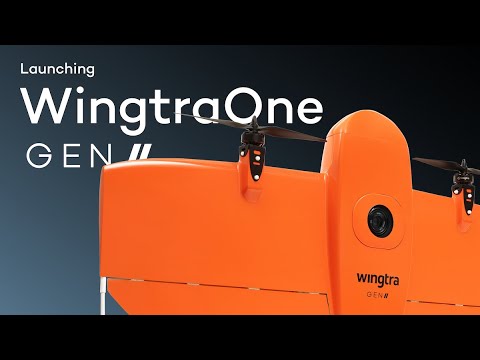
Type: Fixed-Wing VTOL Drone
The WingtraOne Gen II is a professional fixed-wing VTOL known for strong performance in surveying and mapping.
Combining the efficiency of a fixed-wing design with the versatility of vertical takeoff and landing, the WingtraOne Gen II is made for industries requiring high-precision data collection over large areas.
Top Use Cases:
- Land surveying and topographic mapping
- Environmental monitoring
- Construction site planning
- Mining and quarry analysis
Key Specs:
- Flight time. Up to 59 minutes
- Payload capacity. Up to 1.7 pounds (800g)
- Camera options. Sony RX1R II, Sony Alpha, multispectral cameras
- Range. 6.2 miles (10km)
Learn more about the WingtraOne Gen II.
2. Quantum Systems Trinity Pro

Type: Fixed-Wing VTOL Drone
The Trinity Pro from Quantum Systems is a long-endurance fixed-wing VTOL drone built for large-scale mapping missions. With a highly modular design and AI-ready onboard computing, it supports a wide range of sensors and mission profiles.
Top Use Cases:
- Corridor mapping and utility inspections
- Agricultural monitoring
- Large-area LiDAR and photogrammetry
- Defense and government applications
Key Specs:
- Flight time. Up to 90 minutes
- Maximum Take-Off Weight. 12.68 lbs (5.75 kg)
- Camera options. Sony RX1R II, Sony UMC-R10C, MicaSense RedEdge-P, MicaSense Altum PT, Oblique D2M, Qube 240 LiDAR
- Range. 3-4.7 miles (5-7.5km)
Learn more about the Trinity Pro.
3. Autel Dragonfish Pro
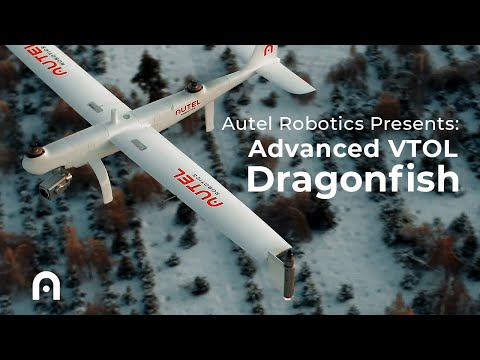
Type: Fixed-Wing VTOL Drone
The Autel Dragonfish Pro is a high-end VTOL drone designed for long-range industrial and public safety operations. Its tilt-rotor design enables smooth transitions between vertical and horizontal flight, making it a solid option for a range of professional missions.
Top Use Cases:
- Surveillance and law enforcement
- Search and rescue
- Infrastructure inspections
- Environmental protection and marine patrol
Key Specs:
- Flight time. Up to 180 minutes
- Payload capacity. 3.3 pounds (1.5 kg)
- Camera options. Multispectral, dual thermal/visual, and zoom optics
- Range. Up to 18.6 miles (30km)
Learn more about the Autel Dragonfish Pro.
4. Voliro T

Type: Multirotor VTOL Drone
The Voliro T is a unique multirotor VTOL drone engineered for industrial inspections, especially in challenging environments. It features rotating thrusters that allow for six degrees of freedom, making it exceptionally maneuverable around vertical and overhead surfaces.
Top Use Cases:
- Ultrasonic thickness testing (UT)
- Non-destructive testing (NDT) in confined spaces
- High-precision structural inspections
- Indoor and offshore asset assessments
Key Specs:
- Flight time. 10-14 minutes depending on payload
- Payload capacity. 2.2 lbs (1 kg)
- Sensor options. Proprietary UT, EMAT, LPS, PEC, and DFT payloads
- Range. 984 feet (300 m)—designed for close-proximity, high-precision work
Learn more about the Voliro T.
5. FIXAR 007
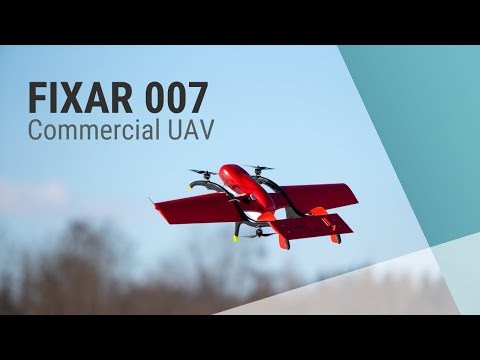
Type: Fixed-Wing VTOL Drone
The FIXAR 007 is a fully autonomous VTOL drone designed for both commercial and industrial use. Its closed-frame design and simplified operation make it well-suited for teams that need a reliable mapping and data collection tool with minimal setup.
Top Use Cases:
- Mapping and surveying
- Energy and utility inspections
- Agricultural analysis
- Infrastructure monitoring
Key Specs:
- Flight time. Up to 60 minutes
- Payload capacity. Up to 4.4 pounds (2kg)
- Camera options. RGB, LiDAR, multispectral
- Range. Up to 37 miles (60km)
Learn more about the FIXAR 007.
What Is a VTOL Drone?
A VTOL drone is a UAV that can take off and land vertically—hence the name (Vertical Takeoff and Landing).
This means VTOL drones don’t need runways, catapults, or large open areas to get airborne.
Instead, they lift off the ground like a helicopter, transition into forward flight like an airplane, and then land vertically again when the mission is complete.
To understand what makes a VTOL drone unique, it helps to compare it to the two most common drone types: fixed-wing and multirotor. Fixed-wing drones are efficient for long-distance flights, but they need a runway or launcher to take off and typically require space to land.

Zipline’s fixed-wing delivery drone
Multirotor drones, like the familiar quadcopters used in aerial photography, can hover and land vertically but are limited in range and endurance due to their constant energy draw.
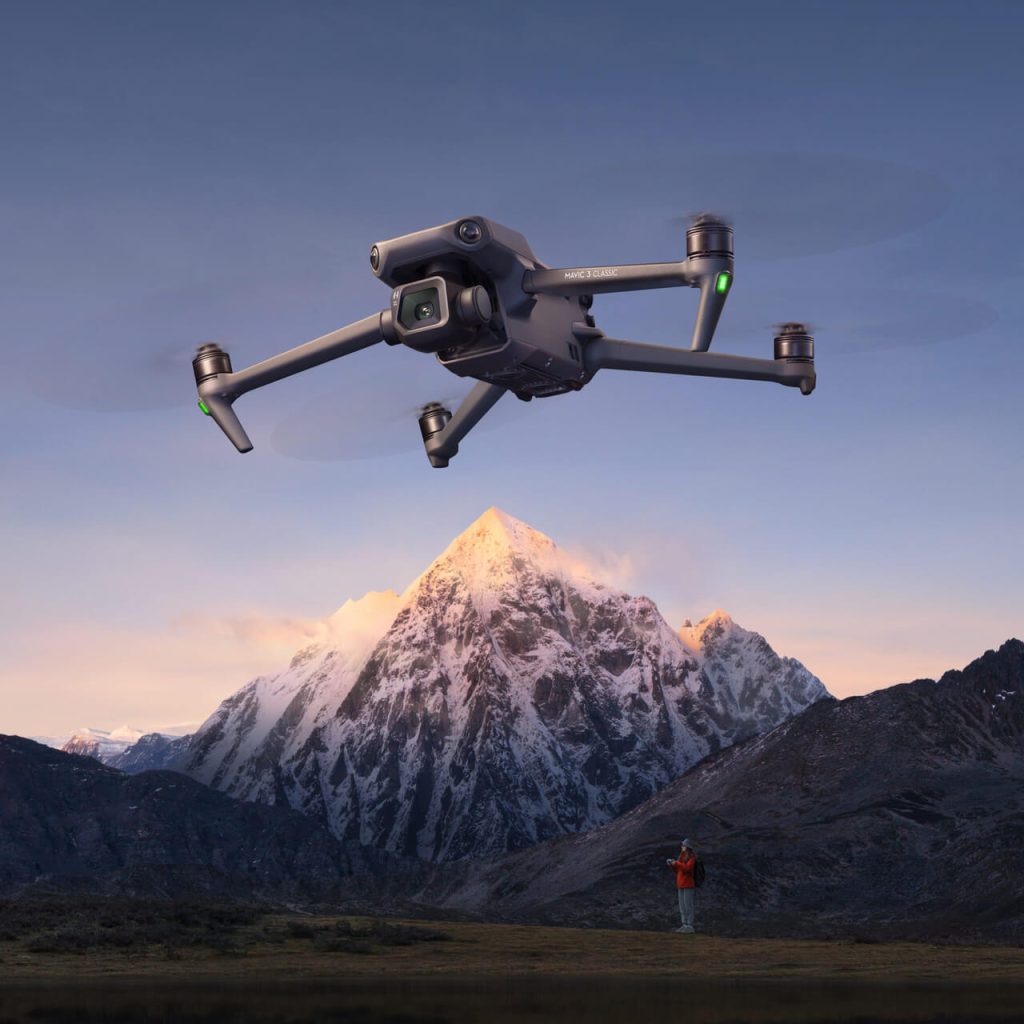
DJI’s Mavic 3 Pro quadcopter
VTOL drones combine the best of both designs.
They can hover like a multirotor, then transition to fixed-wing flight for greater range and efficiency. This hybrid capability makes them incredibly versatile, especially for missions where space is limited but coverage requirements are large.
There are two main subtypes of VTOL drones:
- Multirotor VTOLs. These look similar to quadcopters but are designed for extended forward flight.
- Fixed-wing VTOLs. These use tilt-rotor systems or tail-sitter designs to switch between vertical lift and horizontal flight. These fixed-wing variants are especially popular in mapping, surveying, and long-range delivery missions.
7 Benefits of VTOL Drones
VTOL drones offer a unique hybrid flight capability that brings together the strengths of both multirotor and fixed-wing systems.
This combination lets drone pilots take on more complex missions with fewer logistical constraints.
Here are seven key benefits VTOL drones provide over other types of drones:
1. No need for runways or external launch equipment
VTOL drones take off and land vertically, which eliminates the need for runways, catapults, or net recovery systems.
This makes them ideal for remote, confined, or unprepared environments where traditional fixed-wing drones simply can’t operate. Deployment is faster, safer, and more flexible across a wide range of terrain.
2. Longer range and endurance compared to multirotors
Once airborne, many VTOL drones transition to efficient fixed-wing flight, reducing power consumption and dramatically extending range and endurance.
While a typical quadcopter might fly for 20–30 minutes, some VTOL platforms can stay aloft for over 90 minutes and travel dozens of miles, making them ideal for covering large areas in a single mission.
3. Ability to hover and land in tight or remote areas
Unlike fixed-wing drones, VTOLs retain the ability to hover.
This is crucial for operations that require precise positioning, like infrastructure inspections, vertical asset mapping, or precision deliveries. The ability to land vertically also means they can operate safely in locations without a clear landing strip.
4. Ideal for complex operations like mapping, delivery, and inspection
With their dual-mode flight capabilities, VTOL drones are well-suited for applications that call for both endurance and versatility.
Whether you’re mapping a pipeline corridor, delivering supplies to an isolated village, or inspecting a communications tower, VTOL platforms can adapt to mission needs in a way other drones can’t.
5. Reduced operational footprint and personnel requirements
Because VTOL drones don’t require launch equipment or large takeoff areas, they typically need fewer ground crew members and less setup time.
This reduced footprint means less operational complexity and costs, making VTOLs easier to integrate into regular workflows, especially for organizations scaling up drone operations.
6. Greater safety in dynamic or unpredictable environments
VTOL drones can abort landings or shift flight modes mid-mission if weather conditions change or you detect obstacles in the air.
This adaptability adds a margin of safety that’s often missing from fully fixed-wing aircraft, which need a committed glide path and can’t hover or reverse course as easily.
7. High ROI for organizations with varied mission profiles
Because VTOL drones can perform a wide variety of tasks—often replacing the need for separate multirotor and fixed-wing platforms—they often offer strong return on investment.
A single VTOL system can handle multiple job types, reducing equipment costs and streamlining training across teams.
How VTOL Drones Work
A VTOL drone is designed to combine the best of both multirotor and fixed-wing flight.
It takes off and lands vertically, like a helicopter, then transitions into horizontal forward flight, like an airplane. This hybrid approach is what makes VTOL drone design so effective for missions that require long-range travel without the luxury of a runway.
How It Works
During vertical takeoff, the drone uses rotors oriented downward to lift off the ground.
Once airborne, it transitions into cruising mode, where lift is generated by fixed wings and propulsion comes from either tilted rotors or additional motors designed for forward thrust.
The drone then reverts to vertical flight mode to land in confined spaces or terrain that’s difficult to access.
Hovering is typically used for takeoff, landing, and tasks that require precise positioning, like deliveries or inspections. Cruising is reserved for longer legs of a mission, where the drone can fly more efficiently using aerodynamic lift and glide-like dynamics.
Different VTOL drones use different flight architectures to achieve this:
- Tilt-rotor systems rotate their propellers to change direction of thrust.
- Tail-sitter designs launch vertically and rotate forward in flight.
- Lift-and-cruise drones have separate propulsion systems—rotors for takeoff and landing, and fixed motors for cruising.
VTOL Drone Design: Key Features and Tradeoffs
VTOL drone design requires a careful balance of components, performance, and mission needs.
Each design decision involves tradeoffs that impact how the drone flies, what it can carry, and where it can operate.
Here are some of the most important design factors to consider:
1. Lift and Propulsion Systems
VTOL drones typically use one of three propulsion strategies: dual-motor setups (separate motors for vertical and forward flight), tilt-rotors (motors that rotate mid-air), or shared propulsion systems that handle both phases. Each option comes with tradeoffs in complexity, efficiency, and maintenance.
2. Flight Controller Complexity
Switching between vertical and horizontal flight modes is no simple task. VTOL drones rely on sophisticated flight controllers that manage timing, motor transitions, and onboard stabilization. This complexity adds to development and testing requirements—especially for drones used in commercial or regulated environments.
3. Energy Consumption and Battery Life
Hovering consumes significantly more power than cruising. VTOL drones must carefully manage energy use between both flight phases to avoid depleting batteries mid-mission. Battery life can be further affected by payload weight, wind conditions, and mission duration.
4. Payload Capacity Limitations
VTOL drones can often carry more than a multirotor, but they generally fall short of the lift capabilities of fully fixed-wing aircraft. While this may limit sensor or cargo options, many operators find the tradeoff worthwhile—especially when vertical landing and hover capabilities are mission-critical.
VTOL Drone Types and Classifications
Not all VTOL drones are built the same.
Depending on the mission, some are designed for long-range mapping, others for precise inspections in tight spaces, and some for heavy-duty industrial or defense operations.
In this section, we’ll cover the three main types of VTOL drones—fixed-wing, multirotors, and hybrids—and look at how each type is used in the real world.
VTOL Fixed Wing Drones
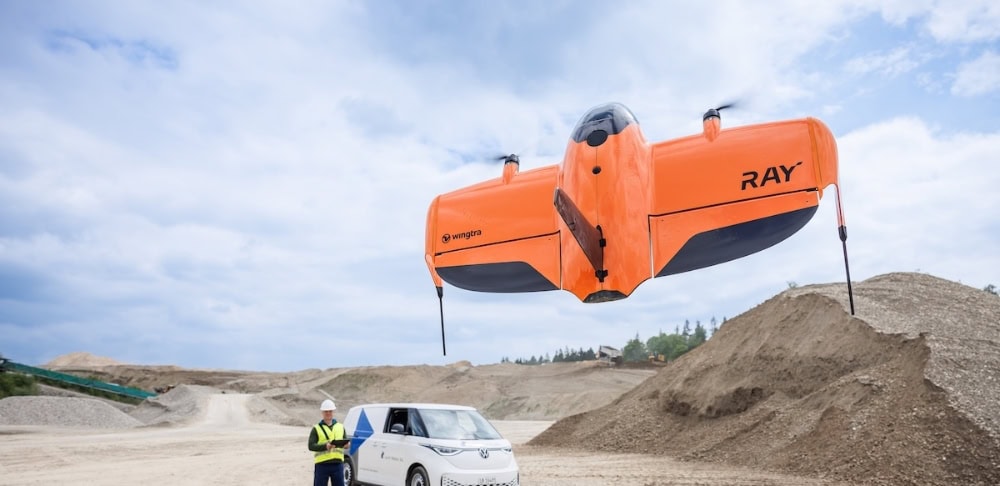
Wingtra’s WingtraRay fixed wing VTOL
A VTOL fixed wing drone is a hybrid aircraft that combines the vertical lift of a multirotor with the forward flight efficiency of a fixed-wing platform.
These drones can take off and land vertically, then transition into fixed-wing flight for longer-range missions. Because they don’t need a runway, they’re ideal for operations in remote or rugged environments.
The biggest advantages of a VTOL fixed wing drone are range and energy efficiency. By relying on aerodynamic lift during cruising flight, these drones can cover far greater distances and stay airborne longer than traditional multirotors—often with heavier payloads.
Multirotor VTOL Drones
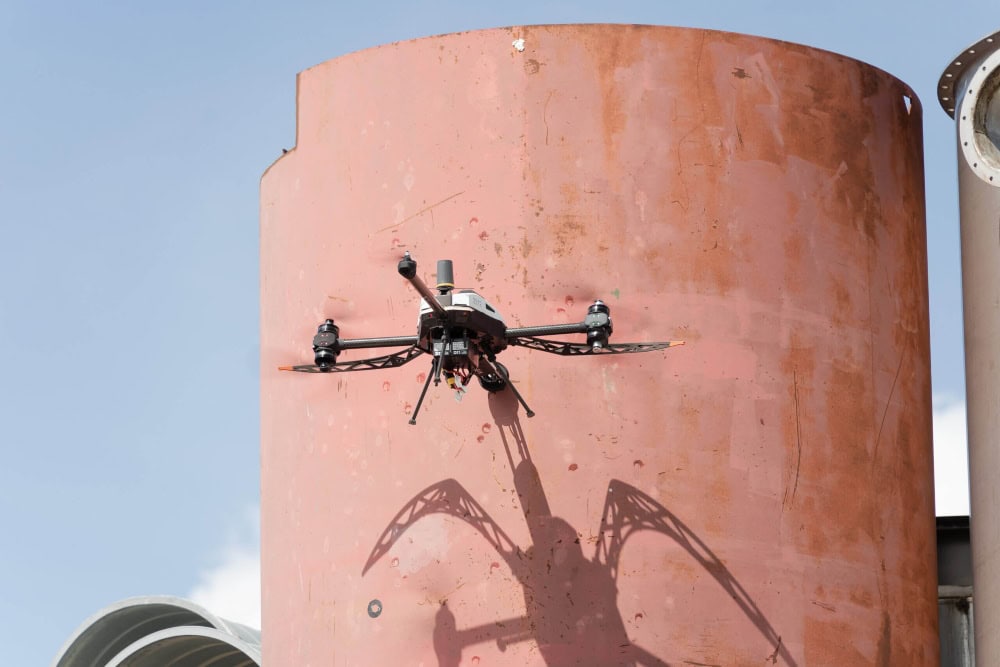
Voliro’s Voliro T multirotor VTOL
Multirotor VTOLs are drones that look and behave like traditional quadcopters but are enhanced for forward flight and longer missions.
Unlike fixed-wing VTOLs, these drones don’t have wings—they rely entirely on rotors for both lift and propulsion, but are often engineered to support smoother, more efficient horizontal flight.
These drones excel in hover performance and precision maneuverability, making them perfect for missions that require stable positioning or operation in confined areas. Common use cases include last-mile delivery, utility inspections, construction monitoring, and tactical response in urban environments.
Hybrid VTOL Drones
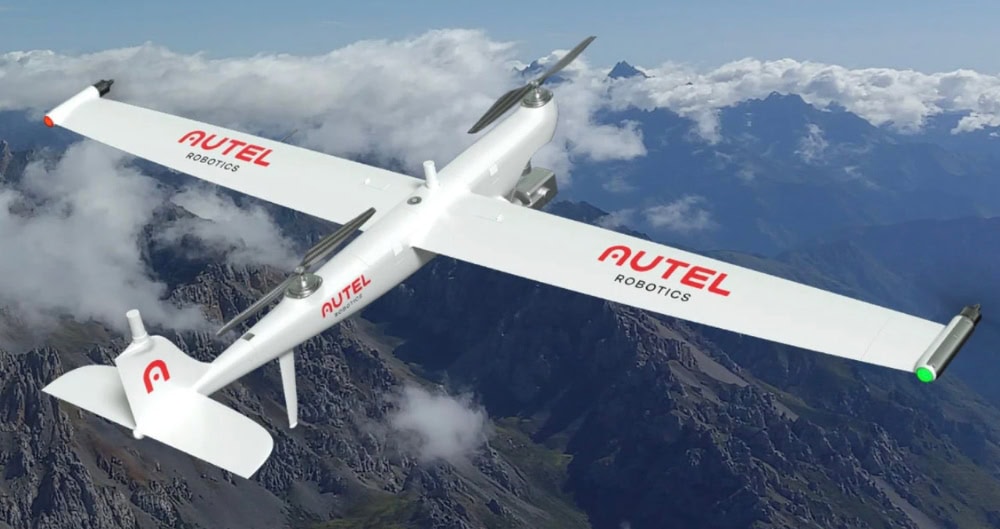
Autel’s Dragonfish hybrid VTOL
Hybrid VTOL drones combine the strengths of both fixed-wing and multirotor designs to deliver unmatched versatility and performance.
They’re equipped with vertically oriented rotors for vertical takeoff, hovering, and landing, but transition seamlessly into fixed-wing mode with aerodynamic wings for efficient long-distance flight and extended endurance.
This dual-flight capability allows hybrid VTOLs to operate in confined or rugged takeoff/landing zones without sacrificing range or flight time.
Top 8 Applications for VTOL Drones
VTOL drones are quickly becoming a go-to solution across industries that need both flexibility and range.
Their ability to take off and land vertically combined with the efficiency of fixed-wing flight makes them uniquely suited for complex, real-world missions.
Here are the top applications for VTOLs:
1. Surveying & Mapping
VTOL drones have transformed the field of geospatial data collection, offering the unique ability to perform vertical takeoff and landing in confined areas while efficiently covering huge expanses in fixed-wing mode.
They’re widely used by surveyors, urban planners, and environmental scientists to acquire high-resolution aerial data with rapid deployment, even in remote or rugged landscapes where traditional aircraft and ground vehicles struggle.
Top VTOL use cases in surveying and mapping:
- Large-area surveys. Mapping hundreds or thousands of hectares per flight with high-resolution imagery.
- Topographic mapping. Generating 3D terrain models for engineering, mining, or construction.
- Mining and quarry analysis. Site monitoring for operational planning and safety.
- Environmental monitoring. Land use tracking, deforestation assessment, and ecosystem studies.
- Urban planning. Capturing up-to-date spatial data for city development and infrastructure projects.
2. Agriculture
In agriculture, VTOL drones enable precision farming by allowing rapid and repeatable imaging of vast crop fields without requiring runways or specialized launch systems.
Farmers and agronomists use these drones for real-time crop health analysis, optimizing irrigation, and identifying issues before they impact yield.
Top VTOL use cases in agriculture:
- Precision agriculture. Multispectral NDVI imaging for crop health diagnostics.
- Irrigation management. Mapping and assessing water distribution across fields.
- Pest and disease detection. Early identification of localized infestations or crop stress.
- Soil health and fertility analysis. High-resolution soil mapping for targeted input application.
- Yield prediction. Accurate and timely estimates for planning harvest and logistics.
- Livestock monitoring. Efficiently surveying large grazing areas for animal welfare.
3. Infrastructure Inspection
VTOL drones offer distinct advantages for inspecting large or linear infrastructure assets like power lines, pipelines, railways, and bridges.
Their capacity to transition between efficient transit flight and precise hovering enables detailed, up-close inspections even in hard-to-access or hazardous locations.
Top VTOL use cases in infrastructure inspection:
- Power lines and electrical grids. Long-distance aerial inspection with close-up hovering for detail capture.
- Oil and gas pipelines. Leak detection and condition monitoring over varied terrain.
- Railways and highways. Asset monitoring for preventive maintenance and safety.
- Bridges and dams. Inspecting structural elements that are high, remote, or otherwise inaccessible.
- Wind turbines and solar farms. Surface and blade inspections in confined or complex environments.
4. Public Safety & Emergency Response
VTOL drones are critical force multipliers for public safety, enabling quicker situational awareness in emergencies where time and access are crucial.
Their rapid vertical takeoff and extended flight times allow first responders to search, assess, and coordinate in disaster zones, fire scenes, or crowd events—often when ground routes are blocked or unsafe.
Top VTOL use cases in public safety:
- Search and rescue missions. Swift area sweeps and supply drops in hard-to-reach terrain.
- Disaster assessment. Aerial mapping of damage from floods, storms, or earthquakes.
- Firefighting support. Real-time monitoring of wildfires and structural fires for tactical decision-making.
- Law enforcement. Surveillance, crowd monitoring, and perimeter security for events or incidents.
- Emergency medical delivery. Transporting critical supplies to isolated locations rapidly.
5. Defense & Security
Defense agencies and security forces leverage VTOL drones for their ability to launch from unprepared sites, conduct extended patrols, and deliver payloads or intelligence in challenging operational environments.
Their hybrid flight ability supports both broad-area surveillance and stealthy, low-profile observations—making VTOLs indispensable in modern border protection and tactical missions.
Top VTOL use cases in defense and security:
- Reconnaissance and surveillance. Real-time border and asset monitoring.
- Tactical support. Supplying units or providing live intelligence in rugged, inaccessible areas.
- Persistent aerial patrols. Extended coverage missions for security and information gathering.
- Covert operations. Quiet, agile surveillance for sensitive or high-risk missions.
6. Logistics & Delivery
The logistics sector is advancing with VTOL drones capable of carrying packages directly to destinations otherwise challenging or impossible for ground-based vehicles.
Their vertical landing allows access to rural, urban, or disaster-affected zones lacking suitable infrastructure, while the fixed-wing mode ensures timely long-distance deliveries.
Top VTOL use cases in logistics and delivery:
- Parcel and package delivery. Overcoming barriers posed by terrain or infrastructure deficits.
- Medical and emergency supply transport. Fast, on-demand dispatch to crisis locations.
- Humanitarian aid. Distributing relief essentials in disaster or conflict areas.
7. Environmental Monitoring
VTOL drones are revolutionizing environmental monitoring by providing robust platforms for long-duration flights in challenging areas such as forests, coasts, and mountains.
Scientists and conservationists rely on these drones to track animal populations, observe landscape changes, and collect data on ecological health without disturbing ecosystems.
Top VTOL use cases in environmental monitoring:
- Wildlife tracking. Non-invasively monitoring species habits and population trends.
- Forest management. Mapping, observing reforestation, and detecting illegal logging.
- Pollution tracking. Air, water, and land sampling as well as oil spill detection.
- Fire detection. Early identification and monitoring of wildfire threats.
8. Research & Scientific Applications
Scientists across disciplines harness VTOL drones for safe, efficient data collection in inaccessible locations.
Their endurance and payload flexibility make them ideal for gathering geological, archaeological, and atmospheric information at scale and with minimal disturbance to sensitive sites or environments.
Top VTOL use cases in research and scientific applications:
- Geological surveys. Assessing landscapes such as mountains, volcanoes, and mines.
- Archaeological site monitoring. Non-intrusive mapping and documentation.
- Climate research. Capturing atmospheric or surface data in remote regions.
VTOL Drones FAQ
Here are answers to the most commonly asked questions about VTOL drones.
What is a VTOL drone?
A VTOL drone is an unmanned aerial vehicle that can take off and land vertically, without the need for a runway. The acronym VTOL stands for “Vertical Take-Off and Landing.” In practice, this means the drone lifts off the ground like a helicopter, transitions to forward flight like an airplane, and returns to a vertical landing—combining hover capability with long-range flight.
What does VTOL stand for?
VTOL stands for Vertical Take-Off and Landing. The term originated in manned aviation and is now widely used in the drone industry to describe aircraft that can launch and land vertically. VTOL technology is valuable because it eliminates the need for a runway or launcher, making operations possible in tight or remote areas.
How much does a VTOL drone cost?
VTOL drone prices vary depending on the platform and use case. Consumer models typically cost between $1,000 and $5,000. Commercial VTOL drones used for mapping, surveying, or inspections generally range from $10,000 to $50,000 or more. Military or industrial-grade VTOL UAVs can cost over $100,000. Build-your-own VTOL drone kits offer a more affordable entry point for hobbyists and researchers.
How far can a VTOL fly?
Flight range depends on the drone’s size, design, payload, and battery capacity. Consumer VTOL drones may fly 5 to 15 miles on a single charge. Commercial platforms often reach 25 to 60 miles. Military or long-endurance VTOL UAVs can exceed 100 miles. Factors like wind conditions, payload weight, and regulatory limits such as BVLOS permissions also impact range.
Are VTOL drones better than quadcopters?
VTOL drones and quadcopters serve different purposes. VTOL drones offer the combined benefits of vertical takeoff and long-range, fixed-wing flight, making them ideal for mapping, delivery, and large-area surveillance. Quadcopters are simpler, easier to fly, and excel in low-altitude hover work like aerial photography and close inspections. The better option depends on your mission.
Can VTOL drones fly in high winds?
Most VTOL drones can fly in moderate wind conditions, but performance varies by model and size. Larger industrial VTOLs are typically more stable and capable of handling stronger winds than smaller consumer models. Flight stability in wind depends on factors like rotor configuration, flight controller tuning, and payload weight.
Do VTOL drones require special licenses?
Licensing requirements for VTOL drones depend on how and where they are used. In the U.S., commercial operators must hold an FAA Part 107 Remote Pilot Certificate. Advanced operations—such as flying beyond visual line of sight (BVLOS), over people, or at night—may require special waivers or additional approvals, particularly for high-end VTOL UAVs.
What’s the difference between VTOL and STOL drones?
STOL stands for Short Take-Off and Landing. STOL drones require a short runway or launch strip to become airborne, while VTOL drones need no runway at all. VTOL is generally preferred in confined or remote locations where space is limited, while STOL is used when some takeoff space is available but a full runway is impractical.