What’s a V-Copter? This New Zero Zero Drone Is a First-of-Its-Kind
BY Zacc Dukowitz
12 March 2025Zero Zero Robotics is stepping outside its selfie comfort zone.
The company known for the HoverAir X1 series just unveiled a drone called the V-Copter Falcon Mini, which is a solid entry-level camera drone similar to drones in the DJI Mini series, which is expected to sell for $700-$800 (actual pricing hasn’t been released yet).
It’s also the first sub-250 gram bi-copter drone—that is, a drone with just two propellers. Take a look:
Note: The Falcon Mini isn’t for sale yet. Sign up to be notified when it goes on sale here.
Why Two Propellers?
Despite having just two propellers, the Falcon Mini flies with the stability and precision you’d expect from any modern drone.
But it can also fly in two different wacky spinning patterns, which Zero Zero calls the reverse one-foot spin and reverse two-foot spin. (The main reason to fly like this is because you love flying—and because it looks cool, which is sometimes all that matters.)
But Zero Zero Robotics didn’t just use a bi-copter design because it looks cool.
The two propellers actually offer several practical advantages, including:
- Stability. Achieves stability through advanced control algorithms and high-precision servomotors.
- Agility. Enables faster turns and quicker acceleration due to dynamic rotor adjustments.
- Longer flight time. Achieved by using fewer motors, reducing energy consumption and allowing for longer flight times.
- Lighter. Results in a lighter drone that is easier to carry and compliant with less restrictive regulations.
- Simplicity. Reduces complexity with fewer moving parts compared to quadcopters.
Specs and Features for the V-Copter Falcon Mini
The V-Copter Falcon Mini is a smaller version of its bigger, chunkier V-Copter Falcon which, at 1.5 pounds (700 grams), weighs three times more than the Mini’s .54 pounds.
While the original is a larger, prosumer-focused drone with extended flight time and advanced features, the Falcon Mini is aimed mainly at enthusiasts and recreational users.
Specs for the Falcon Mini
- Weight. .54 pounds (249g), allowing it to avoid registration with the FAA (just like the DJI Mini series).
- Flight time. Up to 34 minutes with a 2330mAh battery.
- Camera. 4K video at 30fps, 2.7K at 60fps, and 12MP still photos with a 3-axis gimbal (pitch: -90° to 20°).
- Wind resistance. Force 4 wind resistance (up to 26 ft/s).
- Build quality. High-strength alloy steel servo motors rated for one million engagements.
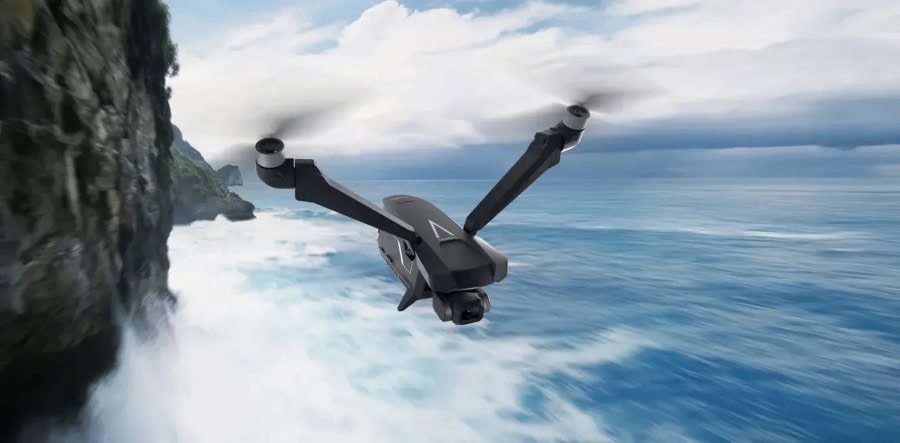
Credit: Zero Zero Robotics
Special Features
- Bi-Copter Design. Features two tilting rotors in a V-shape for enhanced agility, faster acceleration, and quieter operation compared to traditional quadcopters.
- Stability. Advanced rotor tilt precision (0.01-degree adjustments) ensures steady flight even in windy conditions.
- Reverse flight kit. Optional kit enables inverted flying and aerial stunts like reverse spins.
- Portability. Compact folding design makes it easy to carry.
Zero Zero Robotics Goes on the Offensive with the Falcon Mini
We all know DJI dominates the consumer drone market. But Zero Zero Robotics has managed to carve out a successful niche for itself with the HoverAir X1 series—so much so that DJI made the Neo just to compete with the HoverAir X1.
And when DJI was getting ready to launch the Flip a few months back—a more souped-up selfie drone than the Neo—Zero Zero rushed to push out the HoverAir X1 ProMax, so it could compete with the Flip.
But now it looks like Zero Zero Robotics is firing back. With the launch of the Falcon Mini, we see a drone that is made to compete directly with DJI’s flagship Mini series, which you can tell simply by its sub-250 gram weight alone.
When you look at the DJI Mini 4 Pro and the Falcon Mini, you see several similarities:
- Weight. Of course! Both drones weigh under 250g, allowing them to avoid FAA registration requirements.
- Camera capabilities. The Falcon Mini features a 4K camera with a 3-axis gimbal, similar to the DJI Mini 4 Pro’s 4K/60fps HDR camera.
- Portability. Both drones are designed to be compact and easily transportable.
- Flight time. Both drones have 34 minute flight times.
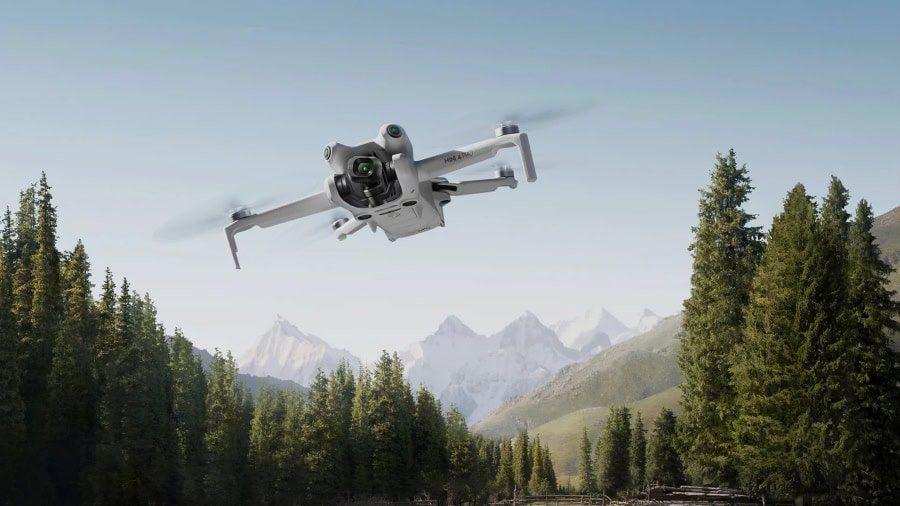
The DJI Mini 4 Pro
That being said, the Falcon Mini stands out in some interesting ways:
- Unique design. Unlike the quadcopter design of the DJI Mini 4 Pro, the Falcon Mini uses a V-shaped bi-copter configuration with two tilting rotors. And that design gives it some advantages, as we detailed above.
- Agility. According to Zero Zero Robotics, the Falcon Mini offers “lightning-fast acceleration” and “unmatched agility” compared to traditional quadcopters like the DJI Mini 4 Pro.
- Stability. The Falcon Mini’s rotors can adjust their tilt with 0.01-degree precision, potentially offering enhanced stability in windy conditions.
Regarding the last point, Zero Zero is really emphasizing how stable the Falcon Mini is in flight.
Check out this video showcasing the Falcon Mini’s steadiness in the air:
The Falcon Mini vs. the DJI Mini 4 Pro vs. the Autel EVO Nano+
Here’s a side-by-side comparison of the Falcon Mini, Mini 4 Pro, and the Autel EVO Nano+:
| Feature | V-Copter Falcon Mini | DJI Mini 4 Pro | Autel EVO Nano+ |
|---|---|---|---|
| Weight | sub 249g | sub 249g | sub 249g |
| Flight Time | 34 minutes | 34 minutes | 28 minutes |
| Camera | 4K/30fps, 3-axis gimbal | 4K/60fps HDR, 3-axis gimbal | 4K/30fps, 1/1.28″ CMOS sensor |
| Gimbal | 3-axis (pitch: -90° to 20°) | 3-axis with true vertical shooting capability | 3-axis (pitch, roll, yaw) |
| Obstacle Avoidance | None mentioned on website | Omnidirectional | 3-direction sensing |
| Transmission Range | Not mentioned on website | Up to 20km (FCC) | 10km |
| Unique features | Bi-copter design, reverse flight capability | ActiveTrack 360°, vertical shooting | Large 1/1.28″ sensor |
| Price | $700-$800 (estimated) | $759 | $679 |
So Which Should You Choose?
Of the three options, the Mini 4 Pro has the most comprehensive feature set, including omnidirectional obstacle avoidance, ActiveTrack 360°, and the ability to shoot vertical video. It also has the longest transmission range and highest video frame rates.
But if you want to fly both for fun and to shoot photos, the Falcon Mini could be your best bet. That’s in part because of that wacky reverse flight capability—that’s definitely a unique draw if stunt flying is top of mind for you.
On the other hand, the Autel EVO Nano+ distinguishes itself with a larger 1/1.28″ CMOS sensor, potentially offering better low-light performance. It’s also the most affordable option, though it has a slightly shorter flight time compared to the other two.
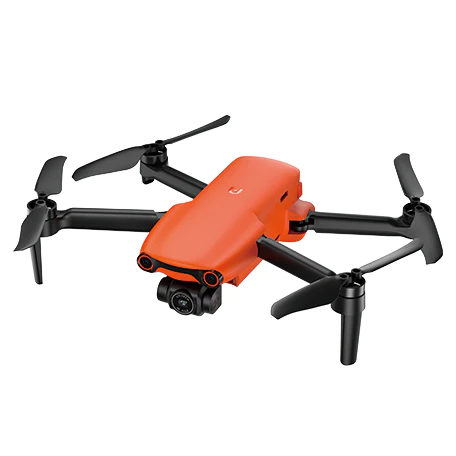
The Autel EVO Nano+
This is all to say, there isn’t a single best option—it really comes down to what you’re looking for.
And that’s a great thing.
DJI’s market dominance can often mean it has the only option on the market for a given type of drone. So when we see new consumer models coming out with fresh ideas from newer names—when we see choices, that is—well, that’s pretty exciting.