Can Skyfish’s Osprey Go Head to Head with the DJI Matrice 350?
BY Zacc Dukowitz
4 June 2025Skyfish just launched the Osprey, an American drone built to go head-to-head with DJI’s Matrice series.
The Osprey is lightweight, fits in a backpack, and has an impressive hour-long battery life. It’s also NDAA-compliant.
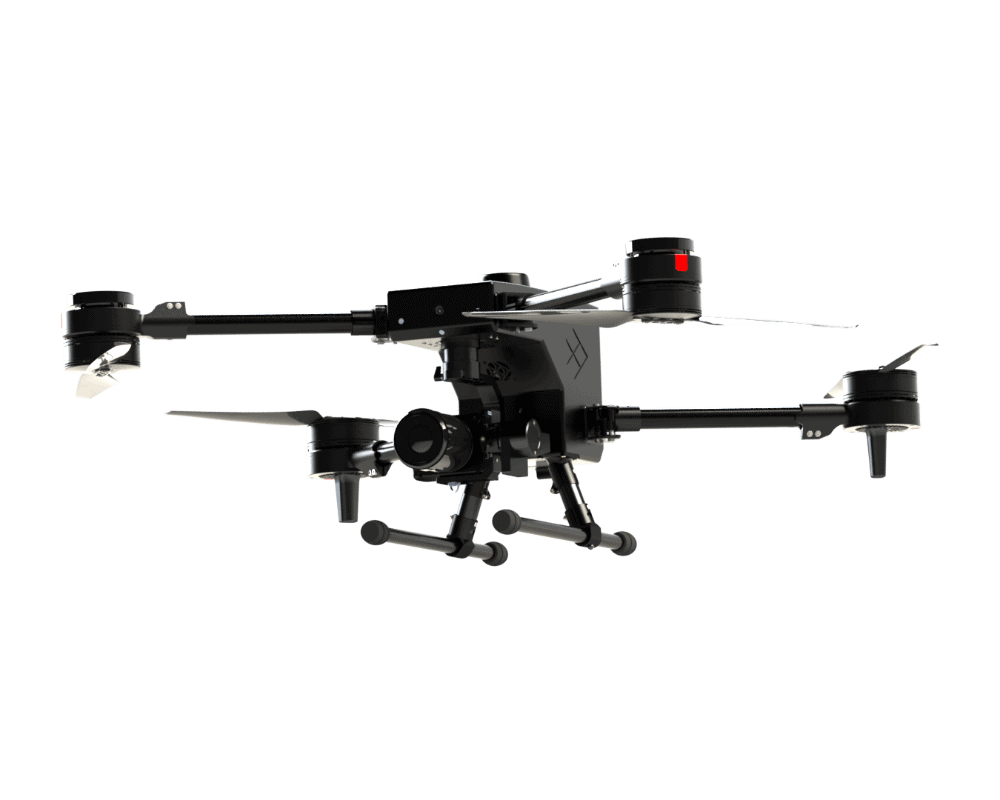
The Skyfish Osprey
Skyfish has steadily been gaining ground in the professional drone space. And with the launch of the Osprey, Skyfish is clearly targeting DJI’s Matrice series.
The Osprey was also originally designed as an American-made replacement for the DJI M30 or DJI M300 series drone, but Osprey turned out to be an even better drone than the DJI equivalent. To all those that say that there isn’t an American-made drone to compete against DJI – well there is now – it’s the American made, NDAA compliant, Skyfish Osprey drone.
— Dr. Orest Pilskalns, CEO of Skyfish
Specs for the Osprey
The Osprey is compact, rugged, and ready to go wherever you need it—just like the Matrice, but with a focus on American manufacturing and compliance.
In addition to being lightweight and portable, the Osprey supports fully autonomous missions for repeatable, high-precision data capture.
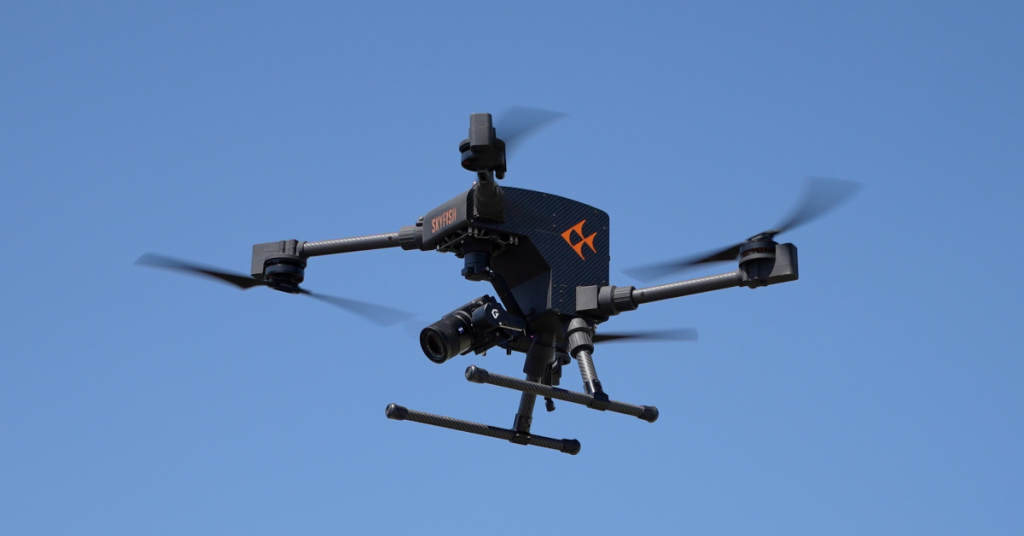
And it has a lot of payload flexibility. Skyfish calls out the Osprey’s integration with the Sony LR1 for ultra-high-res photogrammetry, and NextVision’s Raptor EO/IR for day and night ISR.
But you can also attach several other 3rd party sensors to it, including LiDAR sensors from several companies—not to mention the ability to integrate custom sensors and payloads, making it a Swiss Army Knife for data collection.
Osprey Specs
Here are the key specs for the Skyfish Osprey:
- Weight. About 14 pounds
- Battery life. Up to 60 minutes
- Transmission range. 5+ miles (line of sight)
- Payload support. Sony LR1, NextVision Raptor EO/IR, LiDAR from various makers, and custom payload integration capacity
- Backpack-ready design. Portable and ruggedized for field use
Key commercial features:
- RTK positioning. Centimeter-level accuracy
- Autonomous flight. Full mission planning and repeatable routes
- Digital twin capability. High-fidelity 3D models with detailed geotagged data
Who Is the Osprey For?
Target uses cases for the Osprey include:
- Inspections. Bridges, towers, wind turbines, airports, power lines—the Osprey is purpose-built for high-res, engineering-grade data.
- Public safety. Real-time ISR (Intelligence, Surveillance, Reconnaissance) for law enforcement and defense, including the ability to operate in low-light conditions.
- Photogrammetry and 3D digital twins. The Osprey’s data can be used to create ultra-detailed, measurable 3D models for asset management, precise measurement, and digital twin creation—down to 1/32 of an inch, depending on the payload you’re using.
Speaking of ISR, here’s footage shot on the Osprey with the NextVision Raptor EO-IR showing its high-powered zoom functionality:

Comparing the Osprey to the Matrice Series
Skyfish’s CEO said the Osprey is made to compete with the M30 and the M300.
But the M350 RTK is the most recent big drone in the Matrice series, so we wanted to compare the Osprey to all three to provide a true head-to-head.
The chart below compares all the key features for each drone. Two things to note:
- RTK. All four drones offer RTK systems
- NDAA compliance. The Osprey is the only drone among the four that’s NDAA-compliant, meaning it’s made with components that weren’t made in China, Russia, Iran, or North Korea
Osprey-Matrice Comparison Chart
| Feature | Skyfish Osprey | DJI Matrice 30 (M30) | DJI Matrice 300 RTK (M300) | DJI Matrice 350 RTK (M350) |
|---|---|---|---|---|
| Weight | ~14 lbs (6.35 kg) | 8.2 lbs (3.77 kg) | 13.9 lbs (6.3 kg) | 14.3 lbs (6.47 kg) |
| Flight time | Up to 60 min | Up to 41 min | Up to 55 min | Up to 55 min |
| Transmission range | 3–5 miles (4.8–8 km) | 9.3 miles (15 km) | 9.3 miles (15 km) | 12.4 miles (20 km) |
| Sensor/payload support | Sony LR1, NextVision Raptor EO/IR, modular payload bay | Integrated wide, zoom, thermal, laser rangefinder | Interchangeable: Zenmuse H20/H20T, P1, L1, third-party | Interchangeable: Zenmuse H20/H20T, P1, L1, H30T, third-party |
| Primary camera | Sony ILX-LR1*—61MP full-frame sensor, interchangeable E-mount lenses, remote operation, wide ISO 100–32000, and high-res stills for photogrammetry and inspection
*As an add-on—the Osprey doesn’t come with a camera. |
Integrated multi-sensor payload with 48MP 1/2″ CMOS zoom camera (5–16x optical, 200x digital zoom), 12MP wide camera, 4K/30fps video, and laser rangefinder (up to 1,200m) | Zenmuse H20T*—20MP zoom camera (23x hybrid optical zoom), 12MP wide camera, 640×512 thermal camera, and laser rangefinder (up to 1,200m).
*As an add-on—the Matrice 300 doesn’t come with a camera. |
Zenmuse H20T*—20MP zoom camera (23x hybrid optical zoom), 12MP wide camera, 640×512 thermal camera, and laser rangefinder (up to 1,200m).
*As an add-on—the Matrice 350 RTK doesn’t come with a camera. |
| IP rating | Not specified (designed for field use) | IP55 | IP45 | IP55 |
| Key features | RTK, autonomous flight, digital twin/3D modeling | RTK, integrated sensors, compact, rapid deployment, IP55, obstacle avoidance | RTK, multi-payload, advanced mapping, obstacle avoidance, IP45, 360° vision | RTK, multi-payload, advanced mapping, improved weatherproofing, IP55, new controller, arm lock detection, enhanced FPV night vision |
TL;DR: Key Osprey Advantages
Here are the main things that make the Osprey stand out when compared with the Matrice series:
- American-made & NDAA compliant. Designed, built, and supported in the USA, the Osprey is NDAA compliant, making it ideal for organizations that require domestically produced, secure drone solutions—especially as DJI faces increasing restrictions in the U.S.
- Longest flight time. The Osprey boasts up to 60 minutes of flight time, surpassing the Matrice series and allowing for longer missions without battery swaps.
- Ultra-precise photogrammetry. When equipped with the Sony LR1 61MP camera, the Osprey delivers survey-grade 3D models and digital twins with accuracy down to 1/32 of an inch, offering engineering-grade data for critical infrastructure inspection.
- Backpack-ready portability. Despite its enterprise capabilities, the Osprey is lightweight (~13–14 lbs) and compact enough to fit in a backpack, making transport and rapid deployment easier than most enterprise drones in its class.
Whether the Osprey is actually a better drone than the Matrice 30 or Matrice 300 remains to be seen.
But the combination of NDAA compliance with a robust, U.S.-made platform is likely to be very appealing to commercial clients in the U.S.
And one thing’s for sure—with Chinese tariffs driving up the cost of DJI drones and growing supply chain concerns in the U.S., Skyfish is launching the Osprey at just the right time.