With Sales on the Rise, Parrot Unveils ANAFI UKR Public Safety Drone
BY Zacc Dukowitz
25 June 2025Parrot is on the rise.
Like many major drone companies, Parrot pivoted to focus on commercial platforms not too long ago.
And that pivot is paying off. For the first quarter of this year, Parrot reported revenue of €18.4 million ($21.4 million), marking a strong 17% year-over-year growth.
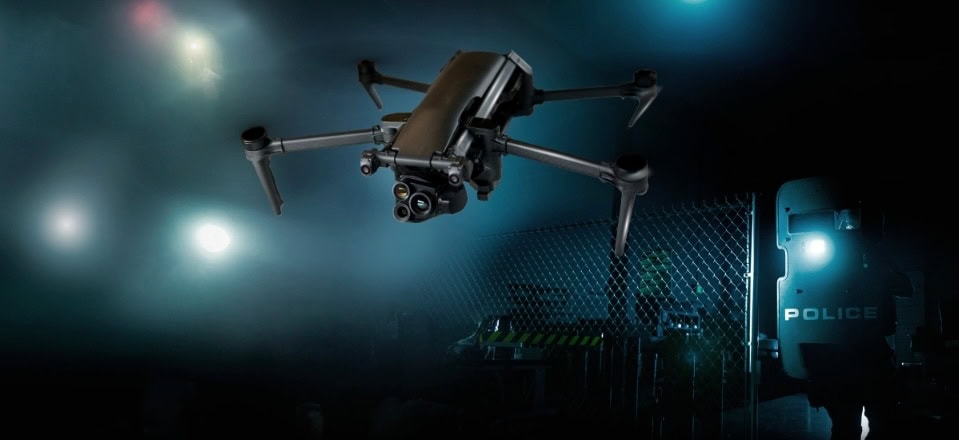
Fresh off that win, Parrot recently unveiled the ANAFI UKR at the Paris Airshow, the first new drone it’s made since launching the Blue UAS-approved ANAFI USA in 2020.
Credit: Parrot
The UKR is a small, AI-driven professional drone made for public safety and ISR (intelligence, surveillance, and reconnaissance).
Built to be rugged, encrypted, and packed with AI-powered features, the new ANAFI could be a direct answer to the needs of first responders and defense professionals in need of smarter, tougher, and more secure drones.
What really stands out is how Parrot is pushing the boundaries of what tactical micro-UAVs can do. With the ANAFI UKR and Chuck 3.0, operators get advanced ISR capabilities—all in a package that’s easy to deploy and even easier to trust.
How Much Does the ANAFI UKR Cost?
There are two versions of Parrot’s new security drone: the UKR for defense and the UKR Gov for public safety.
Pricing for both versions starts at about $16,000.
Both versions are available for purchase right now. But be forewarned that it seems like Parrot is only making enterprise sales to public safety and other government agencies. That is, if you’re an individual consumer, you probably won’t be able to buy one.
Learn more about the ANAFI UKR.
Features & Specs for the ANAFI UKR
At just over two pounds, the UKR is a tiny drone that punches above its class.
One of the most important aspects of the ANAFI UKR to highlight is its compact, rugged design. Although it’s light enough to carry anywhere, it’s also tough enough to handle very harsh conditions, as evidenced by its IP53 rating and ability to operate in extreme temperatures from-32.8°F to 122°F.

Credit: Parrot
The UKR can be ready to fly in under two minutes, and it can navigate without GPS using visual-inertial odometry and satellite image matching.
Another thing that sets the ANAFI UKR apart is its advanced sensor suite. It comes with a dual EO/IR gimbal that combines a powerful 35x zoom RGB camera with a FLIR Boson thermal imager, giving operators the ability to detect human-sized targets from remarkable distances.
Security is another area where the ANAFI UKR excels. It features encrypted dual-band Wi-Fi and 5G connectivity, a military-grade frequency-hopping MARS radio, and a LoRa backup system for resilient operation. These layers of redundancy ensure that your data and control links remain secure, no matter what.
Whether it’s surveillance in low light or thermal mapping in challenging environments, the UKR is made to deliver crucial data in real time to support active operations in the field.
ANAFI UKR Key Specs
- Weight. 2.1 pounds (959 g)
- Max takeoff weight. 3.2 pounds (1,450 g)
- Flight time. Up to 38 minutes (standard battery), up to 50 minutes (XLR)
- Max range. 14.2 miles (23 km, standard), up to 25 miles (40 km, XLR)
- Cameras. 35x zoom RGB, FLIR Boson thermal
- Secure comms. Wi-Fi/5G, MARS radio, LoRa backup
- Harsh weather protection. IP53 (rain/dust), -32.8°F to 122°F
How AI Enhances the Capabilities of the ANAFI UKR Drone
The Parrot ANAFI UKR isn’t just rugged and secure—it’s also incredibly smart, thanks to a suite of AI-driven features that set it apart from other tactical micro-UAVs.
Here’s how its advanced artificial intelligence capabilities make a difference in the field:
- Onboard neural networks. The ANAFI UKR uses powerful onboard AI to process data in real time, enabling features like instant obstacle avoidance and precise target tracking—even in complex environments.
- Real-time decision making. With AI at the core, the drone can autonomously adjust its flight path and mission parameters to respond to changing conditions or emerging threats.
- GNSS-denied navigation. Advanced navigation algorithms allow the ANAFI UKR to operate seamlessly in environments where GPS signals are unavailable or unreliable, using visual-inertial odometry and other sensor fusion techniques.
- Target recognition and tracking. AI-powered object detection and tracking help operators quickly identify and monitor people, vehicles, or other objects of interest, streamlining surveillance and reconnaissance missions.
- Mission adaptability. The open architecture of the Chuck 3.0 autopilot allows users to integrate custom AI models and mission logic, making the drone adaptable to a wide range of operational needs.
How Does the ANAFI UKR Compare?
Parrot has several ANAFI models. So how does the UKR stack up?
This chart shares a side-by-side for a quick comparison:
| Feature | ANAFI UKR | ANAFI USA | ANAFI Ai | ANAFI Thermal |
|---|---|---|---|---|
| Weight | 2.1 lb (959 g) | 1.1 lb (500 g, bare; ~1.2 lb/540–550 g with battery) | 1.5 lb (700 g) | 0.7 lb (315 g) |
| Cameras | 35x zoom RGB + FLIR Boson thermal | 32x zoom RGB + FLIR thermal | 48 MP main + 32x zoom | 4K HDR + FLIR Lepton 3.5 thermal |
| Flight Time | 38–50 min (standard vs. XLR) | 32 min | 32 min | 26 min |
| Max Range | 14–25 miles (23–40 km, standard vs. XLR) | 3 miles (~5 km, visual) | Not specified | 2.5 miles (4 km) |
| IP Rating / Temp Range | IP53, -32.8°F to 122°F (-36°C to 50°C) | IP53, -31°F to 109°F (-35°C to 43°C) | Not specified | Not IP rated, 14°F to 104°F (-10°C to 40°C) |
| AI / Autonomy | Advanced (real-time avoidance, tracking, GNSS-denied) | Basic | Advanced (4G, AI-driven) | Basic |
| Secure Comms | Wi-Fi/5G, MARS radio, LoRa backup | Wi-Fi, AES encryption | 4G, Wi-Fi | Wi-Fi |
| Special Features | Hand launch/landing, rapid deploy, covert ops | NDAA-compliant, made in USA | 4G connectivity, AI-powered | Lossless zoom, upward camera tilt |
Note: Some specifications are approximate and may vary by configuration.
What’s Chuck 3.0 Autopilot?
Along with the UKR, Parrot unveiled Chuck 3.0 at the Paris Airshow, its new autopilot system.
While the Parrot ANAFI UKR is impressive on its own, when you pair it with Chuck 3.0 you’ve got a really powerful system for advanced security and public safety work.
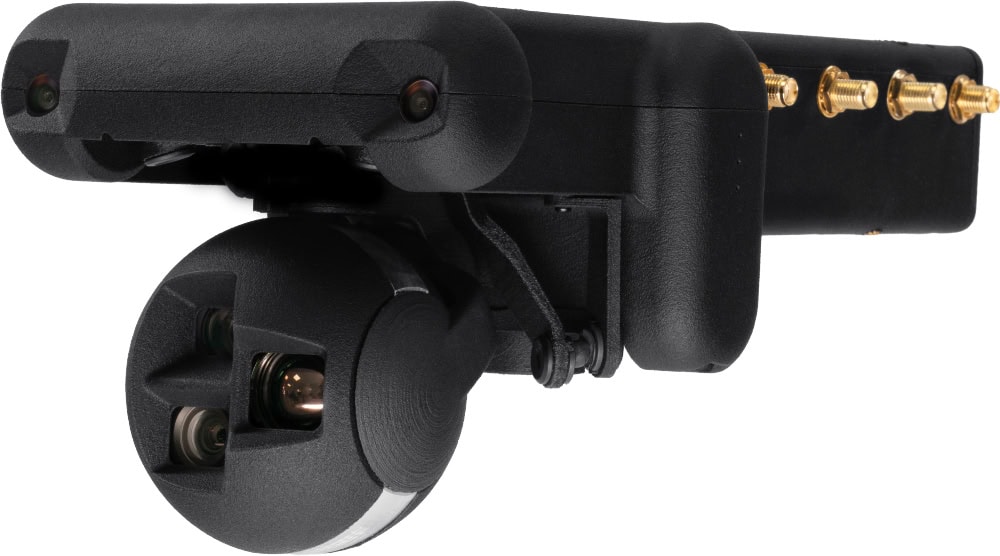
Parrot’s Chuck 3.0 autopilot system
At its core, Chuck 3.0 is all about making complex missions easier to manage. It provides robust support for advanced mission planning, letting operators set up intricate routes, automated tasks, and responsive behaviors with confidence.
The autopilot also brings AI-driven decision-making to the table, so the drone can adapt to changing conditions in real time. Plus, it’s designed to work seamlessly with existing command and control (C2) systems, making it a natural fit for teams that already rely on established workflows.
And Chuck 3.0 is built on open architecture. This means that, through the Parrot SDK, users can develop custom mission logic, experiment with new perception algorithms, or even integrate their own AI models. This kind of flexibility could be a game-changer for organizations that want to tailor their drone operations to specific needs or push the boundaries of what’s possible in the field.
And for those who want to test and refine their setups before deployment, Parrot Sphinx offers full-stack simulations and hardware-in-the-loop testing. This means you can validate your missions, tweak your code, and ensure everything runs smoothly—all before you ever leave the ground.

What’s Next for Parrot?
For anyone watching the drone market, it’s clear from recent sales numbers and its product roadmap that Parrot is going to remain a major player for commercial drone operations.
We’re excited to see Parrot making these strides, not just struggling to keep pace with DJI but launching its own innovative platforms along with supporting features like the Chuck 3.0, as well maintaining an ecosystem to enable users, including the Sphinx simulator.
But one thing Parrot’s successful pivot underscores is the absence of a consumer alternative to DJI. Or even a prosumer alternative.
After all, not everyone can afford a $16,000 drone for their work, and not every drone professional will necessarily qualify as an “enterprise” level deal in Parrot’s eyes.
If DJI is actually banned in the U.S.—a thing that could happen, though we hope it won’t—its sudden absence will create a vacuum of options for all those consumers and prosumers out there looking for reliable drones in the $1,000-$5,000 range.
Want your voice to be heard?
Contact your representatives and let them know how you feel. Here’s some guidance on how to do that.