MightyFly Is Working on a Cargo Drone that Can Fly 1,000-Miles and Carry 500 Pounds
BY Zacc Dukowitz
6 March 2026Cargo drone company MightyFly just raised $10 million to build an autonomous hybrid eVTOL that will fly 1,000 miles carrying 500 pounds.
Those are big numbers. Most delivery drones are designed for “last mile” delivery—just a few miles at most, and with only a few pounds.
But MightyFly’s drones aren’t made to carry burritos. They’re made for an entirely different category of delivery: regional cargo, competing with trucks and crewed aircraft.

What MightyFly Is Building
MightyFly is developing a long-range autonomous cargo drone that aims for an ambitious 1,000-mile range with 500-pound capacity.
The aircraft uses electric propulsion, with an onboard combustion engine acting as a generator to recharge the batteries in flight.
It also promises a small takeoff and landing footprint.
For the MightyFly Cento—the best reference point for the new drone, since its specs aren’t public yet—the footprint is the size of two standard parking spaces.
The MightyFly Cento
Specific specs for the new 1,000-mile, 500-pound beast are under wraps for now.
But the MightyFly Cento, which is already out, offers a preview of the new, unnamed cargo drone’s potential.
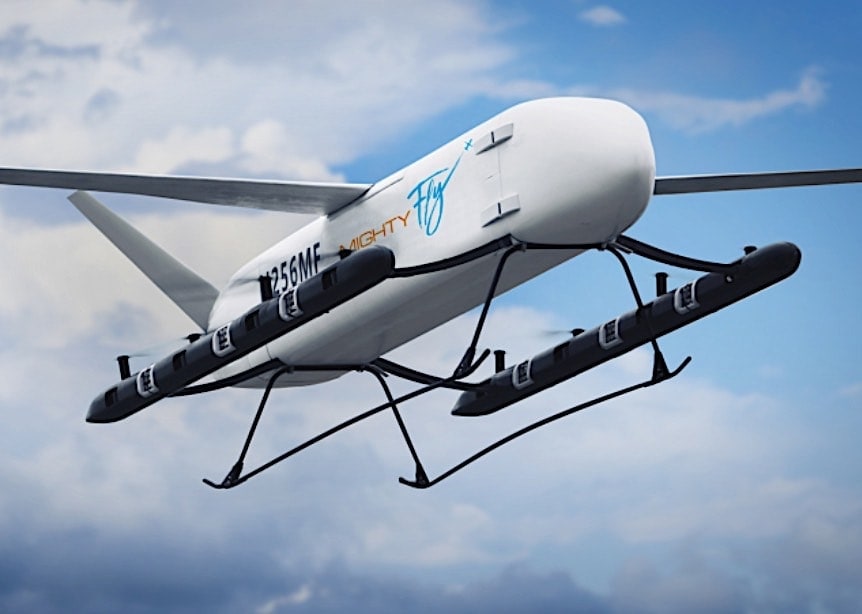
The MightyFly Cento | Credit: MightyFly
MightyFly Cento Specs & Features
- Battery life. About 4 hours of total flight time
- Flight range. Up to 600 miles (about 965–966 km) per mission.
- Payload capacity. 100 lb (45 kg) maximum payload, with enough volume to carry over 200 small parcels in its internal cargo bay.
- Top speed. Up to 150 mph (240 km/h) cruise, significantly faster than road-based vans over similar distances.
- eVTOL configuration. Lift‑and‑cruise eVTOL layout with eight fixed vertical lift propellers for takeoff and landing and a single pusher propeller for efficient forward flight.
Autonomy Highlights
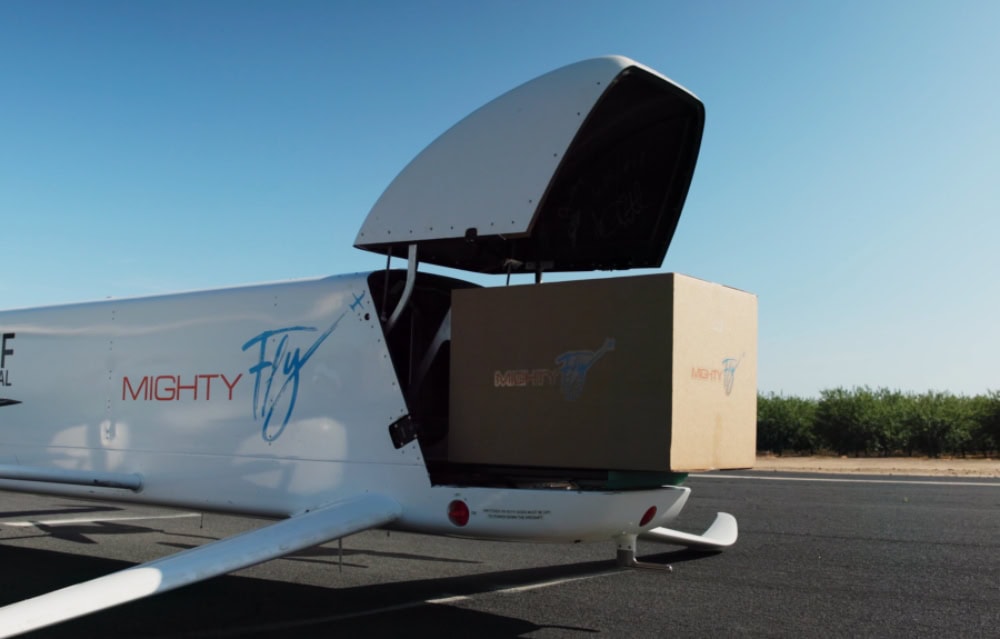
MightyFly’s drones run fully autonomous missions, which are supervised remotely by operators managing fleets from a central hub. And their autonomy extends beyond the flying–the drones can also load and unload cargo on their own.
Key autonomy tech includes:
- Onboard sensors with ADS-B and UTM for collision avoidance and airspace visibility.
- Multi-stop sequencing across customers in one flight.
- ALMS* for automated cargo handling, securing, and center-of-gravity checks.
*Note: ALMS stands for Autonomous Load Mastering System, a patented technology developed by MightyFly for their Cento cargo drone.
MightyFly’s Role in Logistics
MightyFly’s cargo drones target a unique middle-mile niche in logistics.
These platforms can haul 100–500 pounds over 600–1,000 miles with multiple stops per flight, all without needing runways or dedicated landing pads.
These numbers position these drones solidly in the middle between short-range drone delivery—think Zipline or Wing—and long-haul, fixed-route drone delivery for industrial use cases—say, delivering supplies to remote offshore oil rigs.
Credit: MightyFly
In the U.S., goods often travel 300–800 miles by truck due to air cargo’s cost and infrastructure demands. MightyFly aims to disrupt that with pilotless, autonomous efficiency on repeatable routes.
The primary use cases for MightyFly’s drones are:
- Warehouse-to-warehouse transfers
- Medical supply runs between cities
- Rural logistics
- Industrial resupply
Progress Toward Launching
MightyFly has already built and flown several full-scale prototypes as it works toward commercial deployment.
According to the company, three aircraft have collectively completed more than 400 autonomous test flights.
Those flights are part of a broader effort to demonstrate reliability and autonomy under real operating conditions—an essential step before any large-scale cargo service can launch.
On the regulatory side, MightyFly has secured FAA Special Airworthiness Certificates and Certificates of Authorization (COAs) that allow it to conduct advanced testing, including long-range beyond visual line of sight (BVLOS) operations under approved conditions.
The next major milestone will be pursuing Part 135 certification, which would let the company operate as an air carrier for commercial cargo delivery.
MightyFly’s big-drone concept points toward a future where regional cargo moves autonomously between cities, warehouses, and industrial hubs—quietly, predictably, and without a pilot onboard.
But the real test won’t be whether the new drone can hit 1,000 miles and carry 500 pounds, as impressive as that would be.
It will be whether these drones can actually operate reliably on routine flights, over and over.
Reliability is what has made Zipline stand out—they’ve flown over 125 million autonomous miles—and that kind of reliability through repetition will be the target for MightyFly if it wants to make this work.