How Far Can Drones Fly? And How Far Can You Fly a Drone?
BY Zacc Dukowitz
11 February 2026How far can a drone fly?
It really depends on the type of drone. Consumer drones can fly several miles, while toy drones often can’t fly more than a few hundred feet.
Here’s a quick overview of how far different types of drones can fly:
- Toy drones. 50–300 feet (15–90 meters)
- Beginner hobby drones. 0.25–1 mile (400 meters–1.6 km)
- Prosumer drones. 2–7 miles (3.2–11.3 km)
- Enterprise/commercial drones. 5–15+ miles (8–24+ km)

Prosumer drone DJI Air Air 3S can fly up to 12.4 miles (20 km)
But how far can you fly a drone?
If you’re wondering how far you’re allowed to fly a drone—that is, how far you can legally fly a drone—the answer is quite different from how far a drone can fly.
That’s because the FAA requires drone pilots to remain within the operator’s visual line of sight (VLOS) at all times. To do this, you typically can’t fly more than 0.25 to 0.5 miles (roughly 400 to 800 meters)—which is usually a lot less of a distance than the drone can actually fly.
In this guide to how far you can fly a drone and how far a drone can fly, we’ll cover the legality around long distance drone flights, the technical limitations for how far a drone flies, and more.
Here’s a menu in case you’d like to jump around:
- 5 Factors that Impact How Far You Can Fly a Drone
- Drone Signal Systems Compared
- Drone Range by Category
- Return-to-Home (RTH) and What Happens When You Lose Signal
- How Far Should You Fly a Drone?
- Why Fly Long-Distance? Use Cases That Require Flying a Long Way
- How Far Can You Fly a Drone FAQ
5 Factors that Impact How Far a Drone Can Fly
How far a drone can fly—also called a drone’s range—isn’t just about battery size or what the manufacturer says on the box.
In real-world flying, how far a drone can go depends on a combination of factors, including how long it can stay in the air and how far it can stay connected to its controller. And understanding these variables helps pilots fly more safely and get the most out of their drone’s capabilities.
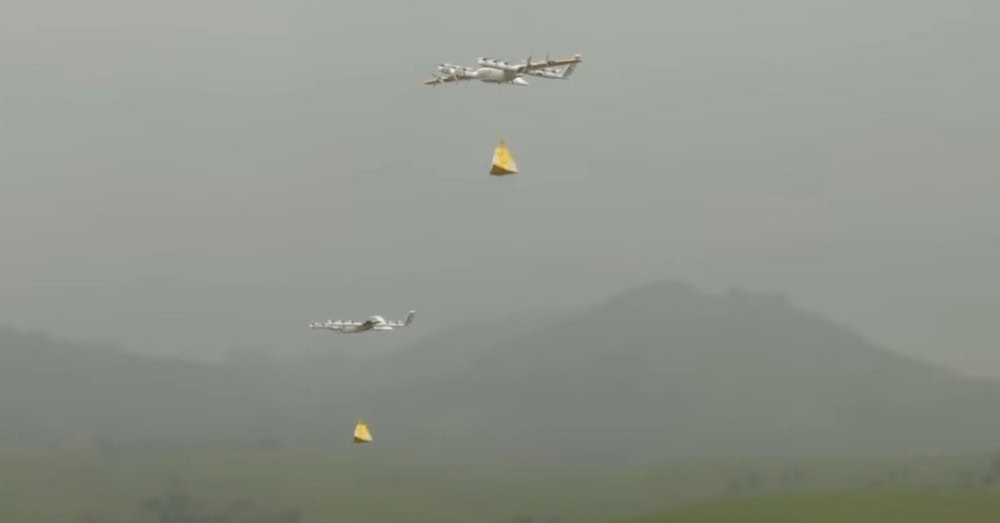
Wing’s delivery drones are made to fly in the rain—which means they can fly farther in harsh conditions
Here are the five main factors that impact how far a drone can fly:
1. Battery Life and Drone Weight
The heavier the drone, the more power it consumes just to stay aloft. Larger payloads, wind resistance, and aggressive flight maneuvers all drain the battery faster. This reduces your maximum physical travel distance, especially on return trips.
2. Transmission System
The drone’s signal system plays a major role in how far it can stay connected to the controller. Basic Wi-Fi drones may lose connection at a distance of 1,000 feet (305 meters), while more advanced systems like DJI’s OcuSync or Autel’s SkyLink can maintain control for 6–9 miles (10–15 km) or more under ideal conditions.
3. Controller Signal Quality and Antenna Orientation
Your controller’s signal strength—and how you position its antenna—can significantly impact range. If the antenna isn’t pointed correctly or if obstacles are blocking the signal, your drone may disconnect much sooner than expected.
4. Environmental Interference
Trees, buildings, hills, and power lines can all block or weaken the drone’s connection. In urban or forested areas, interference can cut your effective range in half. Always expect lower range when flying near obstacles.
5. Weather, Temperature, and Electromagnetic Interference
Cold temperatures reduce battery efficiency, which shortens flight time. High winds require the motors to work harder, further draining power. And in areas with heavy radio traffic—like near cell towers or airports—electromagnetic interference can disrupt signal stability or reduce range.
Drone Signal Systems Compared
Drone signal systems—also called transmission protocols—are the technologies that keep a drone connected to its controller during flight. These systems are crucial for determining how far a drone can fly from the pilot, the stability of the video and control signals, and how well the drone performs in areas with interference.
Drone transmission systems fall into two main categories:
- Proprietary systems. Developed by specific manufacturers, these are tightly integrated with their drones and often deliver superior range, stability, and features. Examples include DJI’s OcuSync and Skydio’s Link, and Autel SkyLink. Proprietary systems are typically found in mid- to high-end consumer and professional drones and are only available on that brand’s products.
- General/open systems. These are industry-standard or open-source protocols and modulation techniques used across a wide variety of drone brands and custom builds. Examples include MAVLink (for telemetry and control), OFDM (for high-bandwidth video), and spread spectrum techniques like FHSS and DSSS. These systems provide flexibility and compatibility, especially in the hobbyist, commercial, and research sectors.
The choice of transmission system is one of the biggest factors in determining a drone’s operational range, video quality, and reliability in challenging environments. Some drones even combine multiple systems—using one protocol for control and another for video—to optimize performance for specific use cases.
Below, we compare the leading proprietary and general/open drone transmission systems to help you understand their strengths, limitations, and where they are most commonly used.
Proprietary Drone Signal Systems
| Company | System | Typical Max Range | Pros | Cons | Used By |
|---|---|---|---|---|---|
| DJI | DJI Wi-Fi | 0.3–0.6 miles (500–1,000 m) | Low cost, widely supported, beginner-friendly | Short range, vulnerable to interference, less stable | DJI Spark, Mavic Air, Mini, Mini SE |
| DJI OcuSync | 6–9 miles (10–15 km) | Long range, low latency, stable video and control | Proprietary to DJI, only in mid- to high-end models | DJI Mavic 3 series, Air 3, Mini 4 Pro, Matrice 350 RTK, Phantom 4 Pro V2.0 | |
| DJI Lightbridge | 1.2–3.1 miles (2–5 km) | Reliable signal, precursor to OcuSync | Older tech, no longer used in new models | DJI Phantom 4 Pro/Advanced, Inspire 1, Inspire 2, Matrice 200/600 Series | |
| Autel | Autel SkyLink | 7.5+ miles (12+ km) | High-range, strong performance in commercial use | Limited to Autel drones, real-world range varies | Autel EVO II Pro V3, EVO Max 4 |
| Skydio | Skydio Link™ | 2–3.7 miles (3–6 km) | Optimized for autonomy, strong link in open environments | Shorter range than OcuSync, proprietary to Skydio | Skydio 2, Skydio 2+ |
| Skydio Connect SL | 7.5 miles (12 km) | Long range, robust point-to-point link, multi-band (2.4/5 GHz), optimized for autonomy and enterprise | Proprietary to Skydio, only on X10/X10D | Skydio X10, Skydio X10D |
General/Open Drone Signal Systems
| System | Type | Typical Max Range | Pros | Cons | Used By |
|---|---|---|---|---|---|
| MAVLink | Open-source protocol | Varies (typically up to telemetry radio range: 1–40 km depending on hardware) | Widely supported, lightweight, efficient, bi-directional, customizable, compatible with many autopilots and ground stations | Not for high-bandwidth video, requires additional hardware for long range | ArduPilot, PX4, many commercial, research, and custom drones |
| OFDM | Modulation technique | Up to 10–150 km (depends on implementation) | High data rates, robust against interference, suitable for HD video, efficient bandwidth use | High power consumption, complex, requires advanced hardware | Many digital FPV systems, long-range commercial drones, some custom builds |
| FHSS (Frequency Hopping Spread Spectrum) | Spread spectrum technique | Typically 1–20 km (depends on hardware and frequency band) | High resistance to interference, enhanced security, widely used in RC links | Lower data rates, less suitable for HD video | FrSky, FlySky, DragonLink, EzUHF, OpenLRS, many hobby and custom drones |
| DSSS (Direct Sequence Spread Spectrum) | Spread spectrum technique | Typically 1–10 km | Interference resistance, better bandwidth efficiency than FHSS | More complex and costly than FHSS, moderate data rates | Some telemetry/control systems, select RC systems |
| DSMX | Proprietary protocol (widely adopted) | Up to 2 km (typical RC range) | Low latency, frequency hopping, backward compatible with DSM2, secure, quick response | Limited range, not for high-bandwidth video, mainly for hobbyist use | Spektrum transmitters/receivers, many hobbyist drones, FPV racers |
| S.Bus | Serial bus protocol | Up to 1 km (depends on RC system) | High channel count (up to 18), simplified wiring, compatible with many control systems | Not a full transmission system (requires underlying RF link), not for video | Futaba, FrSky, and other RC systems; used in complex hobbyist and pro drones |
| Analog (FM/AM) | Legacy video transmission | Up to 2–5 km (with high-power VTX) | Ultra-low latency, simple, inexpensive, easy to install | Susceptible to interference, lower video quality, not encrypted | FPV racers, budget drones, legacy systems |
Key Consideration for Optimizing Signal Strength
Even with the most advanced transmission systems, a drone’s maximum range is only achievable with a clear, unobstructed line of sight between the drone and its controller. Obstacles like trees, buildings, hills, or even other electronic devices can significantly degrade signal performance and reduce operational distance.
Other factors—such as battery life, weather conditions, interference, and flying style—also play a major role in how far a drone can safely travel from the pilot. For example, aggressive flying, extreme temperatures, or strong winds can all shorten effective range.
In the U.S., the Federal Communications Commission (FCC) regulates the power output and frequency bands that drones can use.
Most consumer drones operate on unlicensed frequencies, which are more susceptible to interference, but new FCC rules are beginning to open dedicated spectrum for certain drone operations to improve reliability and safety. Regardless of the technology, all drone pilots must comply with local regulations, including range and line-of-sight restrictions, which often limit how far you can legally fly—even if your drone’s transmission system is capable of much more.
Drone Range by Category
As we mentioned in the introduction, how far you can fly a drone depends a lot on the type of drone.
A toy drone might only be able to fly a few hundred feet, while a commercial model built for long-distance mapping or inspections can fly 10+ miles under the right conditions.
Most drones are limited in how they can fly by:
- Communication range. How far they can stay in contact with the controller.
- Flight range. How far they can travel before the battery runs out.
Here’s a breakdown of drone range by category, along with what to expect from each class:*
| Drone Type | Max Control Range | Typical Flight Time | Transmission Type | Example Models | Notes |
|---|---|---|---|---|---|
| Toy | 50–300 ft (15–90 m) | 5–10 minutes | Basic Wi-Fi, infrared, or simple 2.4 GHz radio | Holy Stone HS210, Syma X20 | Very limited range; mostly for indoor or backyard use |
| Beginner Hobby | 0.25–1 mile (400–1,600 m) | 10–20 minutes | Wi-Fi, OcuSync Lite, proprietary low-power signals | DJI Mini 2 SE, Potensic D88 | Mini 2 SE uses OcuSync Lite for improved range |
| Consumer | 2–7 miles (3.2–11.3 km) | 20–45 minutes | OcuSync (DJI), SkyLink (Autel), Skydio Link (Skydio) | DJI Mini 4 Pro, Mavic 3 Pro, Air 3, Autel EVO Lite+, Skydio 2+ | High-end proprietary systems; strong performance in open areas |
| Enterprise | 5–15+ miles (8–24+ km) | 30–55 minutes | OcuSync Enterprise (DJI), proprietary links (Freefly, Parrot, Watts Innovations) | DJI Matrice 350 RTK, Freefly Astro, Parrot Anafi USA, Freefly Alta X, Watts Innovations Prism Sky | Extended range and redundancy; often used for mapping, inspection, and public safety |
| FPV | Up to 1.5 miles (2.4 km) digital HD 0.5–1 mile (0.8–1.6 km) analog |
5–15 minutes | Analog (FM), digital HD (DJI FPV, Walksnail, HDZero) | DJI Avata 2, iFlight Nazgul, custom FPV rigs | Analog: ultra-low latency, lower range/quality. Digital: higher quality, longer range, slightly higher latency. |
| BVLOS-Capable | 10–60+ miles (16–96+ km) | Varies by mission type (1–10+ hours possible) | LTE, satellite, long-range RF (e.g., 900 MHz, 2.4 GHz, 5.8 GHz) | Percepto Air Max, Skyfront Perimeter 8, American Aerospace AiRanger, Event 38 E455, C2-certified platforms | Fixed-wing/VTOL often used; range and flight time depend on airframe, battery, and mission; regulatory approval required |
*Note: Real-world range is often less than manufacturer claims due to interference, obstacles, and regulatory limits. Always fly within legal and safety guidelines.
Toy Drones
Toy drones are small, lightweight, and designed for indoor or backyard use. They rely on basic Wi-Fi or infrared signals and often lose connection quickly if flown too far. Their limited battery capacity also restricts flight time to just a few minutes.
- Max control range. 50–300 ft (15–90 m)
- Typical battery life. 5–10 minutes
- Common transmission type. Basic Wi-Fi or infrared
- Example models. Holy Stone HS210, Syma X20
Beginner Drones
Beginner hobby drones offer more range and features than toy drones but still focus on casual, short-distance flying. They usually use Wi-Fi-based control and are best suited for new pilots learning the basics of drone operation.
- Max control range. 0.25–1 mile (400–1,600 m)
- Typical battery life. 10–20 minutes
- Common transmission type. Wi-Fi or proprietary short-range systems
- Example models. DJI Mini 2 SE, Potensic D88
Prosumer Drones
These drones are built for high-quality aerial photography, mapping, and general recreation. They feature advanced signal systems like OcuSync and offer excellent range and transmission stability under ideal conditions.
- Max control range. 2–7 miles (3.2–11.3 km)
- Typical battery life. 20–45 minutes
- Common transmission type. OcuSync, SkyLink
- Example models. DJI Mini 4 Pro, Mavic 3 Pro, DJI Air 3S
Enterprise Drones
Enterprise drones are built for commercial applications such as infrastructure inspections, mapping, and public safety. They support long-distance communication, robust control redundancy, and integration with payloads like LiDAR or thermal cameras.
- Max control range. 5–15+ miles (8–24+ km)
- Typical battery life. 30–55 minutes
- Common transmission type. OcuSync Enterprise, proprietary systems
- Example models. DJI Matrice 350 RTK, Freefly Astro
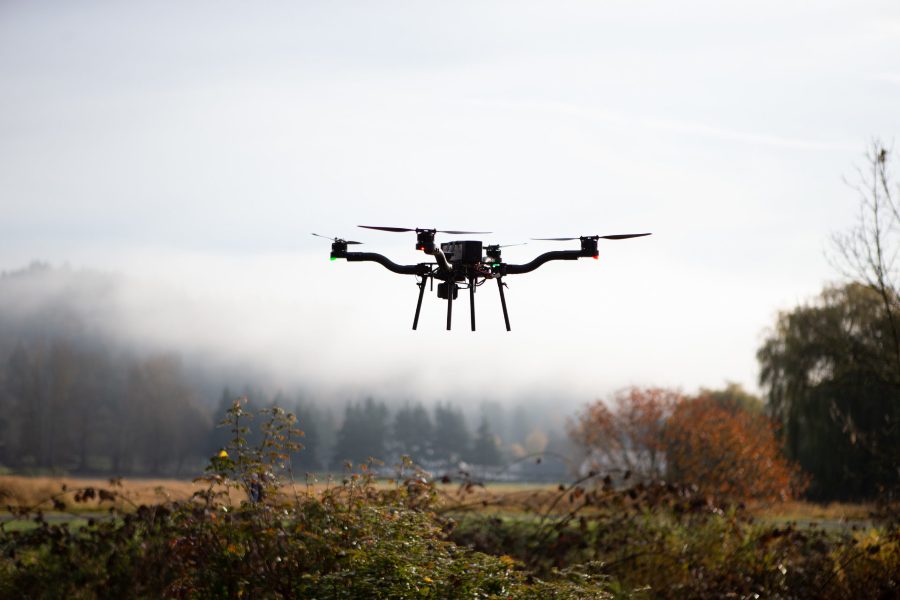
The Freefly Astro
FPV Drones
FPV (First Person View) drones are made for immersive, high-speed flight. Because they’re typically flown manually at low altitudes, range is limited by video transmission type and regulatory constraints.
- Max control range. Up to 1.5 miles (2.4 km)
- Typical battery life. 5–15 minutes
- Common transmission type. Analog or digital (e.g., DJI FPV)
- Example models: DJI Avata 2, iFlight Nazgul, custom-built quads
BVLOS-Capable Drones
These drones are certified or waivered for Beyond Visual Line of Sight (BVLOS) operations. They often rely on LTE, satellite, or long-range RF communication and are used in industrial applications like asset monitoring, energy inspections, and autonomous patrols.
- Max control range. 10–60+ miles (16–96+ km)
- Typical battery life. Varies by mission and payload
- Transmission type. LTE, satellite, long-range RF
- Example models. Percepto Air Maxm, Skyfront Perimeter 8
Return-to-Home (RTH) and What Happens When You Lose Signal
Most modern drones come with a built-in safety feature called Return-to-Home (RTH).
This function is designed to automatically bring the drone back to its takeoff point—or the last recorded home point—if something goes wrong during flight, such as signal loss, low battery, or user command.
Understanding how RTH works can help prevent flyaways and give you confidence when flying at a distance.
How Return-to-Home Works
When RTH is triggered, the drone will typically ascend to a pre-set altitude (to avoid obstacles), then fly back to the home point using GPS-based navigation.
Some drones also use vision-based positioning in environments where GPS is weak—such as near buildings or indoors—but GPS remains the standard for most RTH flights.
Situations that call for RTH:
- Signal loss. If your drone flies beyond the controller’s range or experiences interference, it will initiate RTH after a brief connection timeout—usually a few seconds.
- Low battery. Most drones will return home automatically if the battery drops below a critical threshold required to return safely.
- User command. Pilots can also manually trigger RTH using a button on the remote controller or app.

An image from DJI showing how RTH works
Real-World Scenarios
Let’s say you’re flying a drone and accidentally exceed its controller range, and you lose signal.
The drone will pause briefly, waiting to see if the signal will reconnect. If it doesn’t, RTH engages automatically. The drone will climb to its set altitude—say 200 feet—then begins flying back to the home point.
Once back in range, it reconnects with the controller and begins descending for landing.
Fail-Safes and Limitations
While RTH is reliable, it’s not infallible. There are some situations where it may not work as expected:
- Weak or no GPS lock. Without a good GPS fix, the drone can’t navigate home accurately.
- Flying indoors. Most drones disable RTH when GPS is unavailable, which is common indoors.
- Obstacle interference. If the pre-set RTH altitude is too low, your drone may strike a building or tree on its way back.
Tips to Avoid Failed RTH Attempts
Understanding how RTH works—and how to set it up correctly—can save your drone in a moment of crisis. While signal loss is rare with modern drones, it’s good to know that smart fail-safes are in place to bring your aircraft home safely.
Here are a few tips:
- Set a safe RTH altitude. Always choose an RTH altitude that clears nearby buildings and trees—usually 200–300 feet (60–90 meters).
- Wait for strong GPS before takeoff. Most drones need at least 10–12 satellites to navigate reliably.
- Update the home point after relocating. If you move during the flight (e.g., walking), update the home point in the app if the drone supports dynamic RTH.
How Far Should You Fly a Drone?
As we covered in the introduction, how far your drone can fly and how far you can fly a drone are two different things.
In most cases, your drone will be able to fly a lot farther than you can actually, legally fly it.
Here’s what you need to know about how far you should fly your drone, according to the law.
Legal Framework: FAA Rules and Visual Line of Sight
Whether you’re flying drones commercially under the FAA’s Part 107 rules or as a recreational flyer, the FAA requires that your drone stays within Visual Line of Sight (VLOS). This means you must be able to see your drone with your own eyes at all times—no binoculars, no FPV goggles, and no relying solely on your phone screen.
There’s only one exception: if you use a Visual Observer (VO), they can help maintain line of sight while you focus on the controls. But either you or the VO must always have eyes on the aircraft.
Practical Enforcement: Going Beyond Line of Sight
Flying beyond line of sight—known as BVLOS—is illegal unless you’ve been granted a special FAA waiver. This applies even if your drone is technically capable of flying several miles away. If you can’t physically see the drone, you’re in violation.
The FAA can impose fines or penalties for unauthorized BVLOS flights, especially if they pose a risk to people, property, or airspace users. Enforcement may be rare, but the legal requirement is clear.
Airspace and Situational Limits
Other FAA restrictions can also limit how far you can fly. These include:
- Controlled airspace. Near airports, you may need LAANC authorization and additional limitations may apply.
- Temporary Flight Restrictions (TFRs). These can block access to entire areas—such as during wildfires, major events, or presidential visits.
- Altitude caps. The maximum legal altitude for drone flights is 400 feet above ground level (AGL) unless within 400 feet of a structure.
In addition, local laws and ordinances may impose their own restrictions on where or how far you can fly, particularly in urban or sensitive environments.
The Future: BVLOS Waivers and Changing Regulations
The FAA is actively exploring ways to expand BVLOS operations for commercial drone pilots. Some companies already operate BVLOS flights through waivers—for example, pipeline inspection or drone-in-a-box security systems.
In 2025, the FAA is supposed to release a new rule called Part 108, which is aimed at normalizing BVLOS drone operations in the U.S. So stay tuned for that.
But for now, if you’re planning a long-range mission make sure you understand what your drone can do—and what you’re legally allowed to do. Flying responsibly means staying within the limits of both your tech and the law.

Why Fly Long-Distance? Use Cases That Require Flying a Long Way
While most recreational drone flights happen within a short distance, many commercial drone operations require extended range to complete specialized tasks.
These missions often depend on strong signal transmission, long battery life, and regulatory clearance—especially when flying BVLOS.
Here are some of the main reasons people need to fly long-distance drone missions:
1. Infrastructure Inspections
Drones are increasingly used to inspect long, linear infrastructure such as pipelines, power lines, and railway tracks.
These assets can stretch for dozens or even hundreds of miles, making long-range drone capabilities essential for covering ground efficiently without repeated takeoffs. Industries like oil & gas, utilities, and transportation rely on long-range drones to reduce costs and improve inspection timelines.
2. Mapping and Surveying Large Areas
Surveying land for topographic data, orthomosaics, or 3D models often requires drones to cover hundreds or thousands of acres in a single session.
Longer drone range reduces the need for constant repositioning, minimizes downtime, and improves data continuity. Construction, mining, agriculture, and land development companies regularly deploy long-range drones for this work.
3. Public Safety and Search & Rescue
First responders use drones to locate missing persons, assess disaster zones, and manage large events.
In these high-stakes operations, a long range drone allows coverage of expansive terrain from a single launch point—especially useful in remote or dangerous environments. Law enforcement, fire departments, and emergency management agencies benefit from extended drone range for these missions.
4. Agricultural Monitoring at Scale
Large farms often span thousands of acres, making short-range drones inefficient for scouting and analysis.
Long-range agricultural drones help monitor crop health, irrigation systems, and pest outbreaks more effectively across wide fields. Agribusinesses and precision agriculture companies use these capabilities to optimize yields and reduce input costs.
How Far Can You Fly a Drone FAQ
Here are answers to the most common questions about how far drones can fly and related topics.
How far can a drone fly from its controller?
Drone range depends on the transmission system and environmental conditions. Most consumer drones can fly 4–7 miles (6.4–11.3 km) from the controller under ideal conditions. Toy drones may only reach a few hundred feet, while enterprise drones can exceed 9 miles (14.5 km) with advanced signal systems like OcuSync or LTE.
Can a drone fly 10 miles?
Only certain long range drones—typically commercial or enterprise models—can fly 10 miles (16 km) or more. Drones like the Autel EVO Max 4T and fixed-wing VTOL systems with LTE connectivity are built for these distances. Most consumer drones are limited to around 7 miles (11.3 km).
Do all drones come back when they lose signal?
Most modern drones have a built-in Return-to-Home (RTH) feature that activates if the signal is lost. The drone will ascend to a preset altitude and fly back to its last known home point using GPS. However, RTH may not function properly if GPS is unavailable or if the drone was flying indoors or under heavy interference.
What’s the longest a drone can fly?
Some fixed-wing commercial drones with hybrid or fuel-based propulsion can fly over 60 miles (100 km) and stay airborne for hours. These are typically used in defense, agriculture, or energy sectors. For multirotor drones, the practical range tops out around 15 miles (24 km) under optimal conditions.
How far can a DJI drone fly?
DJI drones vary in range depending on the model and signal system. Consumer models like the DJI Mavic 3 Pro can fly up to 9.3 miles (15 km) using OcuSync 3.0 under FCC conditions. Enterprise models like the Matrice 350 RTK also offer long-distance capability, often reaching 9–10 miles (14–16 km).
How far can drones fly legally?
In the U.S., both recreational and commercial pilots must follow the FAA’s Visual Line of Sight (VLOS) rule. This means you must be able to see your drone with unaided vision, which typically limits legal flights to around 0.5–1.5 miles (0.8–2.4 km), depending on size and visibility. Flying beyond that distance requires a special BVLOS waiver.
What limits how far a drone can go?
Drone range is limited by factors like battery capacity, signal strength, interference (e.g., trees, buildings, radio signals), and controller quality. Environmental conditions like wind and temperature can also reduce range. Even if a drone is rated for 10 miles, real-world performance may vary based on these factors.
Can toy drones fly long distances?
No. Toy drones are typically limited to 100–300 feet (30–91 meters) due to basic Wi-Fi signals and small batteries. They’re meant for indoor or backyard use and don’t have the transmission systems needed for long range flying.