Freefly’s Flying Sun Brings Stadium-Level Lighting to the Skies, Replacing Bulky Lighting Towers
BY Zacc Dukowitz
17 April 2025Freefly just released the Flying Sun, the first drone ever made primarily to be a lighting system.
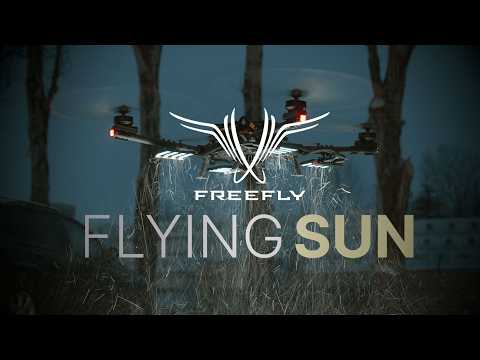
The Flying Sun is an Alta X—Freefly’s flagship heavy-lift quadcopter—equipped with 288 high-power LEDS that produce an incredible 300,000 lumens.
And that alone separates the Flying Sun from other drones-spotlight solutions. While there have been payloads like DJI’s Zenmuse S1 and the newly released spotlight made for the Matrice 350 RTK, no drone has ever been natively equipped with lights for the sole purpose of turning it into a flying lightsource—let alone with almost 300 of them.
Flying Sun Specs & Design
Unless you’re a lighting expert, hearing the Flying Sun can produce 300,000 lumens doesn’t really mean that much.
So let’s make that lumen count more concrete: with its 288 LEDS, the Flying Sun’s lighting is comparable to stadium floodlights. Yes—they are that bright.

Credit: Freefly
Designed for versatility and endurance, the Flying Sun 1000 provides flexible lighting coverage at different altitudes, from focused bright lighting at lower heights to wide-area lighting from higher elevations.

Credit: Freefly
Its power system supports up to 50 minutes of untethered flight. And for extended operations it can be tethered to external power sources for continuous use.
Despite its advanced capabilities, the drone features a compact, foldable design for quick, single-operator deployment in time-sensitive scenarios.
Here are the Flying Sun’s key specs:
- Drone platform. Built on the Alta X heavy-lift quadcopter, known for stability and payload capacity.
- LED array. 288 downward-facing high-intensity LEDs producing 300,000 lumens of light.
- Lighting coverage. Illuminates approximately 14,000 sq ft at 10 foot-candles from 100 feet altitude.
- Wide-area illumination. Covers up to 137,000 sq ft at 1 foot-candle from 316 feet altitude.
- Battery life. Provides up to 50 minutes of untethered flight time on a single charge.
- Tethered operation. Supports continuous power supply via a 5kW+ generator or electric vehicle connection for indefinite use.
- Cooling system. Uses rotor downwash airflow to prevent LED overheating and extend service life.
- Portability. Compact, foldable design enables rapid deployment by a single operator within minutes.
How Much Does It Cost?
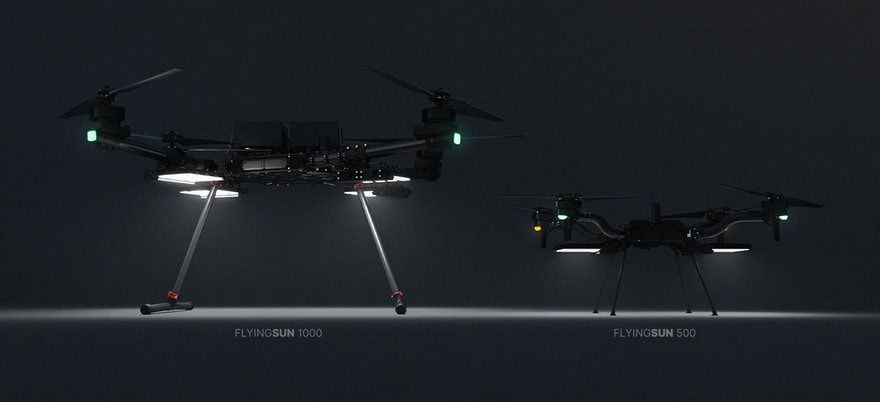
The Flying Sun 1,000, which is the main Flying Sun platform, costs about $60,000.
Freefly is also selling a lower-priced version, the Flying Sun 500, for $50,000.
Credit: Freefly
Here’s what we know about the two versions of the Flying Sun:
| Feature | Flying Sun 500 | Flying Sun 1000 |
|---|---|---|
| Target application | Roadside incidents, accident scenes, emergency work zones; designed for single-person deployment. | Large-scale overhead illumination for search and rescue, construction, emergency response, film production, and other demanding applications. |
| Lighting focus | Targeted, bright, focused illumination for smaller areas. | Diffused, shadow-reducing light from above, illuminating very large areas (up to 137,000 sq ft). |
| Coverage area | Smaller, focused coverage for incident scenes | Up to 137,000 sq ft (about two football fields) at 1 foot-candle; 14,000 sq ft at 10 foot-candles. |
| Power | Continuous operation with shore power or generator. | Continuous operation via tethered power (5kW generator, battery bank, or electric vehicle); short untethered operation possible. |
| Lumens* | Not specified (lower than Flying Sun 1000; designed for targeted illumination). | 300,000 lumens (288 LEDs on four panels). |
*Note: We assume the 500 has less lights on it. But at the moment it seems like Freefly hasn’t yet shared the specs that would allow for a direct Lumen comparison between the two models.
Why Do We Need a Drone Spotlight?
Traditional lighting solutions—such as ground-based towers and portable floodlights—have long been the standard for illuminating worksites, emergency scenes, and outdoor events at night.
But these systems come with significant limitations: they’re heavy, slow to deploy, require substantial manpower, and often struggle to provide uniform coverage in complex or hazardous environments.
Credit: Freefly
As the demands for safety, speed, and flexibility increase across industries, there’s an opportunity to provide a more agile and effective lighting solution. With drones, of course.
We’ve seen this with inspections, where using a drone to collect data is just a lot cheaper, easier, and less expensive than the traditional method.
Drone lighting is the same. The Flying Sun has operational advantages that traditional, ground-based lighting just can’t match:
- Rapid setup. Unlike bulky lighting towers that require transport, assembly, and adjustment, a drone can be launched and positioned in minutes.
- Quiet operation. Emitting just 56 decibels at 100 feet, the drone operates far more quietly than generators or diesel-powered lights, reducing noise pollution and improving working conditions—especially important in residential or sensitive environments.
- Mobility in complex environments. The drone’s ability to hover and reposition mid-air means it can provide consistent illumination even in areas that are inaccessible or hazardous for personnel and equipment.
- Continuous operation. When tethered to a ground power source, a drone like the Flying Sun 1000 can provide uninterrupted lighting for as long as needed, supporting extended missions without the need for battery swaps or generator refueling.
A drone devoted to lighting isn’t just a technological novelty—it’s a practical, game-changing tool that meets the evolving demands of modern nighttime operations. By combining speed, flexibility, and reliability, it empowers teams to work safer, faster, and more effectively, no matter the challenge.
How Will the Flying Sun Be Used?
One of the most critical uses is for a flying spotlight is in emergency response and search-and-rescue missions.
In disaster zones, remote wilderness, or areas with compromised infrastructure, the ability to quickly deploy powerful, mobile lighting can make the difference between life and death. The Flying Sun 1000 can illuminate large swaths of difficult terrain, helping responders locate missing persons, assess hazards, and coordinate rescue efforts with unprecedented efficiency.
And on construction sites, the Flying Sun could allow crews to work late, without needing to spend time erecting and then taking down lighting towers.

Credit: Freefly
Here are all the sectors where the Flying Sun will be useful:
- Emergency response and search-and-rescue. Rapidly lighting disaster zones, wilderness, and hazardous areas for life-saving operations.
- Roadside emergencies. Providing safe, broad illumination for nighttime accident scenes.
- Construction. Allowing teams to continue working even after the sun goes down
- Infrastructure inspection. Enabling detailed assessments of bridges, tunnels, and industrial sites with portable, powerful lighting.
- Film and T.V. production. Replacing large lighting rigs with flexible, creative aerial illumination for dynamic shots and rapid scene changes.
Another potential use case? Making art.
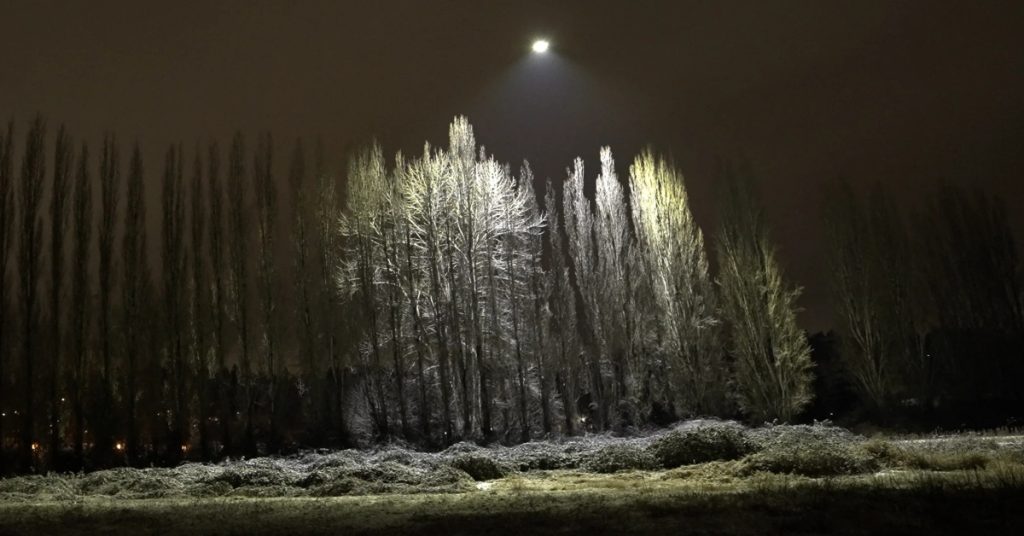
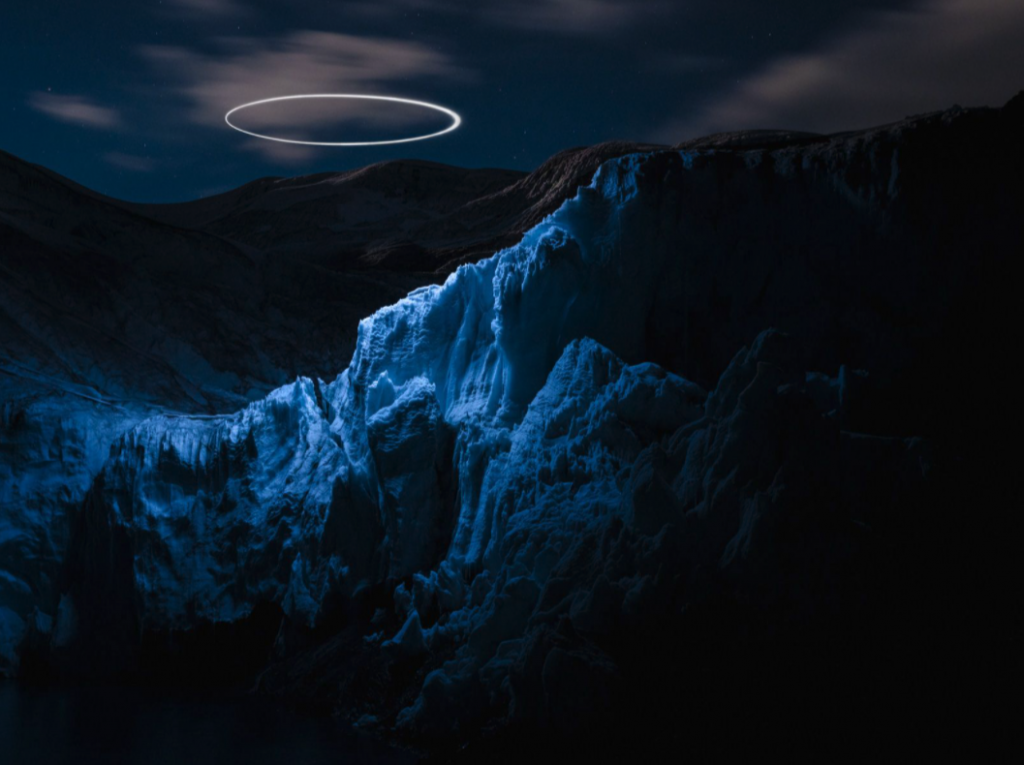
We’d be really curious to see what a master photographer and drone-lighting artist like Reuben Wu—who’s known for his mountain halos made with drone lighting, as well as shooting this incredible photo featured on the cover of Nat Geo, among other things—could do with a drone like the Flying Sun.
Credit: Reuben Wu