Don’t Want a Patchwork of Drone Laws? This FAA Rule Could Help—And Comments Are Open Right Now
BY Zacc Dukowitz
21 May 2026Right now, the FAA has a new proposal live for comment that could shape how drone airspace restrictions work in the U.S. for years to come.
And many drone pilots have never heard of it.
The proposal is tied to Section 2209, a federal law focused on restricting drone flights around certain critical infrastructure sites. And on its face, that sounds reasonable.
But when you look closer, there’s a big concern that the new proposal could lead to a fragmented, site-by-site patchwork of drone restrictions across the country.
That’s because it would allow sites to proactively petition the FAA for drone-specific flight restrictions, making for an ever-changing landscape of where you can and can’t fly.
At the center of the debate is a question that could affect almost every drone pilot: Should drone airspace remain part of one nationally managed FAA system, or slowly turn into a maze of localized restrictions that become harder for drone pilots to track and navigate?
What Is Section 2209?
Section 2209 comes from the FAA Extension, Safety, and Security Act of 2016.
The law directed the FAA to create a process for restricting drone flights around certain fixed-site critical infrastructure facilities. The FAA’s proposal—the one that’s currently open to public comment—focuses on sites like power plants, oil refineries, chemical facilities, and other locations the government considers sensitive from a security standpoint.
The newly released Notice of Proposed Rulemaking (NPRM) lays out how that process could work in practice.
Here’s the catch: under the proposal, qualifying facility owners or operators could apply to the FAA for drone-specific flight restrictions around their sites. If approved, those restrictions would become official FAA-designated no-fly areas for drones.
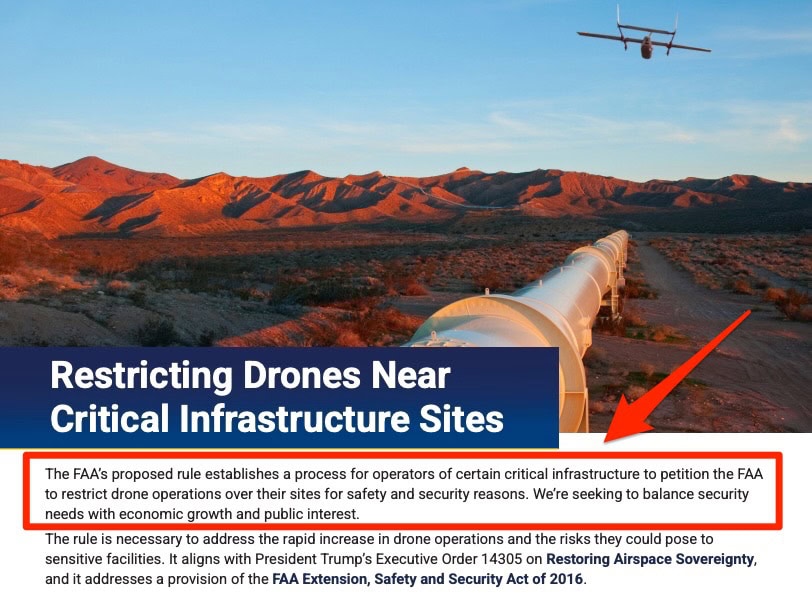
The restrictions wouldn’t apply automatically. Facilities would have to submit requests, provide supporting information, and meet the FAA’s criteria.
But still, this process could lead to a much more fragmented airspace environment, with the potential for large numbers of new restricted areas across the U.S.
See this FAA resource for more on the proposal (this resource is what we screenshotted above).
Why This Proposal Matters
The concern around Section 2209 isn’t whether sensitive infrastructure deserves protection.
Most drone pilots would probably agree that some facilities should have additional security measures in place.
The concern is what happens if the system grows too large or becomes too hard to navigate.
Here’s the core concern:
- The proposal could eventually lead to thousands of site-specific drone restrictions across the U.S.
- Over time, that could make pre-flight planning significantly more complicated for both recreational and commercial pilots.
- Drone groups worry the system could slowly evolve into a maze of localized restrictions of localized restrictions instead of one nationally standardized FAA-managed airspace system.
The underlying concern here is about who controls the national airspace.
Currently, the FAA has federal preemption when it comes to the national airspace.
In plain English, federal preemption means the FAA—not individual states, cities, counties, or private entities—controls U.S. airspace rules.
If too many localized restrictions start appearing through different mechanisms, drone pilots could eventually face inconsistent airspace rules from one area to another.
That’s especially concerning for commercial operators who regularly fly in multiple jurisdictions.
Even now, the airspace landscape is already pretty complex, with Part 107 pilots juggling controlled airspace authorizations, LAANC approvals, Temporary Flight Restrictions (TFRs), Remote ID requirements, NOTAMs, and local operational considerations.
Adding large numbers of infrastructure-specific restrictions could make pre-flight planning a lot more complicated. Especially if pilots have to constantly verify whether new restricted sites have appeared along planned routes or job locations.
What You Can Do Right Now
The FAA is asking for public comments on this proposal.
If you’re concerned, we encourage you to leave a public comment.
Here’s how to do that:
- Go here
- Click the green “Submit a Formal Comment” button
- Write your comment directly into the form or upload a document
- Submit your comment before the deadline closes on July 6, 2026
Tips on Leaving an Effective Comment
Effective comments are typically grounded in real operational experience.
The FAA is most interested in specific operational impacts. How would this proposal impact your work? What real-life consequences could it have on your drone operations?
Here are some things to consider including for an effective comment:
- How do you currently manage airspace compliance?
- Would additional infrastructure restrictions create operational challenges?
- Do you fly commercially across multiple regions or states?
- Could inconsistent restrictions create confusion or safety risks?
- Would the proposal affect your ability to conduct legitimate drone work?