A First on Everest: No-Oxygen Ski Descent Guided by Drones
BY Zacc Dukowitz
12 November 2025In a world first, ski mountaineer Andrzej Bargiel recently climbed Mount Everest without using oxygen, then skied all the way down to Base Camp.
And it would have been impossible without drones.

Drones helped Bargiel with the descent, scouting his route in real-time as he came back down.
Over 6,000 people have summited Everest. But only about 200 have done it without supplemental oxygen, and none of those climbers has gone on to ski straight back to Base Camp as Bargiel did.
The mission took years of planning. Now that it’s complete, Bargiel is the only person to have skied both K2 and Everest—both without oxygen.
Bargiel’s Record-Setting Everest Mission
- World first. First ever full summit-to-Base Camp ski descent of Everest without supplemental oxygen—earlier ski descents either used bottled oxygen or took skis off on key sections.
- 16 hours in the “death zone.” Bargiel spent roughly 16 continuous hours above 4.98 miles (8,000 meters) in Everest’s “death zone,” where the air holds only about a third of the oxygen found at sea level, before clipping into his skis on the summit.
- Multi-day push. He left Base Camp on September 19, summited on September 22, skied down to Camp II that night, and finished the descent back to Base Camp the following day, turning the effort into a multi-day, high-altitude push.
How Drones Made the Mission Possible
The biggest unknown in Bargiel’s descent was the Khumbu Icefall. And this is where the use of drones was essential.
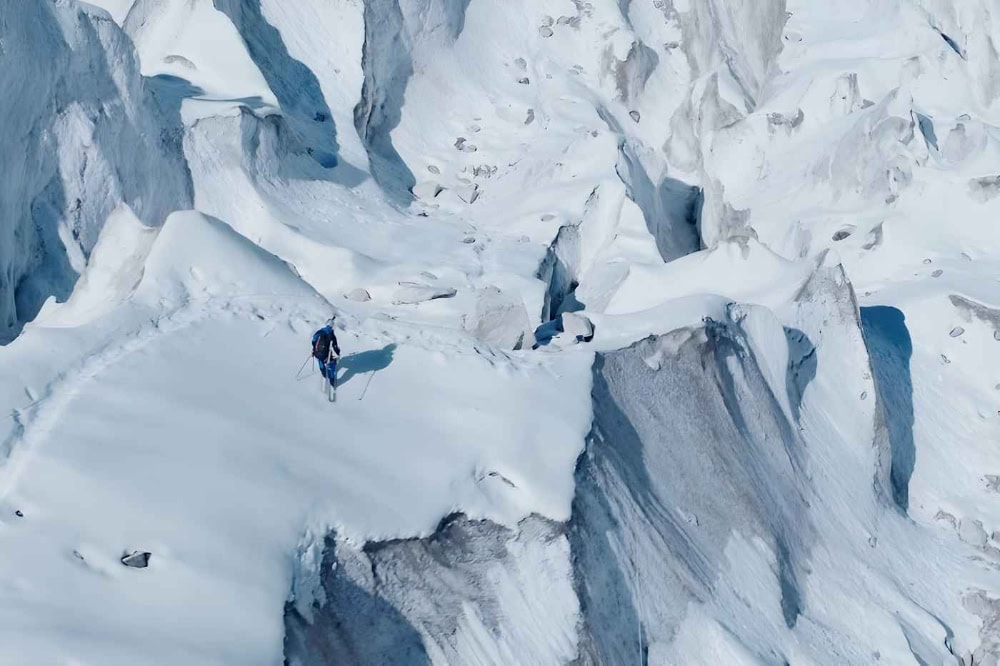
Bargiel skis down the Khumbu Icefall | Credit: Bartłomiej Bargiel/Red Bull Content Pool
Khumbu Icefall is a constantly shifting maze of crevasses and house-sized ice blocks that has killed nearly 50 people since 1953. And in the fall, it’s less traveled and less maintained than during the main spring season.
Traditionally, route finding means putting people directly into harm’s way: Sherpa teams and climbers probing for snow bridges, committing to ladders across crevasses, and hoping nothing collapses overhead while they’re in the line of fire.
But Bargiel didn’t have to do any of this. Instead, as he skied, his brother Bartek flew a drone over his route.
The drone gave Bargiel a live, top-down view, letting him safely thread a line through the dangerous, unstable area instead of guessing from ground level.
With the drone, Bargiel and his team were able to spot dead-ends, identify stable-looking snow bridges, and choose slopes that kept him out from under the most threatening ice towers. And it was all done in real time, while he was skiing down the mountain.
Over 8 Years of Practice and Two Failed Attempts
This record-setting Everest run wasn’t the first time the Bargiel brothers had drones at extremely high altitudes. It wasn’t even the first time they had used drones on Everest.
In fact, they spent years learning how to fly quadcopters in the ultra-thin air near the tops of the world’s highest peaks.
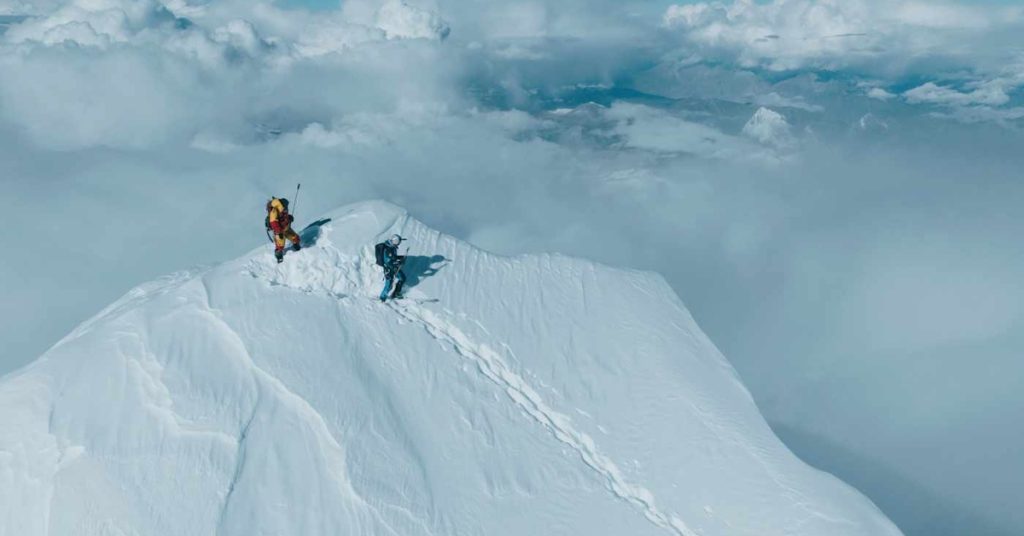
Bargiel on the top of Mount Everest | Credit: Bartłomiej Bargiel/Red Bull Content Pool
Here’s an overview, starting with their first drone-supported descent:
- 2018—K2 ski descent and Broad Peak rescue. Bargiel completes the first full ski descent of K2, with brother Bartek flying a DJI drone to scout his line and film the run. (The same drone is later used to spot and help rescue Scottish climber Rick Allen on nearby Broad Peak.)
- 2019—First Everest attempt. The team’s first try to ski Everest without oxygen is called off after a massive serac (a giant block of ice) overhanging the Khumbu Icefall threatens to collapse.
- 2022—Second Everest attempt. A second expedition reaches the South Col but turns back when extreme winds make it too dangerous to continue toward the summit with skis.
- 2025—Historic Everest ski descent. On the third attempt, Bargiel climbs Everest without supplemental oxygen, spends nearly 16 hours in the “death zone,” and skis all the way back to Base Camp—guided through the Khumbu Icefall by a drone flown by brother Bartek from Base Camp.
By the third attempt, the Bargiel brothers had their drone-supported system dialed.
Andrzej focused on climbing, skiing, and line choice, and Bartek stayed at Base Camp, flying a high-altitude drone over the Khumbu Icefall and calling route updates over the radio as his brother skied below.
In the end, that separation of roles—the skier on the ground and the pilot in the air—was what made the mission possible.