The 15 Biggest Drone Launches of 2025
BY Zacc Dukowitz
16 December 20252025 was one of the most interesting years we’ve seen for drone launches in a long time.
DJI faced serious challenges bringing its drones into the U.S., leading to long periods of scarcity. And this took place under the looming threat of a potential ban, which is still on track to start on December 23.
In DJI’s absence, we saw real competition enter the consumer drone market. Companies like ZeroZero Robotics and Antigravity, the new spinoff from Insta360, put out some high-quality alternatives to DJI.
We also saw major non-DJI releases on the commercial front, with FreeFly, Skyfish, and newcomer SiFly releasing U.S.-made, NDAA-compliant platforms designed to make a big impact on a range of professional operations.
But DJI still dominated the year, accounting for six of the drones on this list across consumer, prosumer, and professional categories.
Here are the top 15 drone launches of 2025.
1. Antigravity A1

The Antigravity A1 was the most surprising and disruptive drone launch of the year.
Created by 360 camera company Insta360, Antigravity entered the drone market with the world’s first off-the-shelf 360-degree drone. It’s the first drone designed specifically around spherical video capture rather than traditional forward-facing cameras.
Instead of worrying about framing while flying, pilots can focus on movement and storytelling, then choose angles later in post. That shift alone makes the A1 one of the most creatively significant drones we’ve seen in years.
Specs & Features
- Camera. Integrated 360° camera capturing full spherical video, allowing reframing after flight; video resolution of 5.7K 360° video (reframed output up to 4K).
- Flight time. About 15 minutes, depending on flight profile.
- Weight. .55 pounds (249 grams).
- Transmission range. 6.2 miles (12 km).
- Obstacle avoidance. Enhanced forward obstacle sensing for smoother, safer flights.
- Control modes. “Point-and-fly” style controls that orient the aircraft based on camera direction.
LEARN MORE
2. DJI Mavic 4 Pro

The DJI Mavic 4 Pro was a massive launch this year. Building on the Mavic 3 line, the Mavic 4 Pro delivered refinements rather than reinvention—better cameras, improved obstacle avoidance, and longer flight times—all wrapped in a familiar, portable form.
But to the frustration of many drone pilots in the U.S., the Mavic 4 Pro didn’t launch here, a fact that was one of the first major signals that DJI’s dominance in the U.S. could be waning.
Specs & Features
- Camera. Triple-camera setup, including a Hasselblad wide camera paired with dual telephoto lenses; main camera resolution is up to 100MP stills/8k video.
- Flight time. Up to 45 minutes, depending on conditions.
- Weight. About 2.2 pounds (about 1,000 grams).
- Transmission range. 18.6 miles (30 km) with the DJI O4+.
- Obstacle sensing. Omnidirectional obstacle detection with advanced APAS flight assistance.
- Intelligent flight modes. Includes ActiveTrack, MasterShots, Waypoints, and advanced return-to-home.
LEARN MORE
3. Potensic Atom 2

The Potensic Atom 2 is a reminder that DJI isn’t the only company pushing capable consumer drones forward.
Positioned as an affordable alternative in the sub-250-gram category, the Atom 2 builds on the original Atom with improvements to image quality, flight stability, and intelligent flight modes. The Atom 2 provides a straightforward flying experience that covers the basics well, making it appealing to beginners and casual pilots who want a capable camera drone without a high price tag.
Specs & Features
- Camera. 1/1.3″ CMOS sensor capable of high-resolution stills and up to 4K video.
- Flight time. Up to 32 minutes.
- Weight. Under 0.55 lb (249 g).
- Transmission range. Up to 6.2 miles (10 km).
- Intelligent flight modes. Includes QuickShots and subject tracking modes.
LEARN MORE
4. DJI Mini 5 Pro

The DJI Mini 5 Pro was the first mini to get LiDAR, and it’s a platform that shows just how much performance DJI can pack into a mini drone.
Building on the Mini 4 Pro, DJI’s latest Mini came with improved image quality, stronger obstacle sensing, and refinements to intelligent flight features, all while retaining a sub-250-gram registration threshold.
Just like the Mavic 4 Pro, the Mini 5 Pro never officially launched in the U.S., making it the second major DJI drone to skip a U.S. release.
Specs & Features
- Camera. 1/1.3″ CMOS sensor capable of high-resolution stills and HDR video at up to 4K at 60 fps.
- Flight time. Up to 34 minutes.
- Weight. Under 0.55 lb (249 g).
- Transmission range. Up to 12 miles (20 km) using DJI O4 digital transmission.
- Obstacle sensing. Omnidirectional obstacle sensing.
- Intelligent flight modes. ActiveTrack, FocusTrack, MasterShots, and QuickShots.
LEARN MORE
5. DJI Neo 2
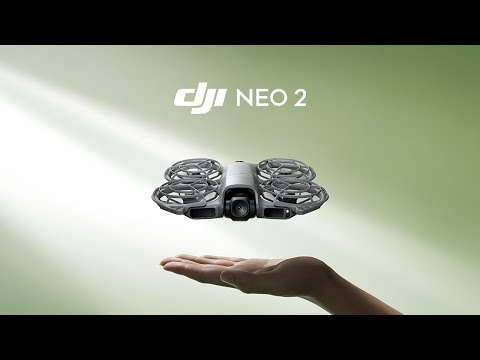
The DJI Neo 2 continued DJI’s push into hands-free selfie drones, focusing almost entirely on autonomous capture rather than manual flight.
Like its predecessor, the Neo 2 was designed for users who want quick aerial shots without learning traditional stick controls. DJI refined the concept this year with improved tracking, smoother subject recognition, and more reliable obstacle avoidance, making the Neo 2 better suited for casual creators, families, and social media users who want a “launch-and-record” experience.
Specs & Features
- Camera. Integrated camera capable of stabilized 4K video.
- Flight time. Up to 22 minutes.
- Weight. Under 0.55 lb (249 g).
- Obstacle sensing. Forward obstacle sensing for collision avoidance during autonomous flight.
- Control system. App-based and gesture-driven autonomous flight modes.
- Launch methods. Hand launch and ground launch supported.
LEARN MORE
6. Freefly Astro Max

The Freefly Astro Max is a big step forward in Freefly’s enterprise drone lineup, building on the original Astro with significantly expanded modularity, endurance, and payload compatibility with high-end sensors.
Built for professional mapping, inspection, and industrial workflows, Freefly made the Astro Max a flexible, open system that can support a wide range of payloads and mission profiles without locking operators into a single camera or ecosystem.
Specs & Features
- Camera. Supports interchangeable payloads, including high-resolution RGB and mapping sensors.
- Flight time. Up to 51 minutes, depending on payload and flight conditions.
- Weight. About 6.6 lb (3 kg) without payload.
- Transmission range. Up to 12.4 miles (20 km).
- Compliance. NDAA-compliant.
LEARN MORE
7. Skyfish Osprey
Credit: Skyfish
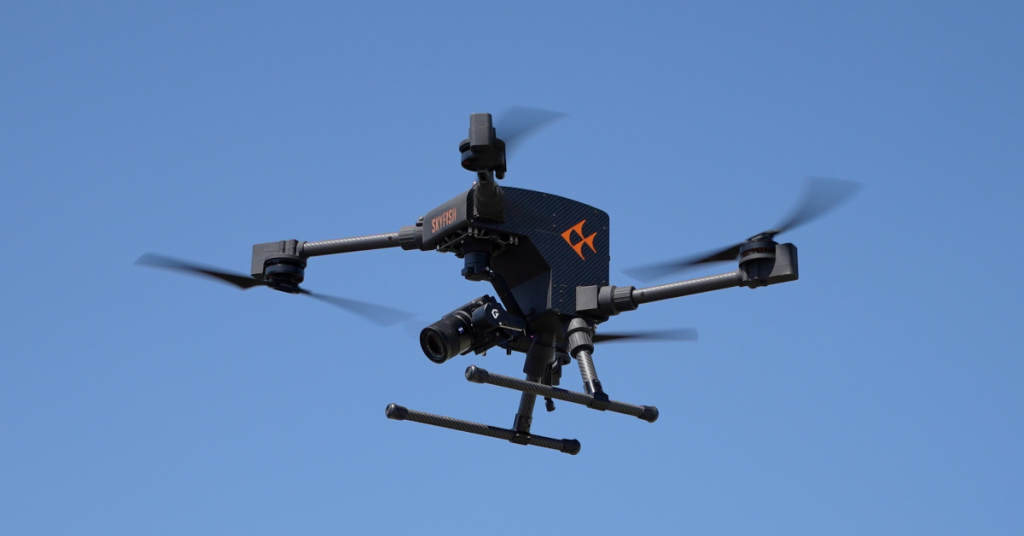
The Skyfish Osprey is an American-made, NDAA-compliant drone built for precision mapping, inspections, and ISR missions.
Rather than chasing portability or consumer features, Skyfish designed the Osprey around accuracy, repeatability, and secure operations. The platform emphasizes stable flight, precise positioning, and support for professional sensors, making it well suited for applications like infrastructure inspection, surveying, and government work where data quality and compliance matter more than convenience.
Specs & Features
- Camera. Supports high-resolution RGB and mapping payloads.
- Flight time. Up to 45 minutes.
- Weight. Approximately 3.7 lb (1.7 kg), depending on configuration.
- Transmission range. Up to 6.2 miles (10 km).
- Compliance. NDAA-compliant and made in the United States.
LEARN MORE
8. SiFly Q12

SiFly’s Q12 stands apart from most drones on this list by prioritizing endurance and range above everything else. Rather than focusing on compact size or portability, SiFly built the Q12 around efficiency, using a hybrid fixed-wing design that allows it to cover vast areas in a single flight.
Designed for long-duration, long-distance missions, the Q12 targets applications like large-area surveying, corridor mapping, and infrastructure inspection—missions where traditional multirotors can’t fly long enough to be practical.
Specs & Features
- Camera. Supports interchangeable payloads, including high-resolution RGB mapping cameras.
- Flight time. Up to 2 hours.
- Weight. Approximately 25 lb (11.3 kg), depending on configuration.
- Transmission range. Up to 56 miles (90 km).
LEARN MORE
9. WingtraRAY
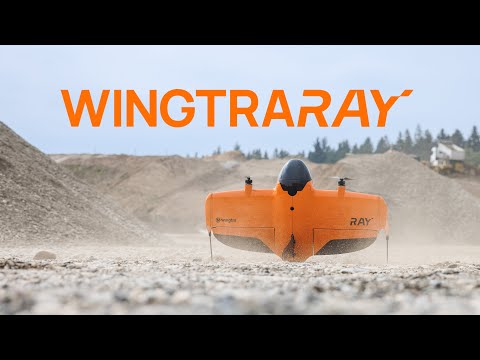
The WingtraRAY brings VTOL efficiency to large-area surveying and mapping.
Built by Wingtra, the WingtraRAY combines vertical takeoff and landing with fixed-wing efficiency, allowing operators to launch from tight spaces while still covering vast areas in a single flight. It’s designed for professional surveyors and mapping teams who need consistent results over large sites without runways, catapults, or complex recovery procedures.
Specs & Features
- Camera. Supports high-resolution mapping cameras for photogrammetry.
- Flight time. Up to 59 minutes.
- Weight. Approximately 9.9 lb (4.5 kg), depending on configuration.
- Transmission range. Up to 6.2 miles (10 km).
LEARN MORE
10. Parrot Anafi UKR

The Parrot Anafi UKR is a rugged variant of Parrot’s Anafi platform built specifically for government and defense use.
Developed in response to real-world operational needs, the Anafi UKR prioritizes reliability, secure communications, and rapid deployment over consumer-friendly features. It’s designed to operate in contested or high-risk environments, where lightweight aircraft, encrypted links, and simple logistics matter more than image quality.
Specs & Features
- Camera. Integrated electro-optical camera with zoom capability.
- Flight time. Up to 32 minutes.
- Weight. Approximately 1.1 lb (500 g).
- Transmission range. Up to 9.3 miles (15 km).
- Communications. Encrypted data link designed for secure operations.
LEARN MORE
11. HoverAir Aqua

The HoverAir Aqua extends the selfie-drone concept into the water, allowing you to get aerial shots easily in situations like swimming, boating, and beach outings. Rather than focusing on manual flight or cinematic control, HoverAir leaned into durability and automation, allowing users to launch the drone, capture footage, and recover it without worrying about splashes or accidental water landings.
Like other HoverAir models, the Aqua emphasizes simplicity and safety over flexibility. It’s aimed at users who want quick aerial clips in places that would normally be off-limits to traditional consumer drones.
Specs & Features
- Camera. Integrated camera designed for automated selfie-style video capture.
- Flight time. About 10–12 minutes.
- Weight. Under 0.55 lb (249 g).
- Water resistance. Designed for operation around water and recovery from water landings.
LEARN MORE
12. Freefly Flying Sun
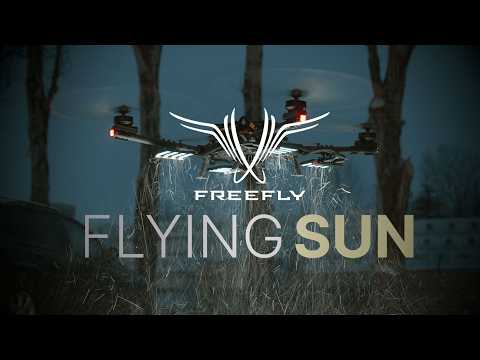
The Freefly Flying Sun isn’t a camera drone—it’s a powerful flying spotlight.
Use cases for the Flying Sun range from film and television production to emergency response, search-and-rescue staging, and nighttime industrial operations. Instead of mounting lights on cranes, towers, or vehicles, teams can deploy the Flying Sun to illuminate large areas quickly from above.
Specs & Features
- Lighting output. High-intensity LED array capable of illuminating large outdoor areas.
- Flight time. Approximately 12–15 minutes, depending on payload and brightness level.
- Weight. Approximately 75 lb (34 kg), including lighting payload.
- Transmission range. Line-of-sight operations dependent on controller and mission setup.
LEARN MORE
13. DJI FlyCart 100

Coming out in late 2025, the DJI FlyCart 100 is DJI’s newest heavy-lift delivery drone in the FlyCart series (the other one is the FlyCart 30).
Built for heavy delivery missions, the FlyCart 100 can carry over 200 pounds and is made for transportation in industrial, emergency response, and infrastructure supply use cases.
Specs & Features
- Payload capacity. Up to 220 pounds (100 kg) with dual batteries.
- Flight time. Up to about 18 minutes with a full payload and up to 40 minutes with no payload, depending on weight and conditions.
- Weight. 154 pounds (70 kg) with no payload; max takeoff weight of 330 pounds (150 kg).
- Range. Up to 12.4 miles (20 km) with a full payload; much farther with lighter loads.
- Flight modes. Tilting rotor design for hybrid VTOL + efficient forward flight.
- Cargo options. Sealed cargo box and integrated winch system.
- Weather performance. IP 55-level protection designed for harsh environments, including wind, cold, and wet conditions.
LEARN MORE
14. DJI Matrice 4

The DJI Matrice 4 emphasizes modular payloads, improved autonomy, and deeper integration with DJI’s enterprise software ecosystem.
It’s also complementary with DJI’s latest dock, the DJI Dock 3. Combining the drone and the dock make a full drone-in-a-box solution, allowing the Matrice 4 to operate autonomously from a fixed location for scheduled missions, remote inspections, and rapid response scenarios without a pilot on site.
Specs & Features
- Camera. Integrated multi-sensor payload with wide-angle RGB, zoom RGB, and thermal camera (model-dependent).
- Flight time. Up to 55 minutes.
- Weight. About 2.6 pounds (1.2 kg).
- Transmission range. 15.5 miles (25 km) with the DJI O4 Enterprise digital transmission.
- Obstacle sensing. Omnidirectional obstacle sensing.
- Weather resistance. Rated for operation in rain, dust, and high winds.
LEARN MORE
15. DJI Matrice 400

The DJI Matrice 400 expands DJI’s heavy-lift enterprise lineup for demanding industrial missions.
The Matrice 400 is built for operations that require longer endurance, heavier payloads, and more complex sensor configurations. It’s designed to support advanced inspection, mapping, and public safety workflows where smaller enterprise drones reach their limits, especially when flying large sensors, LiDAR payloads, or multi-sensor camera systems.
The Matrice 400 continues DJI’s enterprise-first approach, emphasizing redundancy, stability, and compatibility with DJI’s professional software tools. It’s aimed squarely at experienced operators running mission-critical flights, rather than general-purpose or entry-level users.
Specs & Features
- Camera. Supports interchangeable enterprise payloads, including RGB, zoom, thermal, and LiDAR sensors.
- Flight time. Up to 59 minutes, depending on payload and flight conditions.
- Weight. Approximately 15.4 lb (7 kg) without payload.
- Transmission range. Up to 12.4 miles (20 km) using DJI O4 Enterprise transmission.
- Obstacle sensing. Omnidirectional obstacle sensing.