Drone News Roundup: Avata 360 Footage from Denis Barbas, BRINC Guardian Launch, and More!
BY Zacc Dukowitz
30 March 2026This week we’re covering new cinematic footage shot on the DJI Avata 360 by Denis Barbas.
We’re also covering BRINC’s new Guardian DFR drone, rare footage of a sperm whale giving birth captured by drone, DJI suing Insta360, and drone bees helping pollinate crops.
Now on to the links!
New DJI Avata 360 Cinematic Footage

Drone videographer Denis Barbas has released new cinematic footage shot with the DJI Avata 360, offering one of the first extended looks at what the drone can do in real-world conditions. The video leans into 360 capture, showing how footage can be reframed in post to create smooth, flowing camera movements that would be hard to execute in a single pass. The footage was shot in several far-flung locations, including ice caves and waterfalls in Iceland and scenic coastlines in Sardinia, highlighting the drone’s ability for both immersive 360 capture and beautiful FPV shots.
LEARN MORE
BRINC Launches Guardian DFR Drone, Opens Seattle Factory

Public safety drone company BRINC just launched the Guardian, a new drone designed specifically for Drone as First Responder (DFR) programs. At the same time, it announced plans for a new manufacturing facility in Seattle, signaling BRINC’s push to scale domestic production as demand grows for U.S.-made public safety drones.
The new Guardian drone is made for rapid deployment in law enforcement and other public safety scenarios, with features aimed at improving response times and situational awareness. Here are its standout features:
- Advanced imaging. Features dual 4K visual cameras with 640x zoom (40x optical), dual HD thermal imagers with 64x zoom (4x optical), SkyBeam spotlight, and laser rangefinder up to 4,900 ft.
- Long flight time. 62 minutes flight time, 60 mph top speed, IP55 weather resistance, and 44 lbs max weight for pursuing vehicles and covering large areas.
- Interaction tools. 130 dBA siren (3x louder than police sirens), loudspeaker, emergency lights, and 10 lbs payload capacity for AEDs, trauma kits, or hazmat sensors.
- BVLOS safety features. ADS-B receiver, anti-collision beacon, integrated parachute, and dual RTK GNSS for precise beyond-visual-line-of-sight flights.
- Automation and durability. Robotic battery swapping and payload loading, integrated radar/LiDAR obstacle avoidance, plus Kevlar-reinforced carbon fiber design.
LEARN MORE
Rare Drone Footage Captures Sperm Whale Giving Birth in the Wild

This drone footage from Project CETI—a non-profit devoted to listening to and translating sperm whale communication—shows what appears to be one of the first recorded instances of a sperm whale giving birth in the wild. The aerial view provides a clear look at behavior that would be almost impossible to observe from a boat, including the moment of birth and the surrounding pod’s response. A moving part of the footage that caught our attention was when the pod of whales closely surrounds the mother during birth. Researchers believe this behavior may help protect the calf in its first moments.
LEARN MORE
DJI Sues Insta360 Over 360 Drone Patent Dispute
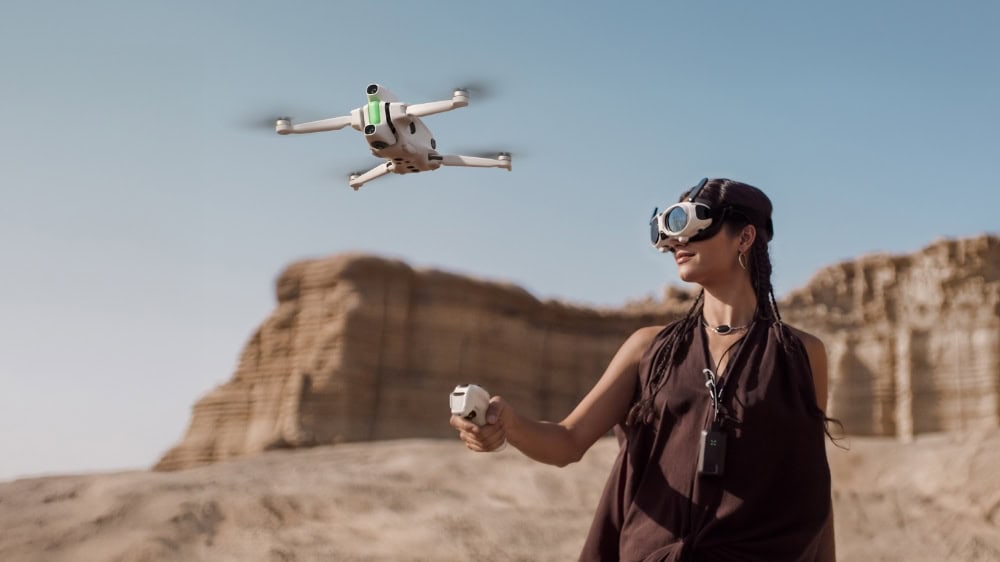
The A1 360 drone, from Insta360’s drone company Antigravity | Credit: Antigravity
DJI is suing Insta360 over alleged patent infringement. The lawsuit comes right as DJI is launching its own 360 drone—the Avata 360—escalating a rivalry that’s now playing out in both the market and the courtroom. At the heart of the case are claims that Insta360 hired former DJI employees, who brought over technology DJI says rightfully belongs to it. According to reporting, the dispute involves a range of patents tied to drone flight control, hardware design, and image processing, not just 360 capture features.
LEARN MORE
Drone “Bees” Are Being Used to Help Pollinate Crops
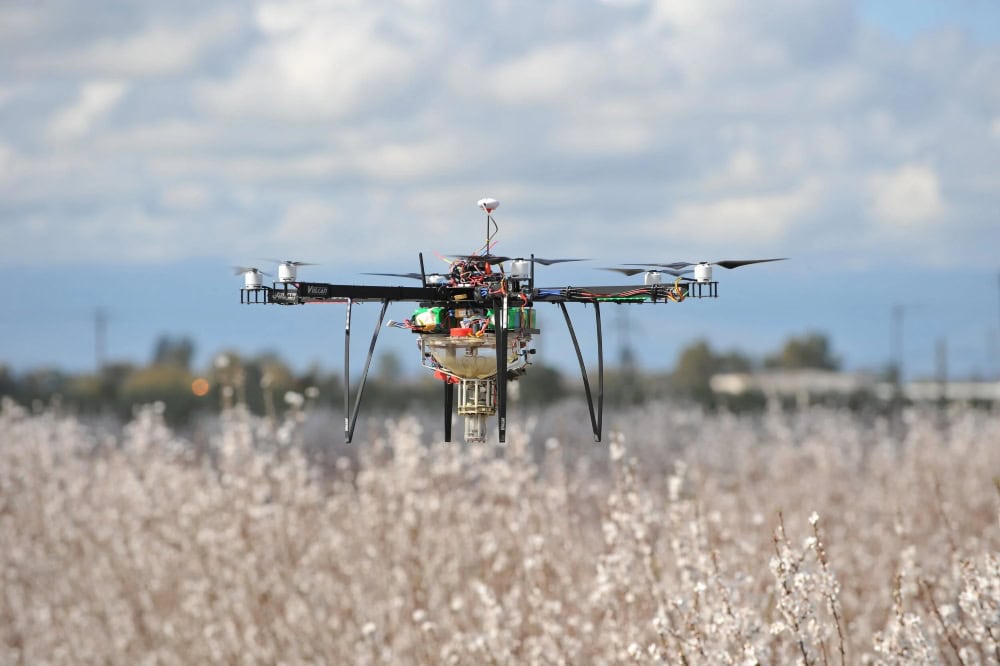
Credit: Dropcopter
Companies like Dropcopter are using drones to help pollinate crops, offering an alternative or supplement to traditional bee pollination. The drones disperse pollen over fields with controlled application, which can be especially useful in scenarios where natural pollinator populations are low or conditions limit bee activity. While still an emerging approach, drone-based pollination is gaining traction in agriculture as growers look for more reliable ways to ensure crop yields. With bee populations under pressure globally, this approach could provide a supplemental tool to help maintain pollination in certain crops and conditions where traditional methods fall short.
LEARN MORE
Make sure to sign up for our free weekly newsletter using the button below so you can get our weekly newsletter every Saturday, with this roundup and our other featured stories from the week.