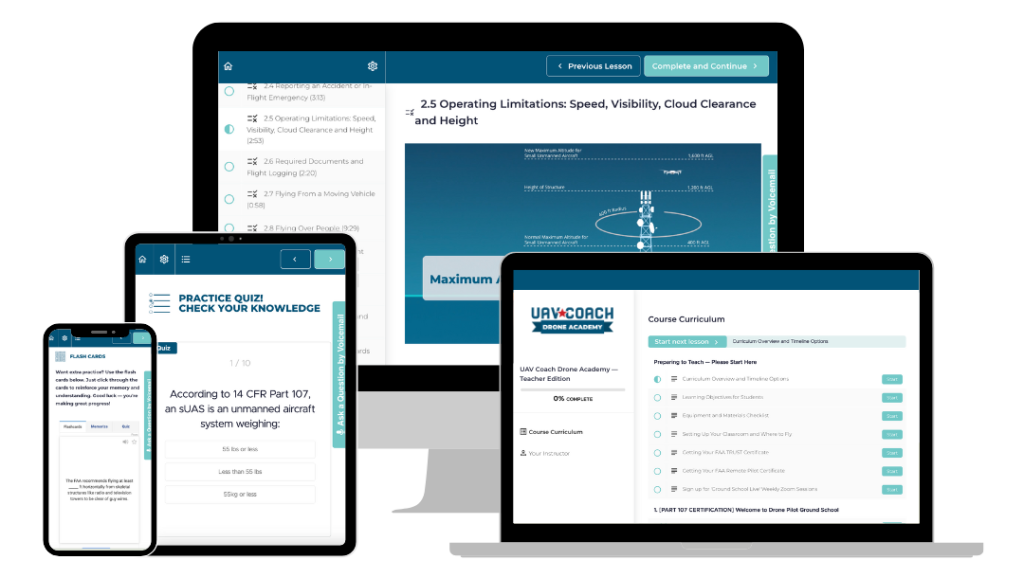
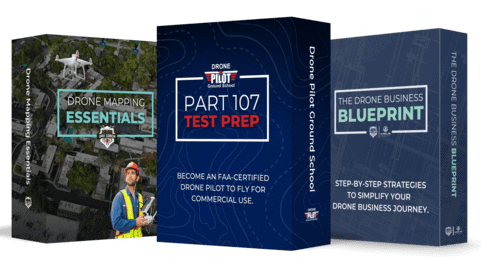
See how content is structured, how teaching notes are provided, and how students progress through the material — so you can decide if it’s the right fit for your classroom.

Students gain the skills and knowledge to get a drone pilot’s license and fly a drone for hire. From public safety departments to construction companies, many industries need drone pilots.

This turnkey program adapts to your schedule – quarter, semester, year-long, after school, or summer. Ideal for high school, college, and CTE classrooms.

Teachers get their own portal with teaching resources that include an orientation to the course materials, teacher notes and teacher guides for all classroom activities.

Educators get a progress report with their students’ scores on the knowledge checks and practice exams, so you can see how they’re doing before they go to take the FAA exam.

Our dynamic instructor turns dry concepts like regulations into digestible lessons that are enjoyable to watch. We also include the full lesson text for those who learn best by reading.

Each module includes classroom activities that help students apply the knowledge to real-world scenarios that turn theory into action.

We use multiple teaching methods, including flash cards and quizzes, to make sure the knowledge sticks for every type of learner.

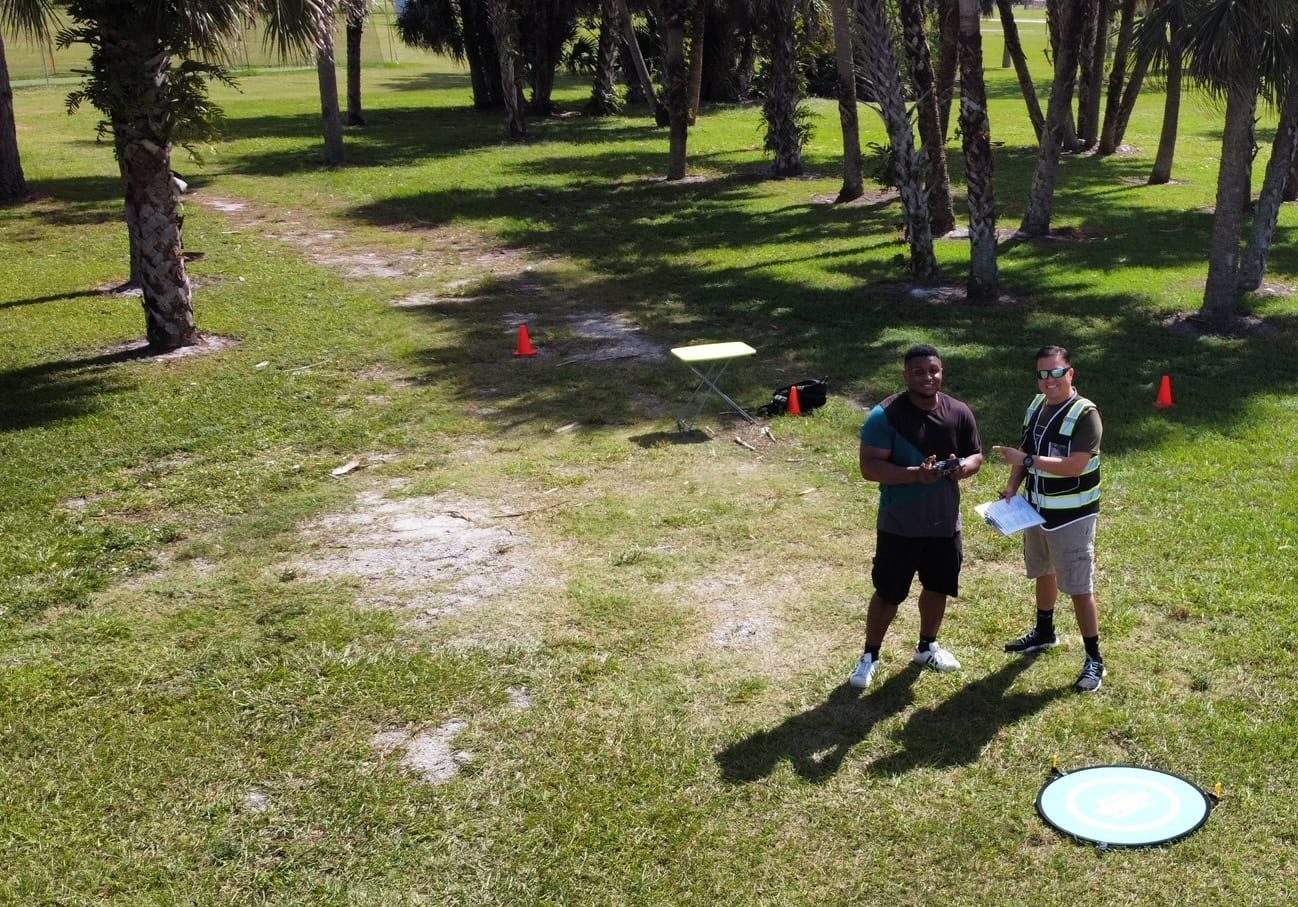
Students learn how to operate a drone, including safety procedures, operational checklists and real-world scenarios.

1.1 Course Orientation & Quick Tips
1.2 Download the PDF Test Supplement
1.3 Common Drone Industry Terms (Glossary)
2.1 Intro to Part 107 Regulations
2.2 Crew Member Definitions
2.3 Registering Your Drone
2.4 Reporting an Accident or In-Flight Emergency
2.5 Operating Limitations: Speed, Visibility, Cloud Clearance
2.6 Required Documents and Flight Logging
2.7 Flying from a Moving Vehicle
2.8 Flying Over People
2.9 Flying Visual Line-of-Sight
2.10 Alcohol, Drugs, and Physiology
2.11 Airspace Authorization and Operational Waivers
3.1 Anti-Collision Lighting and Civil Twilight Hours
3.2 Night Ops Environment & Best Practices
3.3 How Your Eyes Function at Night
3.4 Understanding Visual Illusions
4.1 Class B Airspace
4.2 Class C Airspace
4.3 Class D Airspace
4.4 Class E Airspace
4.5 Class G Airspace
4.6 Special Use Airspace
4.7 Military Training Routes (MTRs)
4.8 TFRs and NOTAMs
5.1 What’s a Sectional Chart?
5.2 Latitude and Longitude
5.3 VFR Checkpoints
5.4 Notification Boxes
5.5 MSL vs. AGL
5.6 Airport Icons and Data
5.7 Isogonic Lines
5.8 Maximum Elevation Figures
5.9 Victor Airways
5.10 Advanced Sectional Chart Interpretation
6.1 Reading a Chart Supplement
6.2 Runways and Traffic Patterns
6.3 Right of Way
6.4 Towered vs. Non-Towered Airports
6.5 Airport Signs and Markings
7.1 Standard Conditions and Density Altitude
7.2 Wind and Currents
7.3 Moisture, Fog and Frost
7.4 Reading a METAR Report
7.5 Reading a TAF Report
7.6 Operating in Extreme Weather
7.7 Clouds, Ceilings and Visibility
7.8 Stable vs. Unstable Air (Understanding Air Masses)
8.1 Hazardous Flight Operations
8.2 Emergency Operations
8.3 Lost Link Procedures
8.4 LiPo Batteries
8.5 Aeronautical Decision-Making (ADM)
8.6 Crew Resource Management (CRM)
8.7 PAVE, IMSAFE & DECIDE Models
8.8 5 Hazardous Attitudes
8.9 Radio Communications
8.10 UAS Loading and Performance
8.11 UAS Maintenance and Inspection
8.12 Preflight Checklist
8.13 Remote Identification (Remote ID)
9.1 Full-Length Practice Tests
9.2 Cram Sheet (Am I Ready to Take the Test?)
9.3 Getting Your FAA Tracking Number (FTN) and Booking Your Exam
9.4 Test Day Checklist
9.5 Using IACRA to Apply for Your Remote Pilot Certificate
9.6 How to Renew Your FAA Part 107 Remote Pilot Certificate
10.1 Overview of FAA Drone Rules
10.2 Drone Registration Walkthrough
11.1 Do I Need Airspace Authorization?
11.2 How to Get Airspace Authorization (Using LAANC)
11.3 How to Get Airspace Authorization (Using FAA DroneZone)
11.4 A Few Days Before Your Flight
11.5 The Night Before (or Morning of) Your Flight
12.1 Your Guide to Drone Hardware & Flight Controls
12.2 Mastering the Basic Flight Maneuvers
12.3 How Return to Home (RTH) Works
12.4 Risk Management (AKA Planning for What Can Go Wrong)
12.5 Using Intelligent Flight Modes
12.6 Cinematic Maneuvers & Settings to Level Up Your Drone Shots
12.7 NIST Bucket Training
13.1 Drone Industry Pathways & Careers
13.2 Real Estate & Event Marketing
13.3 Construction
13.4 Energy & Utilities
13.5 Public Safety
13.6 Agriculture
13.7 Starting a Drone Services Business

Drones provide students with a unique opportunity to apply STEM concepts in real-world scenarios. From physics and engineering to coding and design, drones bring lessons to life and foster a deeper understanding of technology and problem-solving.

Students have the opportunity to research challenging environments and tackle complex problems while staying safe. They can map rugged terrains, explore engineering solutions, or simulate disaster response scenarios, all within a secure and controlled setting.

Drones help students think on their feet and prioritize tasks effectively. Whether in group projects or competitions, drones encourage real-time problem-solving, teamwork, and the ability to develop solutions under tight deadlines.
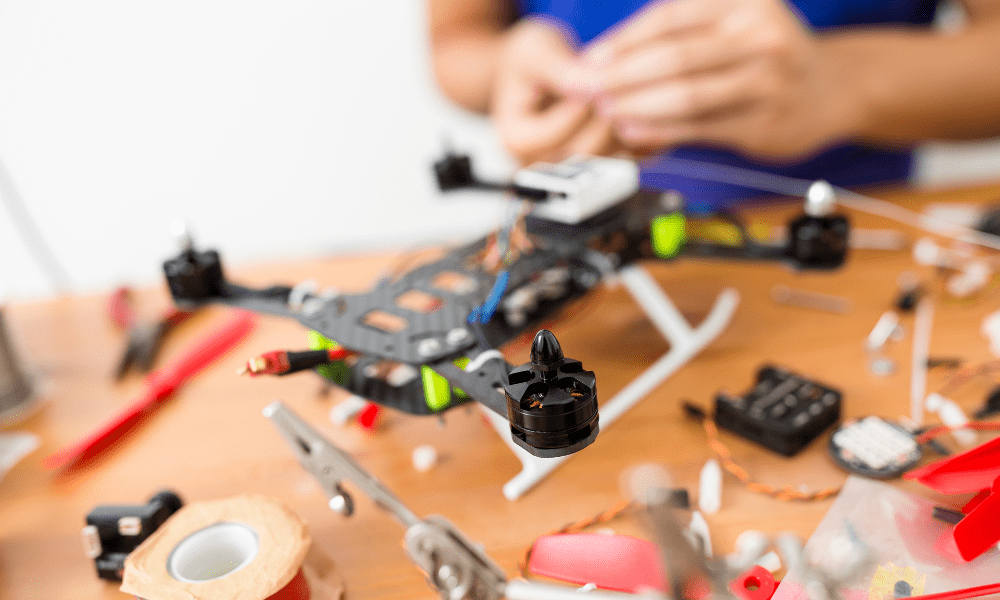
With thermal imaging, high-resolution cameras, and advanced sensors, drones introduce students to emerging career paths in fields like environmental science, search and rescue, filmmaking, and more. By learning to operate and maintain drones, students gain a head start in industries poised for growth.
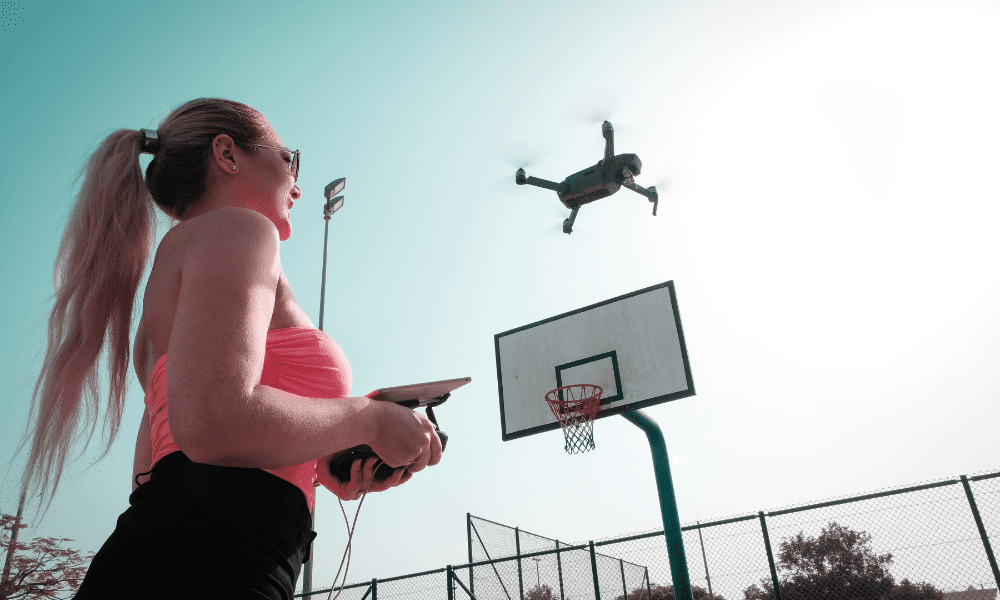
Drones provide schools with an affordable way to enhance lessons across STEM, arts, and other subjects. Their versatility and reusability make them an excellent long-term investment, offering engaging, hands-on learning experiences while staying within budget.
We’ll send an invoice to you and/or the appropriate person in your organization, and we accept payments by credit card, PayPal and check.
Yes, we’ll process your purchase order and issue an invoice.
If your institution is tax-exempt, please email a copy of your state-issued tax-exempt form to enroll@uavcoach.com, including the number of people you wish to enroll.
Sure, we’re happy to provide the necessary information to officially get set up in your system.
Yes, each teacher gets access to live progress reporting, including student knowledge check and practice exam scores. Contact enroll@uavcoach.com for assistance.
It’s to your advantage to have your own log-in so you can easily track your progress through the course. We operate on the honor system and reserve the right to revoke access if we see an unusually high number of log-ins from the same account.
Yes, you can transfer an enrollment to another team member if the original enrollee completed less than 25% of the course. This substitution option is made available one time for each paid enrollment seat at no additional cost. Contact enroll@uavcoach.com for assistance.
This course includes 30+ hours of structured curriculum and each paid enrollment retains access to their account for one academic year.
Our course is best completed online because it allows you to work at your own pace and to go back to any lesson as many times as you need.
Yes, if you’re looking for additional training or curriculum please contact training@uavcoach.com for pricing and scheduling.