DJI’s New Lito Series Targets Beginner Pilots—But Not in the U.S. Just Yet
BY Zacc Dukowitz
23 April 2026DJI has launched a new pair of beginner drones: the Lito 1 and the Lito X1.

At first glance, they look a lot like Minis. They’re small, foldable, under 249 grams, and built around the kind of simple, approachable flying experience DJI has spent years refining.
But these aren’t just toned-down Minis.
The Lito line looks like a new entry point in DJI’s lineup—one aimed squarely at beginners, with the X1 adding a few higher-end features for people who want a little more room to grow.
DJI has launched the Lito series outside the U.S., with European pricing starting at €339 for the Lito 1 and €419 for the Lito X1. But there’s still no official U.S. launch date (roughly $396 and $489).
(For reference, the Avata 360 just went on sale in the U.S.—about a month after its global launch).
What the Lito 1 and Lito X1 Actually Are
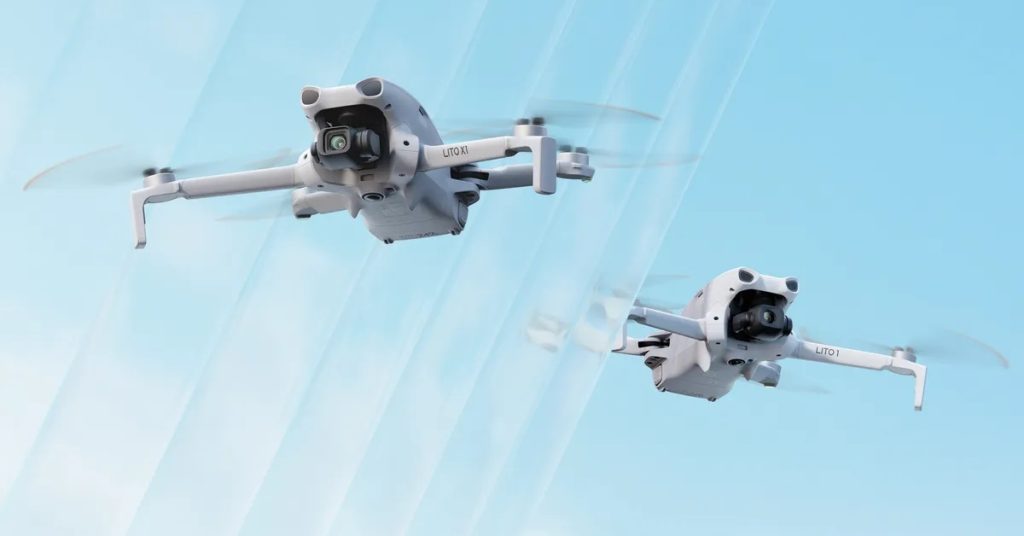
The Lito 1 and Lito X1 are lightweight camera drones made for new drone pilots.
Both come in under 249 grams, which keeps them below the FAA’s registration threshold for recreational flyers.
Both are designed to be easy to carry, quick to launch, and simple to fly. And both offer more than the bare-minimum beginner specs DJI used to reserve for its cheapest models.
Credit: DJI
The Lito 1 is the simpler of the two. It has a 1/2″ sensor, shoots 4K video at up to 60fps, and is clearly positioned as the lower-cost, easier-to-use option.
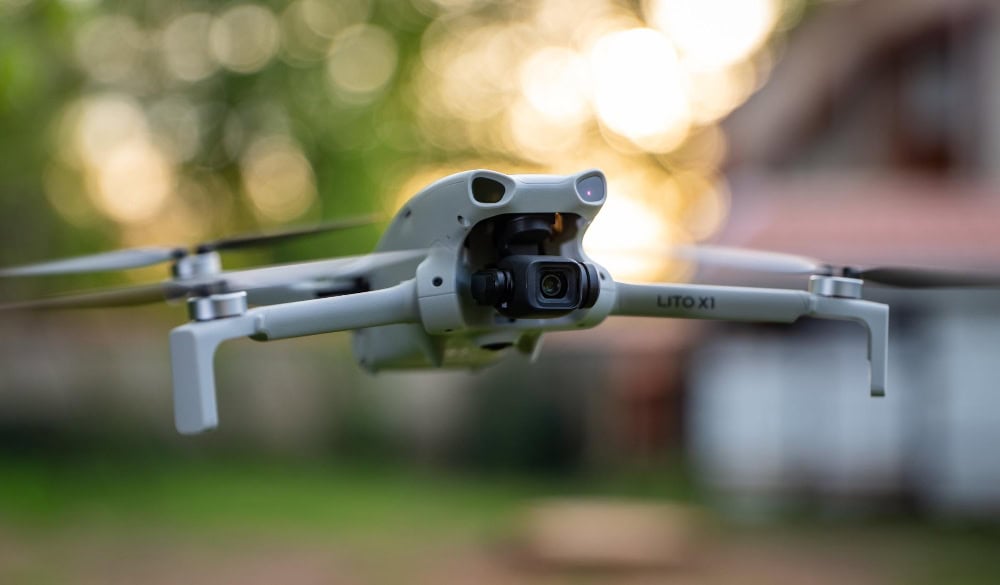
The Lito X1 is a step up in quality and capabilities. It gets a larger 1/1.3″ sensor, and supports HDR video, 4K/100fps slow motion, and 10-bit D-Log M, and comes with 42GB of built-in storage. It also adds forward-facing LiDAR to support DJI’s omnidirectional obstacle sensing system.
If the Lito 1 is meant to get beginner drone pilots in the air, the X1 looks like it’s meant to keep them in the air longer—offering better image quality and more confidence in tighter or lower-light conditions.
Specs and Features for the Lito Series
Here’s the quick version of what separates the two Lito models—and how they compare to the top- and bottom-tier Minis:
| Spec | DJI Lito 1 | DJI Lito X1 | DJI Mini 4K | DJI Mini 5 Pro |
|---|---|---|---|---|
| Weight | Under 249 g | Under 249 g | Under 249 g | Under 249 g |
| Starting price | About $396 (€339 ) | About $489 (€419) | About $299 | About $759 |
| Sensor | 1/2″ CMOS | 1/1.3″ CMOS | 1/2.3″ CMOS | 1″CMOS (higher-end camera system) |
| Video | 4K/60fps | 4K/60fps HDR, 4K/100fps slow motion, 10-bit D-Log M | 4K/30fps | 4K/60fps HDR, 4K/120fps slow motion, 10-bit D-Log M/HLG |
| Obstacle sensing | Basic obstacle sensing (no LiDAR) | Omnidirectional with forward-facing LiDAR | Downward vision system | Omnidirectional with LiDAR |
| Flight time | Up to 36 minutes | Up to 36 minutes | Up to 31 minutes | Up to 36 minutes |
| Storage | microSD (no internal storage) | 42GB internal storage + microSD | microSD (no internal storage) | 42GB internal storage + microSD |
| Who it’s for | New pilots who want an easy first drone | Beginners who want more room to grow | Budget-minded beginners | Pilots who want top-tier mini performance |
The chart makes the positioning pretty clear.
The Lito 1 looks like a step above the cheapest beginner options, like the Mini 4K.
And the Lito X1 starts to blur with the lower end of the Mini line, but it doesn’t reach the higher-end capability of something like the Mini 5 Pro.
A New Entry-Level Line that Sits Awkwardly Next to the Mini Series
For a long time, the Mini line was DJI’s obvious recommendation for beginners. If you wanted something small, capable, and easy to travel with, you bought a Mini.
The Lito series complicates this.
On one end, the Lito 1 gives DJI a cleaner entry-level option than the Mini line offers. On the other, the Lito X1 overlaps with the Mini 5 Pro just enough to make it a little confusing why it was made.

Credit: DJI
With the X1, you lose some of the Mini 5 Pro’s higher-end appeal. But you do get a bigger step up from the base model than many people might expect from a “beginner” drone series.
And maybe that’s the point.
As DJI’s Mini drones have become more capable—and more expensive—it makes sense to create more separation below them. The Lito series fits that space: more capable than the cheapest beginner options, but still clearly below DJI’s top-tier Mini drones.
Why the LiDAR on the X1 Matters
The most notable feature in the Lito series isn’t the camera. It’s the LiDAR on the X1.
The Lito X1 | Credit: DJI
This kind of sensing has typically been reserved for higher-end drones. But now it’s showing up in a beginner-focused model.
LiDAR-based obstacle sensing works differently than the vision-based systems DJI has used for years. Instead of interpreting what a camera sees, it actively measures distance using laser pulses.
In practice, that matters most in situations like:
- Flying at dusk or in low light
- Navigating around trees or buildings
- Dealing with shadows or low-contrast surfaces
These are conditions where vision sensors can struggle. LiDAR tends to be more consistent because it doesn’t rely on ambient light or texture in the same way.
This doesn’t make the X1 crash-proof. But it may help you avoid crashing in difficult scenario, which could be especially important for newer pilots.
For a beginner drone, that’s a meaningful shift—and a sign that safety and confidence are becoming just as important as camera specs.
For now, the real question isn’t what the Lito series can do. It’s whether you’ll actually be able to buy one any time soon.