What Are Autonomous Drones? A Practical Guide for Pilots
BY Zacc Dukowitz
1 April 2026An autonomous drone is a drone that can perform tasks and make certain decisions without direct, continuous input from a human pilot.
In many cases, the drone is only one part of an autonomous system.
True autonomy usually involves onboard sensors, AI-driven navigation, cloud software, and sometimes a docking station that lets the drone launch, land, and recharge on its own.
→ Jump to the top autonomous drone companies
That doesn’t mean it operates completely on its own in every situation. In most real-world deployments, a human is still involved at some level—monitoring operations, approving missions, or stepping in when needed.
In this guide, we’ll separate what’s real and what’s just hype when it comes to autonomy, and go into how autonomy actually works in practice.
Here’s a menu in case you’d like to jump around:
- What Is an Autonomous Drone?
- Top Autonomous Drone Companies
- How Autonomous Drones Actually Work
- Key Drone Autonomy Terms: Drone-in-a-Box, DFR & More
- Where Autonomous Drones Are Used Today
- 4 Main Limits of Autonomous Drones
- Autonomous Drone FAQ
What Is an Autonomous Drone?
Autonomous drones are one of the most talked-about developments in the drone industry—but the term is often misunderstood.
At a basic level, an autonomous drone is any drone that can perform tasks and make some decisions without constant human control. But in practice, there’s a big difference between a drone that follows a pre-programmed route and one that can actively navigate, adapt, and respond to its environment.
That distinction matters because most drones today are not fully autonomous. They’re automated, assisted, or conditionally autonomous depending on how they’re used.
The key difference comes down to decision-making:
- Manual. A drone flown manually relies entirely on a pilot’s inputs.
- Automated. An automated drone follows pre-programmed instructions, like flying a waypoint route for a mapping mission.
- Autonomous. An autonomous drone can adjust its behavior based on what it senses: avoiding obstacles, changing its path, or responding to changing conditions.
These differences matter, and blurring them can create confusion. Many drones marketed as “autonomous” today are actually automated—they can repeat flights or follow routes, but they aren’t actively making decisions in real time.
True autonomy usually involves several technologies working together, including computer vision, onboard processing, and advanced navigation systems.
Levels of Drone Autonomy
Autonomy isn’t an on-or-off feature.
It exists on a spectrum, from fully manual flight to systems that can run repeatable missions with very little human involvement.
Here’s how autonomy scales across a typical drone operation:
| Level | What It Means | Example |
|---|---|---|
| 1. Manual | Pilot controls all movement | FPV flying, manual inspection flight |
| 2. Assisted | Basic safety and stabilization features | GPS hold, return-to-home |
| 3. Automated | Follows pre-programmed routes | Waypoint mapping mission |
| 4. Conditional autonomy | Can react and adapt during flight | Obstacle avoidance, subject tracking |
| 5. System-level autonomy | Integrated system runs missions with minimal input | Drone-in-a-box inspections |
Key takeaway: most drones today sit somewhere in the middle. They combine automated workflows with some autonomous behaviors, rather than operating as fully independent systems.
Why Companies Are Investing in Autonomous Drones
Companies are investing in autonomous drones for a simple reason: they make drone operations easier to scale.
That doesn’t mean autonomy makes sense for every mission. But in workflows that are repetitive, time-sensitive, or spread across large sites, it can reduce labor, speed up response, and make data collection more consistent.
A big part of that value comes from repeatability. If a company needs the same flare stack, substation, perimeter, or job site documented every day or every week, an autonomous or semi-autonomous system can handle more of that workflow without requiring a pilot to fly every mission manually.
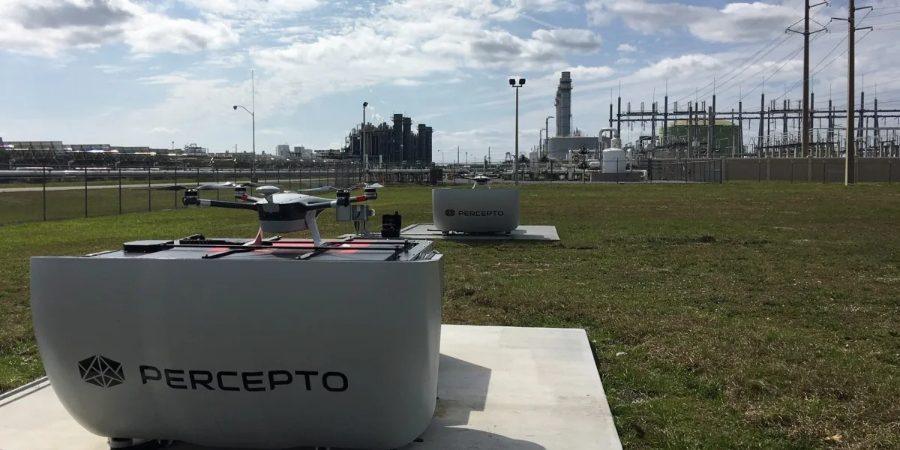
Percepto’s autonomous drone-in-a-box solution is used for continuous monitoring | Credit: Percepto
This is where automated data collection becomes so important.
Autonomous systems are often less about replacing people and more about creating a reliable way to gather the same data over time. For inspections, mapping, and monitoring, that consistency can be just as valuable as speed.
In other words, they’re not just buying a drone—they’re investing in a system that can help them run more missions with less manual effort.
Will Autonomous Drones Replace Drone Pilots?
Probably not.
What autonomy is more likely to do is change the role of the drone pilot, not eliminate it.
In traditional workflows, the pilot is responsible for almost everything: planning the mission, flying the aircraft, collecting the data, and reacting to conditions in real time.
As autonomy increases, more of that work shifts to the system. The drone can handle more of the flight itself, especially in repeatable missions, while the human moves into more of an operator, supervisor, or workflow-management role.
But even highly autonomous systems still depend on people to plan missions, monitor operations, review data, respond to anomalies, and step in when something unexpected happens.
In regulated environments, they also depend on human accountability. For the most part, operators still need to fly within visual line of sight unless they have approval for something more expansive, which is one reason human oversight remains central to commercial drone operations today.
It’s true that autonomy will reduce some kinds of manual flying, especially in repetitive commercial missions. But it will also create more demand for people who know how to deploy, monitor, troubleshoot, and manage drone systems.
The Top 5 Autonomous Drone Companies
If you’re researching autonomous drones from a product or deployment perspective, it helps to think in terms of companies and systems—not just individual drones.
Most real-world autonomous deployments involve a full stack: the drone, onboard sensors, cloud software, and often a docking station that enables remote or unattended operations.
Here’s our list of the most important commercial autonomy and automation players in the drone industry.
1. Skydio

Credit: Skydio
Mainly used in: Public safety (DFR programs), infrastructure inspection, defense and government
Skydio approaches autonomy differently than most companies. Instead of focusing only on docking infrastructure, it emphasizes onboard autonomy powered by computer vision and AI.
Its drones are designed to navigate complex environments in real time, making them well-suited for inspections, public safety, and missions where GPS may be unreliable or obstacles are dense.
Flagship autonomous systems:
- Skydio X10 (enterprise inspection and public safety drone)
- Skydio Dock (automated deployment system)
Key autonomy capabilities:
- Real-time obstacle avoidance using computer vision
- Autonomous navigation in GPS-denied environments
- AI-assisted tracking and inspection workflows
2. Percepto

Credit: Percepto
Mainly used in: Oil and gas, utilities, and mining
Percepto is one of the leading companies focused specifically on fully autonomous drone-in-a-box systems for industrial monitoring and inspection. Its platform is designed for persistent operations—meaning drones can be deployed at a fixed site and run recurring missions without requiring a pilot on location.
The company’s system combines aircraft, dock, and cloud software into a single workflow, with a strong emphasis on remote operations and centralized monitoring across multiple sites.
Flagship autonomous systems:
- Percepto Air (inspection drone platform)
- Percepto Base (drone-in-a-box docking station)
Key autonomy capabilities:
- Automated launch, landing, and charging from a fixed dock
- Scheduled and on-demand inspection missions
- Remote operations with centralized fleet management
3. Airobotics

Credit: Airobotics
Mainly used in: Industrial security, oil and gas, infrastructure monitoring
Airobotics was one of the earliest companies to build fully automated drone-in-a-box systems for industrial and security applications. Like Percepto, it focuses on persistent, unattended operations—but with an emphasis on continuous deployment and system-level automation.
Its platform is designed to operate with minimal human involvement on-site, making it a fit for facilities that require constant monitoring or rapid response capability.
Flagship autonomous systems:
- Optimus System (automated drone + docking infrastructure)
Key autonomy capabilities:
- Automated drone deployment and recovery from a dock
- Continuous, remote operation across fixed sites
- Integrated workflows for recurring missions
4. Zipline
Credit: Zipline
Mainly used in: Delivery and logistics for healthcare, e-commerce, and food delivery
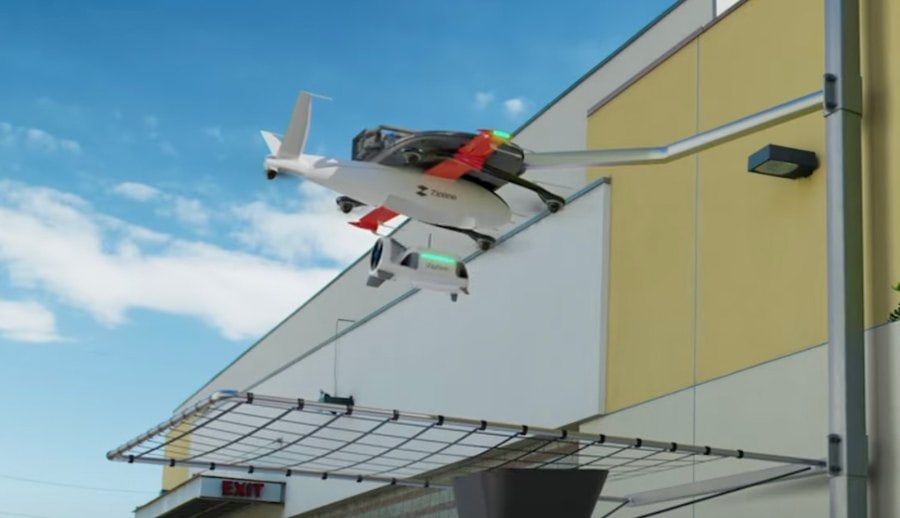
Zipline has flown over 120 million autonomous miles with its delivery drones.
Zipline is one of the clearest examples of autonomy deployed at scale. Its systems are designed for long-distance delivery, with a focus on reliability, repeatability, and network-level operations rather than individual flights.
Unlike most other companies on this list, Zipline’s autonomy is built around logistics systems—coordinating aircraft, distribution centers, and delivery workflows across large regions.
Flagship autonomous systems:
- Zipline Platform 1 (fixed-wing delivery system)
- Zipline Platform 2 (precision delivery with tethered drop system)
Key autonomy capabilities:
- Autonomous long-range flight and delivery routing
- High-frequency, repeatable delivery operations
- Integrated logistics and distribution network management
5. DJI

The DJI Dock 2 | Credit: DJI
Mainly used in: Inspection and asset monitoring, mapping and surveying, and public safety/emergency response
DJI is not an autonomy-first company in the same way as Percepto or Skydio, but it plays a major role in automated and semi-autonomous drone operations due to its scale and ecosystem.
Its enterprise systems support automated missions, waypoint flights, and dock-based deployments. This ecosystem of automated solutions make DJI a leader in enterprise automation and remote operations.
Flagship autonomous systems:
- DJI Dock 2 (automated deployment system)
- Matrice 3D / 3TD (dock-compatible enterprise drones)
Key autonomy capabilities:
- Automated flight missions and waypoint planning
- Dock-based launch, landing, and charging
- Integration with cloud-based mission management tools
How Autonomous Drones Actually Work
Autonomous drones don’t rely on a single piece of technology. What makes them “autonomous” is how several systems work together to perceive the environment, make decisions, and execute a flight.
At a high level, an autonomous drone is constantly doing three things: sensing what’s around it, deciding what to do next, and adjusting its flight in real time. And there’s a fourth piece, which is the ability to charge and offload data on its own.
Here’s a look at all four components that drive autonomy in drones:
1. Sensors: How the Drone “Sees” the World
Autonomous drones rely on multiple types of sensors to understand their surroundings. This can include cameras, GPS, inertial measurement units (IMUs), and sometimes LiDAR or radar depending on the system.
These sensors provide the raw data the drone needs to detect obstacles, understand its position, and track movement through space. Without reliable sensing, autonomy breaks down quickly.
2. Onboard Processing and AI: How Decisions Are Made
Once the drone gathers sensor data, it has to interpret it. That’s where onboard processing and AI-driven software come in.
Computer vision systems can identify objects, map the environment, and detect obstacles. Navigation algorithms then use that information to decide how to move—whether that means avoiding a tree, adjusting a flight path, or maintaining position in a changing environment.
This is what separates conditional autonomy from simple automation. The drone isn’t just following a route—it’s adapting to what’s happening around it.
3. Flight Control Systems: How the Drone Executes Decisions
After a decision is made, the drone still has to act on it. Flight control systems translate those decisions into motor commands and movement.
This includes stabilizing the aircraft, adjusting speed and direction, and maintaining safe flight. Even highly autonomous drones rely on precise control systems to execute decisions smoothly and safely.
4. Docking Stations and Cloud Software: How Full Systems Operate
In many commercial deployments, autonomy goes beyond the drone itself. Systems like drone-in-a-box platforms include a docking station that allows the drone to launch, land, recharge, and prepare for the next mission without human intervention on site.
Cloud-based software ties everything together. Operators can schedule missions, monitor flights remotely, review data, and manage multiple drones across different locations.
Put together, these four components form a loop: the drone senses, decides, and acts—while the broader system manages when and why those missions happen.

Several Skydio Docks on a rooftop | Credit: Skydio
Key Drone Autonomy Terms: Drone-in-a-Box, DFR, and More
Autonomous drone systems come with a lot of overlapping terminology—and a lot of acronyms—which can make things a little confusing.
This section breaks down the most important terms so you can understand what they are, and how they relate to each other in practice.
1. Autonomous vs. Automated Drones
People often use autonomous and automated as if they mean the same thing. But they don’t.
An automated drone follows instructions. An autonomous drone can do that too, but it also has some ability to react to the environment and make limited decisions during a mission.
That difference matters because it changes how much human input is required, how the drone behaves when conditions change, and what kinds of missions the system can realistically support.
Here’s the practical difference:
| Automated drones | Autonomous drones |
|---|---|
| Follow pre-programmed instructions | Can adjust behavior during a mission |
| Depend more heavily on predefined routes or commands | Use sensors and software to react to the environment |
| Work well for repeatable, predictable missions | Work better in missions where conditions may change |
| Usually require more direct human setup and oversight | Can reduce hands-on control, though humans still supervise |
Key takeaway: Most commercial systems sit somewhere in between, combining automated workflows with autonomous behaviors.
2. Drone-in-a-Box Systems
A lot of drone autonomy today is built around “drone-in-a-box” systems—a setup that combines a drone, a docking station, and software into one operational unit.
The “box”—also called a nest or dock—is usually a weather-resistant charging station installed at a fixed location. It acts as a home base for the drone, handling charging, data transfer, and mission readiness between flights.
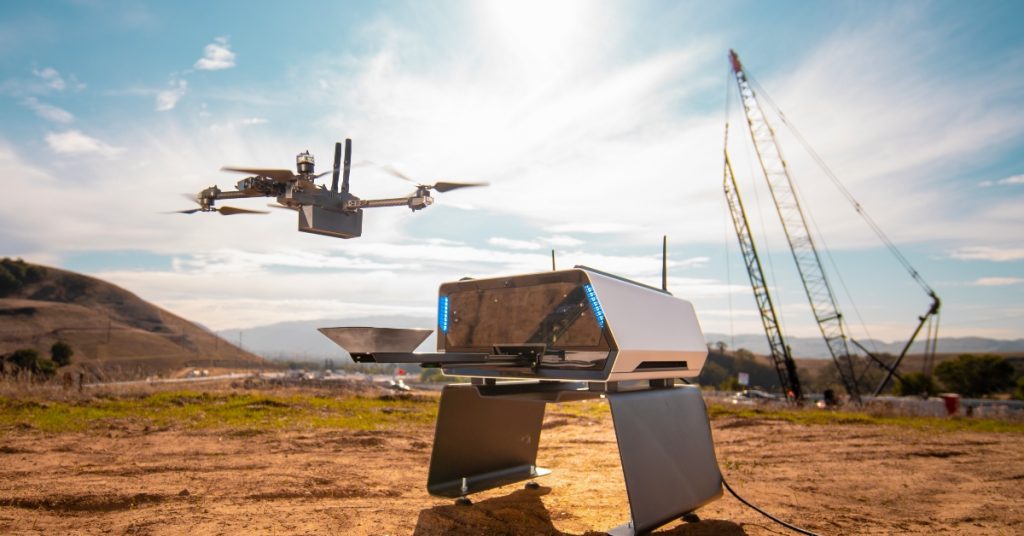
The Skydio Dock | Credit: Skydio
From there, the system can run missions with minimal on-site involvement. A drone can launch from the dock, fly a planned or adaptive route, collect data, and return to recharge without a pilot standing nearby.
Most drone-in-a-box systems include three core parts:
- The drone, which handles flight, sensing, and data collection
- The dock, which manages launch, landing, charging, and protection between missions
- The software platform, which controls scheduling, remote operations, data review, and system health
This setup supports continuous operations—things like daily inspections, continuous monitoring, or rapid-response flights triggered by an alert.
3. DFR (Drone as First Responder) Drones
A “drone as first responder” refers to a public safety agency using a drone to respond immediately to emergency calls. In some cases, these drones are automated or autonomous.
Here’s how it works:
- 911 call comes in
- Drone is deployed to scene of call
- Drone provides real-time aerial data for first response en route to the scene, informing their planned response to the situation
DFR operations are one of the clearest examples of autonomy being used in a real operational model, not just as a feature set. The drone may fly a pre-planned route, respond to dispatch, stream live video, and help responders assess what’s happening before they commit personnel.
That said, DFR does not automatically mean “fully autonomous.” Many DFR programs still involve a human operator actively supervising the flight, approving launch, and taking over when needed.
4. BVLOS (Beyond Visual Line of Sight)
BVLOS stands for beyond visual line of sight. It means flying a drone without the pilot maintaining direct visual contact with the aircraft.
Some key use cases for autonomous drones depend on BVLOS. For example, when you’re flying a drone remotely from a box, the pilot isn’t physically present to observe the drone—which makes the flight BVLOS.
Where Autonomous Drones Are Used Today
Autonomous drones aren’t used evenly across every industry. They tend to make the most sense in missions that are repeatable, time-sensitive, or spread across large sites where sending a pilot out for every flight is inefficient.
Here are the seven top sectors using autonomous drones today.
1. Industrial Inspections

The Skydio X10 inspects a power line | Credit: Skydio
Industrial inspection work is one of the strongest fits for autonomy.
Facilities like oil and gas sites, power plants, mines, and utilities often need the same infrastructure checked on a recurring schedule, which makes drone-in-a-box systems especially useful.
Autonomous drones are often used in industrial inspections for:
- Routine flare stack, tank, and pipe rack monitoring
- Repeat inspections of substations, transmission assets, and utility sites
- Mine-site progress checks and perimeter condition monitoring
- Scheduled visual inspections triggered by anomalies or alarms
2. Security and Perimeter Monitoring
Security is another strong use case because it depends on regular patrols and fast response.
Autonomous drones can cover more ground than fixed cameras and can be launched on schedule or in response to a detected event.
Autonomous drones are often used in security for:
- Automated perimeter patrols at industrial sites and ports
- Alarm-triggered flights to investigate possible intrusions
- Monitoring remote sections of critical infrastructure
- Overwatch for large campuses, depots, and fenced facilities
3. Mapping and Surveying
Mapping missions are already heavily automated, which makes them a natural stepping stone toward autonomy.
In this category, the value usually comes from consistency, coverage, and the ability to repeat the same mission over time.
Autonomous drones are often used in mapping and surveying for:
- Pre-programmed corridor mapping for roads, rail, and pipelines
- Recurring site surveys for mines, landfills, and construction projects
- Progress documentation on large infrastructure jobs
- Topographic and orthomosaic capture over broad areas
4. Delivery and Logistics

Credit: Zipline
Delivery is one of the clearest examples of autonomy at scale.
These operations depend on highly repeatable routes and reliable system behavior, since manual piloting would be too labor-intensive for routine long-distance delivery networks.
Autonomous drones are often used in delivery for:
- Medical supply delivery to hospitals and clinics
- Transport of blood, vaccines, and prescription medications
- Campus or regional delivery between fixed distribution points
- Last-mile logistics in areas with limited road access
5. Emergency Response
Autonomous capabilities are starting to play a larger role in emergency response, especially when speed matters more than precision piloting.
In these scenarios, the goal is usually to get eyes on a scene quickly so responders can make better decisions.
Autonomous drones are often used in emergency response for:
- Rapid launch to assess fires, crashes, or hazardous scenes
- Early situational awareness before responders arrive
- Overwatch during active incidents or evacuations
- Search support over predefined areas or routes
6. Construction and Site Progress Monitoring

Construction sites are a good fit for autonomy because they often need the same area documented again and again.
Repeatable flights make it easier to compare progress over time and reduce the need for ad hoc manual flights.
Autonomous drones are often used in construction for:
- Weekly or daily progress flights over active job sites
- Stockpile and earthwork documentation
- Monitoring site access roads, staging areas, and equipment zones
- Comparing recurring image sets for change detection
7. Agriculture and Land Management
Agricultural workflows can also benefit from autonomy, especially when operators need to cover large areas on recurring schedules.
The strongest fit is in monitoring and data collection rather than fully autonomous decision-making in the field.
Autonomous drones are often used in agriculture for:
- Recurring crop health monitoring flights
- Field mapping and stand-count surveys
- Irrigation and drainage pattern observation
- Large-property and land-management documentation
4 Main Limits of Autonomous Drones
Autonomous drones are advancing quickly, but they still have several limits.
Most systems today operate within clear constraints—technical, environmental, and regulatory. Understanding those limits is important, especially if you’re evaluating autonomy for real-world use.
In many cases, the gap isn’t whether autonomy works. It’s where it works reliably, and under what conditions.
Here are the main limits of autonomy in drones today:
1. Regulatory Constraints (Especially BVLOS)
One of the biggest limitations on autonomous drone operations isn’t the technology. It’s the rules.
In the U.S., most commercial drone flights must be conducted within visual line of sight (VLOS), unless the operator has a specific waiver or authorization. That makes fully remote, unattended operations more complex to deploy at scale.
Some companies are operating beyond visual line of sight (BVLOS) under waivers or in specific approved environments. But these approvals are still limited, and requirements can vary depending on the use case and location.
This means that even highly autonomous systems often operate within controlled conditions or under structured regulatory approvals.
2. Environmental and Operational Limits
Autonomous systems depend heavily on sensors and environmental awareness, which means conditions matter.
Weather can affect performance, especially in high winds, heavy rain, or low visibility. Lighting conditions can also impact computer vision systems, particularly at night or in high-glare environments.
GPS reliability is another factor. In dense urban areas, indoors, or near large structures, positioning can become less reliable, which can limit how autonomous a system can be in practice.
Even advanced systems are designed with boundaries. They work best in environments that are at least somewhat predictable.
3. Edge Cases and Reliability
Autonomous drones are good at handling known scenarios. They’re less reliable in edge cases—situations that fall outside the conditions they were designed or trained for.
Unexpected obstacles, unusual terrain, signal interference, or rapidly changing conditions can still require human intervention. That’s one reason most systems are built with layers of redundancy and fail-safes.
In critical operations, autonomy is often paired with human oversight rather than used as a complete replacement.
4. Human Oversight Is Still Part of the System
Even in highly autonomous deployments, people are still involved.
Operators plan missions, monitor flights, review data, and step in when something doesn’t go as expected. In many cases, autonomy reduces how often a pilot needs to actively control the drone, but it doesn’t eliminate responsibility.
This is especially important in regulated environments, where accountability and safety requirements still apply regardless of how the drone is flown.
The practical takeaway is that autonomy is a tool, not a replacement. It can make operations more efficient and scalable, but it still depends on human judgment and oversight to work safely and reliably.
Autonomous Drones FAQ
Here are answers to some of the most commonly asked questions about drones and autonomy.
Are autonomous drones legal?
In most countries, including the U.S., autonomous drone operations are allowed only within certain limits. Many commercial flights must still comply with visual line of sight (VLOS) rules unless the operator has a specific waiver or authorization. Fully remote or unattended operations are typically subject to additional regulatory requirements.
Do autonomous drones still need a pilot?
In most real-world deployments, yes. Even when a drone can fly autonomously, a human operator is usually responsible for planning missions, monitoring operations, and intervening if something goes wrong.
What is BVLOS, and how is it related to autonomy in drones?
BVLOS stands for “beyond visual line of sight.” It refers to flying a drone without the pilot maintaining direct visual contact. Many advanced autonomous use cases depend on BVLOS operations, but approvals for BVLOS are still limited and regulated.
Are consumer drones autonomous?
Most consumer drones are better described as automated rather than fully autonomous. They can follow waypoint routes, track subjects, or return home automatically, but they generally don’t operate as independent systems without human oversight.